+91 945 889 6091
  infodesk@ibluu.com
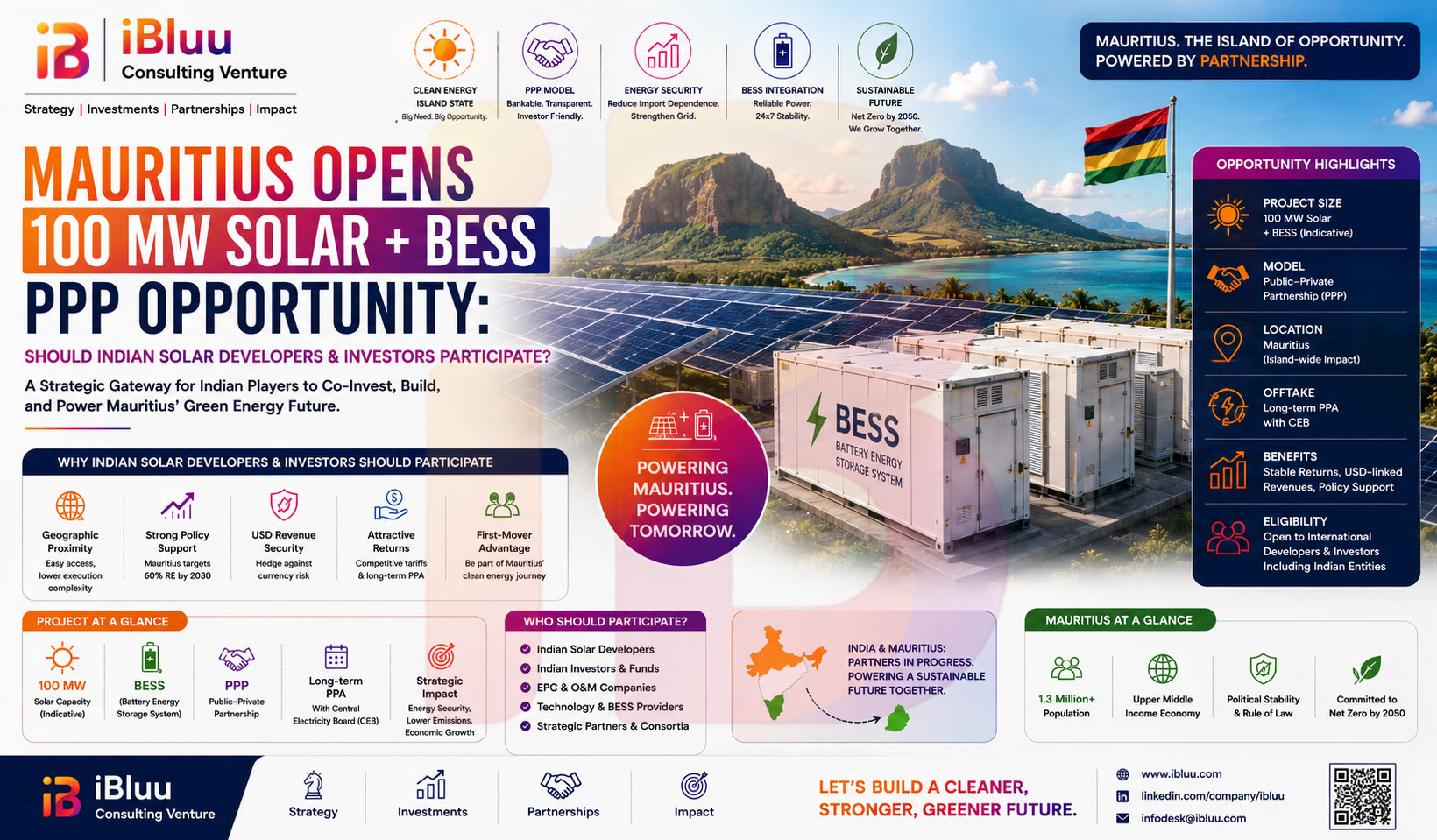
Mauritius Opens 100 MW Solar + BESS PPP Opportunity: Should Indian Solar Developers and Investors Participate?
Understanding the Opportunity, Strategic Context and Project Fundamentals
The global renewable energy sector is entering a new phase. The first wave was dominated by utility-scale solar deployment. The second wave focused on reducing generation costs. The third—and perhaps most transformative—wave is centered on hybrid renewable infrastructure, where solar generation is integrated with Battery Energy Storage Systems (BESS) to deliver reliable, dispatchable, and grid-responsive electricity.
Mauritius’ newly announced 100 MW Solar Photovoltaic (PV) + Battery Energy Storage System (BESS) procurement programme represents this transition.
Although modest in capacity compared to multi-gigawatt programmes in India or the Middle East, the tender carries strategic significance that extends well beyond its size. Structured under a Public-Private Partnership (PPP) model with a 20-year Take-or-Pay Power Purchase Agreement (PPA), the programme reflects the growing global preference for hybrid renewable infrastructure capable of providing firm, flexible, and reliable power.
For Indian renewable energy developers, EPC contractors, infrastructure investors, battery manufacturers, and international project developers, Mauritius offers far more than a single procurement opportunity. It presents an opportunity to establish an operational footprint within the Indian Ocean region while strengthening international project execution capabilities in an increasingly competitive global renewable energy market.
The tender also aligns closely with India’s rapidly expanding expertise in utility-scale solar parks, hybrid renewable systems, and Battery Energy Storage Systems, creating natural strategic synergies between the two nations.
A New Phase in the Global Energy Transition
The renewable energy industry is no longer competing solely on the basis of generation capacity.
The defining challenge of this decade is reliability.
Across the world, governments are discovering that adding renewable capacity alone is insufficient. As solar penetration increases, electricity systems face growing challenges related to intermittency, evening peak demand, frequency stability, renewable curtailment, and transmission congestion.
Battery Energy Storage Systems are increasingly emerging as the missing infrastructure layer that transforms renewable generation into dependable power.
This shift is evident across developed and emerging markets alike.
Countries including Australia, the United States, Saudi Arabia, the United Arab Emirates, the United Kingdom, Chile, Spain, and India are rapidly integrating large-scale battery storage into renewable energy planning.
Island economies, however, face an even greater imperative.
Their dependence on imported fossil fuels, relatively isolated grids, and exposure to volatile fuel prices make renewable energy with storage not merely an environmental objective but a strategic necessity.
Mauritius exemplifies this transition.
Why Mauritius Deserves Serious Attention
Mauritius has long maintained one of Africa’s most stable business environments, supported by transparent governance, a robust legal framework, strong financial institutions, and an investor-friendly regulatory ecosystem.
However, like many island nations, Mauritius remains heavily dependent on imported petroleum products for electricity generation.
This dependence creates multiple structural challenges:
- Exposure to global fuel price volatility.
- Foreign exchange outflows for energy imports.
- Higher electricity generation costs.
- Increased carbon emissions.
- Reduced long-term energy security.
The country’s response is becoming increasingly clear:
Accelerate renewable energy deployment while integrating Battery Energy Storage Systems to enhance grid flexibility and reliability.
Rather than relying solely on conventional utility-scale solar projects, Mauritius is moving directly toward hybrid renewable infrastructure—an approach increasingly regarded as global best practice for modern electricity systems.
Project Overview
The programme is being implemented under the Renewable Energy Hybrid Facility (REHF), representing one of Mauritius’ most significant renewable energy procurements to date.
| Project Parameter | Details |
|---|---|
| Procuring Agency | Central Electricity Board (CEB), Mauritius |
| Programme Capacity | 100 MW AC |
| Project Structure | 10 Independent Projects of 10 MW AC each |
| Technology | Solar Photovoltaic (PV) integrated with Battery Energy Storage System (BESS) |
| Procurement Model | Public-Private Partnership (PPP) |
| Scheme | Renewable Energy Hybrid Facility (REHF) |
| Power Purchase Agreement | 20-Year Take-or-Pay |
| Procurement Method | Competitive International Bidding |
| Buyer | Central Electricity Board (CEB) |
| Revenue Model | Long-term contracted electricity sales |
| Target Outcome | Reliable hybrid renewable generation with integrated storage |
Unlike traditional solar tenders, this programme prioritizes dispatchable renewable electricity rather than generation alone, reflecting a broader shift toward grid-oriented energy planning.
Understanding the Renewable Energy Hybrid Facility (REHF)
The Renewable Energy Hybrid Facility (REHF) is more than a procurement mechanism—it is a strategic policy framework designed to accelerate Mauritius’ transition toward a resilient, low-carbon electricity system.
The programme combines three critical infrastructure components:
- Utility-scale Solar PV generation.
- Integrated Battery Energy Storage Systems.
- Long-term utility procurement through the Central Electricity Board.
This integrated structure aims to ensure that renewable electricity can be generated, stored, and dispatched when required, rather than only when solar irradiance is available.
Such hybrid configurations are becoming increasingly common in global renewable energy markets where grid stability and energy security are gaining importance alongside decarbonization.
Why Mauritius Is Investing in Solar + BESS
Several structural drivers explain why Mauritius is accelerating investment in hybrid renewable infrastructure.
1. Energy Security
Mauritius imports a substantial proportion of its conventional energy requirements.
Reducing dependence on imported fossil fuels strengthens long-term economic resilience while improving national energy independence.
Every megawatt generated domestically reduces exposure to international oil price fluctuations.
2. Carbon Reduction Commitments
Mauritius has committed to increasing renewable energy penetration as part of its broader climate and sustainability objectives.
Solar coupled with battery storage supports emissions reduction while maintaining electricity reliability.
3. Diversification of the Electricity Mix
Historically, electricity systems in island economies have relied heavily on imported thermal generation.
Hybrid renewable infrastructure diversifies generation sources while reducing systemic energy risk.
4. Grid Stability
Unlike conventional solar facilities, integrated Battery Energy Storage Systems can respond almost instantaneously to fluctuations in electricity demand.
This improves:
- Frequency regulation.
- Voltage control.
- Reserve management.
- System reliability.
- Grid resilience.
5. Peak Demand Management
Electricity demand typically peaks during evening hours when solar generation declines sharply.
Battery storage bridges this mismatch by storing daytime solar generation and releasing electricity during periods of maximum demand.
This reduces dependence on expensive thermal generation during evening peaks.
6. Long-Term Energy Independence
Hybrid renewable infrastructure enables Mauritius to gradually reduce dependence on imported fuels while building a cleaner and more resilient electricity system.
The programme therefore contributes not only to environmental objectives but also to long-term economic and geopolitical resilience.
Why Battery Energy Storage Makes This Tender Fundamentally Different
For years, utility-scale solar projects were evaluated primarily on two parameters:
- Installed capacity.
- Lowest tariff.
That framework is rapidly changing.
Today’s electricity markets increasingly value reliability, flexibility, responsiveness, and dispatchability.
Battery Energy Storage Systems fundamentally transform the value proposition of renewable energy.
Instead of supplying electricity only during daylight hours, hybrid systems enable renewable energy to behave more like conventional generation assets.
The transformation is significant.
| Traditional Solar PV | Solar PV + Battery Energy Storage |
|---|---|
| Generates only during sunlight hours | Generates and stores electricity for later dispatch |
| Subject to intermittency | Delivers firm and predictable power |
| Limited support for evening demand | Supplies electricity during peak demand periods |
| Higher renewable curtailment risk | Significantly reduces curtailment |
| Minimal ancillary grid services | Supports frequency regulation, reserve capacity, voltage stability, and grid balancing |
| Lower operational flexibility | Highly dispatchable and grid-responsive |
Battery storage effectively converts renewable electricity from an intermittent resource into an infrastructure asset capable of supporting modern power systems.
That distinction makes this Mauritius programme strategically significant.
It reflects where the global renewable energy market is heading—not where it has been.
Strategic Implications for Indian Developers
For Indian renewable energy companies, this tender represents more than an overseas EPC opportunity.
It offers exposure to several strategic capabilities that are increasingly becoming essential across international markets:
- Utility-scale Solar + BESS project development.
- Cross-border PPP execution.
- International PPA structuring.
- Island-grid renewable integration.
- Long-duration energy storage deployment.
- Utility-scale hybrid operations and maintenance.
- International project financing.
- Global consortium development.
As governments worldwide accelerate hybrid renewable procurement, developers capable of successfully delivering integrated Solar + BESS infrastructure are likely to possess a significant competitive advantage.
For Indian firms that have developed expertise through India’s rapidly expanding renewable energy sector, Mauritius provides an opportunity to demonstrate those capabilities in a stable international market while building credentials for future opportunities across Africa, the Middle East, Southeast Asia, and other island economies.
Commercial Viability, Investment Economics and Strategic Positioning
Why Battery Energy Storage (BESS) Makes This Tender Fundamentally Different
For more than a decade, utility-scale solar projects competed primarily on one variable—lowest possible tariff.
That era is rapidly coming to an end.
Electricity systems across the world no longer need only renewable generation; they increasingly require renewable generation that can be dispatched precisely when the grid needs it.
This distinction explains why Battery Energy Storage Systems (BESS) have become one of the fastest-growing segments of the global energy industry.
Solar power naturally reaches maximum production during midday. Electricity demand, however, generally peaks during evening hours, when solar output falls sharply. Without storage, this mismatch creates significant operational inefficiencies.
Battery storage fundamentally changes this equation.
Instead of treating solar energy as an intermittent resource, BESS transforms it into a flexible infrastructure asset capable of supporting modern electricity markets.
Solar Without Storage
Traditional solar plants typically experience:
- Midday generation surplus
- Evening generation deficit
- Grid curtailment during low-demand periods
- Reduced revenue opportunities
- Lower dispatch flexibility
- Dependence on conventional backup generation
Solar Integrated with BESS
Solar paired with storage provides:
- Time-shifting of renewable energy
- Peak-demand supply capability
- Higher capacity utilization
- Improved frequency regulation
- Voltage stabilization
- Reduced renewable curtailment
- Enhanced grid resilience
- Improved revenue optimization
- Better predictability for utilities
The Mauritius programme reflects this broader structural evolution.
Rather than procuring electricity alone, the Central Electricity Board is effectively procuring dispatchable clean energy, a capability that aligns closely with the future architecture of modern power systems.
Government Support and Policy Framework
Large-scale renewable investments require more than attractive resource availability.
They require institutional certainty.
Mauritius has sought to reduce investor uncertainty through a policy architecture designed around long-term procurement stability.
Several characteristics strengthen the programme’s attractiveness.
Renewable Energy Hybrid Facility (REHF)
The Renewable Energy Hybrid Facility serves as the government’s flagship mechanism for accelerating hybrid renewable infrastructure by integrating solar generation with battery storage.
The programme supports national objectives related to:
- Renewable energy expansion
- Grid modernization
- Reduced fossil fuel dependence
- Energy resilience
- Long-term decarbonization
Central Electricity Board (CEB)
The Central Electricity Board functions as the country’s integrated electricity utility and project procuring agency.
Its responsibilities include:
- Tender administration
- Power procurement
- Grid integration
- Operational coordination
- Long-term energy planning
The presence of an established utility counterparty enhances institutional confidence for investors.
Public-Private Partnership Structure
The PPP model enables private developers to finance, construct, own, operate and maintain renewable infrastructure while selling electricity under a long-term contractual arrangement.
This framework allows:
- Risk sharing
- Private capital mobilization
- Operational efficiency
- Technology transfer
- Reduced fiscal burden on government
Long-Term Power Purchase Agreement
Long-term PPAs remain one of the strongest drivers of infrastructure bankability.
The proposed twenty-year Take-or-Pay structure offers:
- Stable cash flow visibility
- Revenue certainty
- Improved lender confidence
- Lower financing risk
- Enhanced project valuation
Transparent Competitive Procurement
Transparent bidding processes reduce uncertainty while encouraging:
- Competitive tariffs
- Technological innovation
- Efficient capital allocation
- International participation
- Improved project governance
For international investors, policy predictability often carries as much weight as resource quality.
Key Qualification Requirements
Although final tender documentation should always be reviewed carefully, projects of this nature generally require bidders to demonstrate technical capability, financial strength and execution experience.
Key evaluation areas typically include:
Technical Capability
Developers should demonstrate prior experience in:
- Utility-scale solar projects
- Battery Energy Storage Systems
- Grid-connected renewable facilities
- EPC delivery
- Commissioning experience
- Operational performance
Financial Capacity
Sponsors generally need to satisfy minimum thresholds relating to:
- Net worth
- Annual turnover
- Access to financing
- Creditworthiness
- Balance sheet strength
These criteria ensure developers possess adequate financial resilience throughout construction and operations.
Operations and Maintenance Experience
Long-term operational reliability has become increasingly important for hybrid renewable assets.
Authorities typically evaluate:
- Historical plant performance
- O&M capability
- Asset management systems
- Availability records
- Preventive maintenance practices
Bid Security and Development Security
Security mechanisms help ensure only serious participants enter the procurement process.
These instruments generally include:
- Bid security
- Performance guarantees
- Development security
- Financial commitments
Such requirements protect the procuring authority while improving project execution certainty.
Consortium and Joint Venture Eligibility
Large infrastructure projects frequently encourage consortium participation.
This allows developers to combine complementary strengths such as:
- EPC expertise
- Financing capability
- Battery technology
- Local partnerships
- Asset management
- International development experience
For many Indian companies, consortium participation could represent the most efficient market-entry strategy.
Understanding the Tariff Structure
The commercial design of the tender is arguably one of its strongest investment features.
Unlike merchant electricity markets, where revenues fluctuate with market prices, Mauritius is expected to rely on a structured long-term contractual framework.
Take-or-Pay Revenue Model
A Take-or-Pay arrangement provides greater revenue visibility by obligating the offtaker to make payments according to agreed contractual conditions, thereby reducing demand-related uncertainty.
Such structures are widely regarded as favourable for infrastructure financing because they improve the predictability of project cash flows.
Competitive Tariff Discovery
Rather than prescribing electricity prices administratively, tariffs are expected to be determined through competitive bidding.
This approach encourages:
- Cost efficiency
- Market-based pricing
- Technology optimization
- Commercial discipline
- Innovation
High Pricing Precision
Tender documents require tariff quotations with multiple decimal places, reflecting the precision increasingly demanded in international renewable procurements.
This level of pricing sophistication emphasizes the importance of detailed financial modelling.
Twenty-Year Revenue Visibility
Infrastructure investors value duration.
Long-term contracted revenues improve:
- Debt service capability
- Internal Rate of Return stability
- Financing flexibility
- Asset valuation
- Investor confidence
Such characteristics explain why renewable infrastructure increasingly attracts pension funds, sovereign wealth funds and infrastructure investment platforms.
Revenue Streams Beyond Energy Generation
Hybrid projects can create multiple sources of value beyond solar generation alone.
Battery systems can contribute through:
- Peak demand delivery
- Energy shifting
- Ancillary grid services
- Frequency response
- Voltage support
- Curtailment reduction
- Dispatch optimization
As electricity markets mature globally, these additional value streams are expected to become increasingly important.
Investment Potential: Why Global Developers Are Likely Watching Mauritius Closely
Although the market is relatively small compared with India, the strategic significance of this programme extends well beyond its 100 MW capacity.
The project aligns closely with the international expansion strategies of many established renewable energy developers.
Companies that may find such opportunities attractive include:
- NTPC Green Energy
- ReNew
- Adani Green Energy
- ACME Solar
- Waaree Energies
- JSW Energy
- Juniper Green Energy
- Sembcorp
- ENGIE
- EDF Renewables
- Masdar
- Scatec
- AMP Energy
- TotalEnergies Renewables and similar international IPPs
Their interest is driven not merely by project size, but by several strategic considerations:
- International market diversification
- Stable long-term PPAs
- Growing demand for hybrid renewable assets
- Experience transfer across markets
- Portfolio diversification
- Expansion into island energy systems
- Strengthening regional presence in the Indian Ocean
For developers with ambitions beyond domestic markets, Mauritius represents a commercially manageable yet strategically meaningful international entry point.
Investment Economics: Assessing Financial Attractiveness
Every renewable project ultimately depends on economic viability.
While actual project economics will depend on bid pricing, financing costs, technology selection and contractual terms, investors generally evaluate several core financial dimensions.
Indicative Capital Cost Components
Major investment categories typically include:
- Solar PV modules
- Inverters
- Mounting structures
- Battery Energy Storage System
- Power Conversion Systems
- Civil works
- Internal roads
- Transmission infrastructure
- Grid interconnection
- SCADA systems
- Engineering and project management
- Insurance
- Working capital
- Contingency provisions
Financing Structure
Large PPP renewable projects often utilize a combination of:
- Sponsor equity
- Commercial debt
- Development finance
- Export credit support
- Infrastructure lending
- Green financing instruments
Debt-to-equity ratios are optimized according to lender requirements, project risks and contractual structures.
Key Financial Metrics
Professional investors generally evaluate:
- Internal Rate of Return (IRR)
- Net Present Value (NPV)
- Debt Service Coverage Ratio (DSCR)
- Equity Multiple
- Payback Period
- Levelized Cost of Energy (LCOE)
- Project bankability
- Sensitivity analysis
Rather than relying solely on optimistic base-case assumptions, sophisticated investors stress-test multiple scenarios involving exchange rates, battery degradation, financing costs and construction delays before making investment decisions.
Strategic Comparison, Risk Assessment, Investment Outlook and the Road Ahead
Mauritius vs India: A Strategic Investment Comparison
Although Mauritius represents a relatively small electricity market compared with India, comparing projects purely by installed capacity misses the broader strategic picture.
For international developers, market attractiveness is determined by a combination of regulatory certainty, revenue visibility, ease of doing business, payment security, execution complexity and long-term portfolio diversification—not simply project size.
The Mauritius programme offers a distinctly different investment profile from India’s highly competitive renewable energy market.
| Investment Parameter | Mauritius | India |
|---|---|---|
| Market Size | Small but strategically important | One of the world’s largest renewable markets |
| Competition Level | Moderate | Extremely High |
| Procurement Model | Government-backed PPP | Central & State tenders |
| PPA Structure | 20-Year Take-or-Pay | Generally 25-Year PPA |
| Payment Risk | Comparatively Lower | Depends on individual DISCOM financial health |
| Ease of Doing Business | High | Improving but varies by state |
| Land Availability | Limited | Comparatively Better |
| Grid Infrastructure | Stable Island Grid | Large but uneven across regions |
| Renewable Energy Growth | Accelerating | Among the fastest globally |
| Solar Resource | Excellent | Excellent |
| BESS Adoption | Emerging | Rapidly Expanding |
| Local Manufacturing | Limited | Strong Domestic Manufacturing Ecosystem |
| Currency | Mauritian Rupee (MUR) | Indian Rupee (INR) |
| International Expansion Value | High | Domestic Market |
| Strategic Portfolio Diversification | Excellent | Limited to Domestic Exposure |
For many developers, Mauritius should not be viewed as an alternative to India.
Instead, it represents an international portfolio diversification opportunity that complements domestic growth strategies while providing exposure to overseas utility-scale renewable infrastructure.
Why Indian Companies Hold a Natural Competitive Advantage
Over the past decade, India has emerged as one of the world’s largest renewable energy execution hubs.
Indian developers have accumulated deep expertise across engineering, procurement, financing, construction and operations, creating capabilities that translate effectively into international markets.
Several structural advantages position Indian firms strongly for overseas Solar + BESS opportunities.
1. Utility-Scale EPC Experience
Indian companies have successfully delivered some of the world’s largest solar parks.
This experience enables efficient project execution under challenging timelines and cost structures.
2. Competitive Cost Structures
Indian EPC contractors benefit from mature supply chains, engineering efficiency and cost optimization.
These advantages improve bid competitiveness without necessarily compromising quality.
3. Strong Manufacturing Ecosystem
India’s rapidly expanding manufacturing ecosystem now includes:
- Solar Modules
- Cells
- Inverters
- Mounting Structures
- Power Electronics
- Battery Components
- Energy Management Systems
The Production Linked Incentive (PLI) programme has further strengthened domestic manufacturing capacity.
4. Growing Battery Storage Expertise
As India accelerates BESS deployment, domestic companies are rapidly developing expertise in:
- Utility-scale storage
- Battery integration
- Hybrid plant optimization
- Energy management software
- System controls
- Grid integration
These competencies are increasingly transferable to international markets.
5. International Project Experience
Many Indian companies have already executed projects across:
- Middle East
- Africa
- Southeast Asia
- Australia
- Latin America
This growing international footprint reduces execution risks associated with overseas expansion.
6. Financing Capability
Indian renewable developers increasingly enjoy access to:
- Domestic Banks
- International Banks
- Infrastructure Funds
- Climate Finance
- Multilateral Institutions
- Green Bonds
- Sustainability-linked Financing
This financing ecosystem enhances competitiveness in global infrastructure tenders.
Investment Economics: Looking Beyond Construction Costs
Sophisticated investors evaluate infrastructure assets over their entire lifecycle rather than focusing solely on initial capital expenditure.
Key investment considerations include:
Capital Expenditure Components
Typical project costs include:
- Solar PV Modules
- Battery Energy Storage Systems
- Inverters
- Mounting Structures
- Civil Infrastructure
- Grid Interconnection
- Transmission Facilities
- SCADA Systems
- Site Development
- Engineering & Design
- Environmental Compliance
- Insurance
- Contingencies
Operating Expenditure
Long-term operational costs include:
- Plant Operations
- Preventive Maintenance
- Battery Monitoring
- Asset Management
- Insurance
- Spare Parts
- Land Lease
- Security
- Grid Compliance
- Battery Replacement Planning
Financial Performance Indicators
Professional investors typically assess:
- Internal Rate of Return (IRR)
- Net Present Value (NPV)
- Debt Service Coverage Ratio (DSCR)
- Levelized Cost of Energy (LCOE)
- Equity IRR
- Project Payback
- Cash Flow Stability
- Residual Asset Value
A long-term PPA with a government-backed utility materially enhances financing prospects by improving cash flow predictability and reducing perceived market risk.
Risks Every Investor Should Carefully Evaluate
Every infrastructure opportunity offers potential upside alongside identifiable risks.
Disciplined investment decisions require rigorous evaluation of both.
Currency Risk
Revenue is expected to be denominated in Mauritian Rupees while many equipment purchases may occur in foreign currencies.
Exchange-rate volatility can influence long-term project returns.
Import Dependency
As an island nation, Mauritius relies significantly on imported equipment.
Potential challenges include:
- Shipping costs
- Freight delays
- Customs procedures
- Global supply-chain disruptions
Island Logistics
Transporting heavy equipment requires careful planning.
Developers must consider:
- Port capacity
- Warehousing
- Inland transportation
- Installation sequencing
Weather and Climate
Mauritius periodically experiences cyclonic weather conditions.
Projects should incorporate:
- Wind-resistant engineering
- Structural resilience
- Disaster recovery planning
- Appropriate insurance coverage
Battery Degradation
Battery systems naturally experience capacity degradation over time.
Financial models should include:
- Performance decline assumptions
- Replacement schedules
- Technology warranties
- Lifecycle cost optimization
Regulatory Risk
Although Mauritius maintains a relatively stable regulatory environment, investors should continuously monitor:
- Policy updates
- Tax regulations
- Environmental approvals
- Grid codes
- Renewable procurement frameworks
Interest Rate Risk
Project economics remain sensitive to financing costs.
Higher borrowing costs can materially influence equity returns.
Technology Evolution
Battery technologies continue to evolve rapidly.
Investors should consider future advancements in:
- Sodium-ion batteries
- Flow batteries
- Solid-state batteries
- Long-duration storage
- Artificial intelligence-enabled energy management
Selecting technologies with strong commercial track records helps reduce long-term technology risk.
SWOT Analysis
| Strengths | Weaknesses |
|---|---|
| Government-backed procurement | Smaller overall market size |
| Long-term PPA visibility | Limited land availability |
| Growing renewable demand | Dependence on imported equipment |
| Stable regulatory environment | Higher logistics costs |
| Solar + BESS integration | Limited local contractor ecosystem |
| Opportunities | Threats |
|---|---|
| International portfolio diversification | Currency fluctuations |
| Regional expansion | Technology obsolescence |
| Growing BESS market | Global supply-chain disruptions |
| Grid modernization | Extreme weather events |
| Island renewable leadership | Increasing international competition |
Key Benefits of Investing
The programme offers several strategic advantages.
Long-Term Revenue Stability
Government-backed PPAs provide predictable long-term cash flows that enhance project bankability.
International Diversification
Developers reduce concentration risk by expanding beyond domestic markets.
Government Commitment
The procurement programme aligns directly with national renewable energy objectives.
Growing Renewable Demand
Electricity demand is expected to increase alongside economic development and electrification.
Future Storage Expansion
Successful participation could position developers for future Battery Energy Storage procurements.
Regional Platform
Mauritius may serve as an operational gateway into other island and African renewable energy markets.
Challenges That Cannot Be Ignored
Balanced investment analysis requires equal attention to execution challenges.
These include:
- Limited developable land
- Imported equipment dependency
- Higher logistics costs
- Battery replacement planning
- Foreign exchange exposure
- Smaller contractor ecosystem
- Skilled workforce availability
- Cyclone resilience requirements
These challenges are manageable but require disciplined project planning and risk allocation.
Why This Tender Matters Beyond Mauritius
Viewed in isolation, a 100 MW procurement may appear modest compared with gigawatt-scale developments elsewhere.
Viewed strategically, however, it signals a broader transformation in global energy infrastructure.
The defining shift is no longer from fossil fuels to renewables alone—it is from intermittent renewable generation to intelligent, dispatchable renewable systems.
Hybrid Solar + BESS projects are becoming foundational infrastructure because they deliver not just electricity, but flexibility, resilience and reliability.
For island economies, storage reduces dependence on imported fuels while enhancing energy security.
For utilities, it improves grid stability and operational efficiency.
For investors, it creates long-duration infrastructure assets with predictable cash flows.
For technology providers, it accelerates innovation in energy management, digital controls and storage solutions.
Mauritius is therefore participating in a structural transition that many larger markets are only beginning to scale.
How iBluu Consulting Venture (iBCV) Can Support International Participants
International infrastructure projects require more than technical expertise. They demand strategic planning, commercial structuring and coordinated execution across multiple stakeholders.
iBluu Consulting Venture Private Limited (iBCV) positions itself as a strategic advisory platform supporting developers, EPC contractors, investors and consortium partners throughout the project lifecycle.
Its advisory capabilities include:
- Opportunity Assessment
- Bid Qualification Review
- Consortium Formation
- Joint Venture Structuring
- Strategic Partner Identification
- Financial Modelling
- Commercial Advisory
- Project Structuring
- EPC Partner Identification
- Documentation Support
- Bid Strategy Development
- Due Diligence
- International Partner Connect
- Investment Facilitation
- Government Engagement Support
- Cross-Border Strategic Advisory
- Risk Assessment and Mitigation Frameworks
Reflecting the strategic perspective of J Parasher, Founder and Managing Director of iBluu Consulting Venture (iBCV), a venture of iBluu Corporations, iBCV views renewable infrastructure as more than an engineering sector. It represents a strategic platform for strengthening industrial capabilities, attracting cross-border investment, enabling technology partnerships and advancing long-term economic resilience. This perspective emphasizes that successful projects are built not only on capital and technology, but also on strategic alignment among governments, investors, developers and industry partners.
Executive Conclusion
The Mauritius 100 MW Solar + BESS Public-Private Partnership represents far more than a conventional renewable energy procurement.
It reflects the accelerating evolution of global electricity systems toward dispatchable, digitally managed and storage-enabled renewable infrastructure.
For Indian developers, EPC companies, institutional investors and strategic partners, the opportunity extends beyond project execution. It offers a platform to demonstrate international capabilities, diversify geographically and participate in one of the defining infrastructure transitions of this decade.
Success in the next generation of renewable markets will not be determined solely by who can build the largest solar plants. It will belong to organizations capable of integrating generation, storage, digital intelligence, financing and long-term asset management into resilient infrastructure platforms.
Mauritius is moving decisively in that direction. Developers who recognize this shift early may find that the project’s greatest value lies not only in its immediate commercial returns, but in the strategic positioning it offers within the rapidly expanding global market for hybrid renewable energy systems.
Disclaimer: This article is intended solely for informational and strategic insight purposes. Project specifications, qualification criteria, commercial terms, timelines and regulatory requirements should be verified against the official tender documents and notifications issued by the Central Electricity Board (CEB), Mauritius, and other relevant authorities. Any financial assumptions or investment observations are illustrative and should not be interpreted as investment, legal or tax advice. Investors and developers are encouraged to undertake independent technical, commercial, financial and legal due diligence before making participation or investment decisions.