+91 945 889 6091
  infodesk@ibluu.com
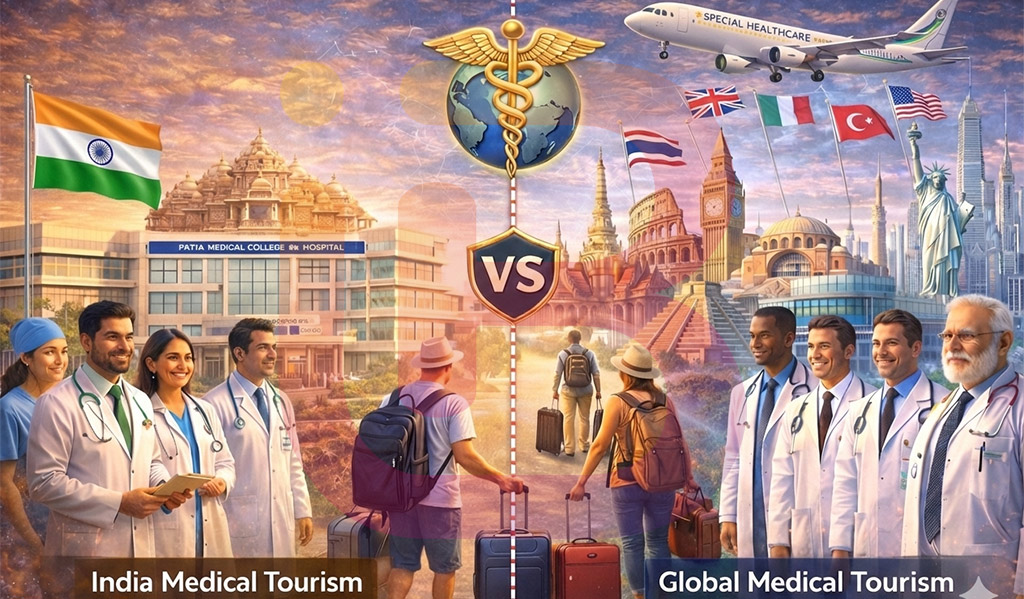
India vs Global Medical Tourism: A Strategic Benchmark of Healthcare Competitiveness in the New Geo-economic Era
Global medical tourism has transitioned from a peripheral healthcare trend into a $40–50 billion strategic industry in 2025, projected to scale towards $150–250 billion by 2033–2034, growing at a 15–16% CAGR. This growth is not incidental. It is driven by structural failures in advanced healthcare systems — rising costs, ageing populations, insurance gaps, and long surgical waiting lists — creating a permanent global arbitrage opportunity in cross-border healthcare.
India has emerged as one of the most consequential players in this landscape. With a medical tourism market estimated at $12–18 billion in 2025–2026, India already commands 10–15% of global medical tourist flows, serving between 500,000 to over 2 million international patients annually, depending on inclusion of wellness and elective segments.
Yet the strategic story is not one of dominance — it is one of asymmetric leadership.
India leads the world in affordability and treatment volume, while global leaders such as Thailand, Singapore, South Korea, and Turkey outperform India in patient experience, specialization branding, and system orchestration.
The future of India’s medical tourism advantage will be determined not by cost alone, but by system design, institutional trust, digital integration, and global positioning.
The Global Medical Tourism Market: A System Under Structural Stress
Medical tourism is not a consumer trend. It is a systemic response to global healthcare inefficiencies.
Global Market Snapshot (2025)
| Metric | Global |
|---|---|
| Market Size | USD 40–50 billion |
| Projected Market (2033–34) | USD 150–250 billion |
| CAGR | 15–16% |
| Annual International Patients | 14–16 million |
| Key Demand Drivers | Cost inflation, ageing populations, insurance gaps, surgical delays |
Leading Global Destinations by Strategic Positioning
| Country | Strategic Advantage |
|---|---|
| Thailand | Patient experience, hospital branding, hospitality integration |
| Singapore | Premium quality, clinical outcomes, regulatory trust |
| South Korea | Aesthetic medicine, dermatology, cosmetic innovation |
| Turkey | Hair transplants, cosmetic surgery, aggressive global marketing |
| Mexico | Proximity to US, dental and outpatient procedures |
| Malaysia / Colombia | Emerging general healthcare hubs |
Global medical tourism is increasingly segmented, not generic:
- Thailand dominates elective surgeries.
- Turkey owns cosmetic interventions.
- South Korea controls aesthetic medicine.
- Singapore leads high-complexity care.
Each has built a specialization brand.
India, in contrast, operates a volume-led generalist model.
India’s Medical Tourism Landscape: Scale Without Full System Maturity
India’s rise is anchored in three structural pillars:
- Cost advantage.
- Clinical depth.
- English-speaking medical workforce.
India Market Snapshot
| Metric | India |
|---|---|
| Market Size (2025–26) | USD 12–18 billion |
| Projected Market (2031–35) | USD 22–58 billion |
| CAGR | 12–16% |
| Annual Foreign Patients | ~500,000 to 2 million |
| Top Source Countries | Bangladesh (54%), Middle East, Africa, SAARC |
| Key Hubs | Delhi NCR, Mumbai, Chennai, Bengaluru, Hyderabad, Kerala |
India’s medical tourism engine is powered by tertiary care excellence:
- Cardiac surgery.
- Oncology.
- Orthopaedics.
- IVF.
- Organ transplants.
- AYUSH and integrative wellness.
India today hosts:
- 63+ JCI-accredited hospitals (comparable to Thailand).
- 4,650+ NABH-accredited facilities.
- 170+ robotic surgery platforms.
- Proton therapy and CAR-T at one-fifth global cost.
From a capability standpoint, India is no longer a “low-cost destination”.
It is a high-complexity healthcare producer at emerging-market cost structures.
Head-to-Head Cost Benchmarking: India’s Structural Edge
Cost remains India’s most powerful strategic weapon.
Average Procedure Cost Comparison (USD)
| Procedure | US / UK | Thailand / Singapore | Turkey / Mexico | India | Savings vs US |
|---|---|---|---|---|---|
| Heart Bypass (CABG) | 100,000–150,000 | 14,000–16,000 | 10,000–15,000 | 2,000–5,000 | 90–95% |
| Knee Replacement | 30,000–50,000 | 14,000–16,000 | 10,000–15,000 | 6,000–8,000 | 80–85% |
| IVF Cycle | 15,000–20,000 | 5,000–8,000 | 4,000–6,000 | 3,000–5,000 | 70–80% |
| Hair Transplant | 10,000+ | 3,000–5,000 | 2,000–4,000 | 1,500–3,000 | 70–90% |
India offers the largest cost delta in the global system without material compromise on clinical capability.
This is not price competition.
It is global healthcare arbitrage at industrial scale.
Where India Wins — And Where It Still Lags
India’s Structural Strengths
| Dimension | India |
|---|---|
| Affordability | Global leader |
| Clinical Volume | Top 3 worldwide |
| Tertiary Care | Cardiac, oncology excellence |
| English Proficiency | High |
| Treatment Complexity | Advanced |
| Digital Talent | Emerging strength |
| AYUSH & Wellness | Unique global differentiation |
India’s Strategic Gaps
| Dimension | Gap |
|---|---|
| Patient Experience | Fragmented |
| Branding | Weak national healthcare identity |
| Follow-up Care | Poor cross-border continuity |
| Digital Integration | EMR penetration ~35% |
| Trust & Transparency | Pricing variability |
| System Coordination | Lack of one-stop facilitation |
By contrast:
- Thailand operates healthcare as hospitality.
- Singapore operates healthcare as financial services.
- Turkey operates healthcare as consumer marketing.
India still operates healthcare as clinical infrastructure — not as a global service product.
Policy Architecture: India’s Strategic Push
India has initiated a systemic repositioning.
Key Government Interventions
- Heal in India Campaign – National medical tourism brand.
- E-Medical Visa – 48–72 hour processing.
- AYUSH Visa Category – Integrative medicine.
- 100% FDI in hospitals and diagnostics.
- Budget 2026 Proposal – 5 regional medical tourism hubs (PPP model).
- Multilingual medical tourism portal (real-time beds, doctors, packages).
These initiatives signal a critical shift:
Healthcare is no longer a social sector.
It is now treated as a strategic export industry.
Strategic Risks and Constraints
Top-tier consulting analysis demands balance.
India-Specific Risks
- Fragmentation across Tier II/III cities.
- Absence of standardized pricing models.
- Low outcome transparency.
- Weak global insurance integration.
- Limited international accreditation density.
Global Risks
- Geopolitical visa restrictions.
- Data protection laws.
- Regulatory harmonization challenges.
- Emerging competition (Colombia, Vietnam, Eastern Europe).
The biggest risk for India is not competition.
It is institutional inertia.
Future Outlook: From Volume Engine to Global Healthcare Platform
India stands at a strategic inflection point.
Two scenarios emerge:
Base Case (Status Quo)
- CAGR: 12–14%
- Continued cost leadership.
- Incremental patient growth.
- Weak branding.
Strategic Upside Case
If India achieves:
- Global hospital clusters.
- Insurance portability.
- Digital outcome transparency.
- Single-window medical facilitation.
Then India can realistically command:
- 20–25% of global medical tourism market by 2035.
- A USD 60–80 billion healthcare export economy.
That would make medical tourism comparable to:
- IT services.
- Pharma exports.
- Electronics manufacturing.
Strategic Recommendations: The Consulting Playbook
For India to move from volume leader to global healthcare superpower, five strategic shifts are required:
- Cluster Development
Delhi (tertiary), Chennai (cardiac), Kerala (wellness), Hyderabad (oncology). - National Healthcare Branding
From “low cost” to “high complexity at global efficiency”. - Outcome Transparency
Global dashboards for survival rates, recovery times. - Insurance Integration
Cross-border coverage with Middle East, Africa, Europe. - Digital Medical Infrastructure
AI triage, tele-follow-ups, global patient lifecycle platforms.
The iBluu Strategic Lens
At iBluu Corporations, we view medical tourism not as a healthcare segment, but as a national capability system — a convergence of infrastructure, diplomacy, technology, and economic statecraft.
Through iBluu Ventures Private Limited, iBluu InfraVenture Private Limited, and iBluu Consulting Venture Private Limited, our work spans:
- Strategic government engagement.
- Healthcare infrastructure advisory.
- Investment structuring.
- M&A and hospital alliances.
- Global market entry strategies.
The analytical depth of this perspective is shaped by J Parasher, Founder and Managing Director of iBluu Corporations, whose strategic work focuses on capability building, industrial benchmarking, and long-horizon economic transformation.
His framework reframes consulting not as advisory, but as economic architecture design.
Final Thought: The Real Question
The question is not whether India can dominate global medical tourism.
The question is whether India can design a healthcare system worthy of global trust.
Because the next phase of competition is not cost.
It is credibility, experience, and institutional confidence.
And that is not built in hospitals.
It is built in systems.