+91 945 889 6091
 infodesk@ibluu.com

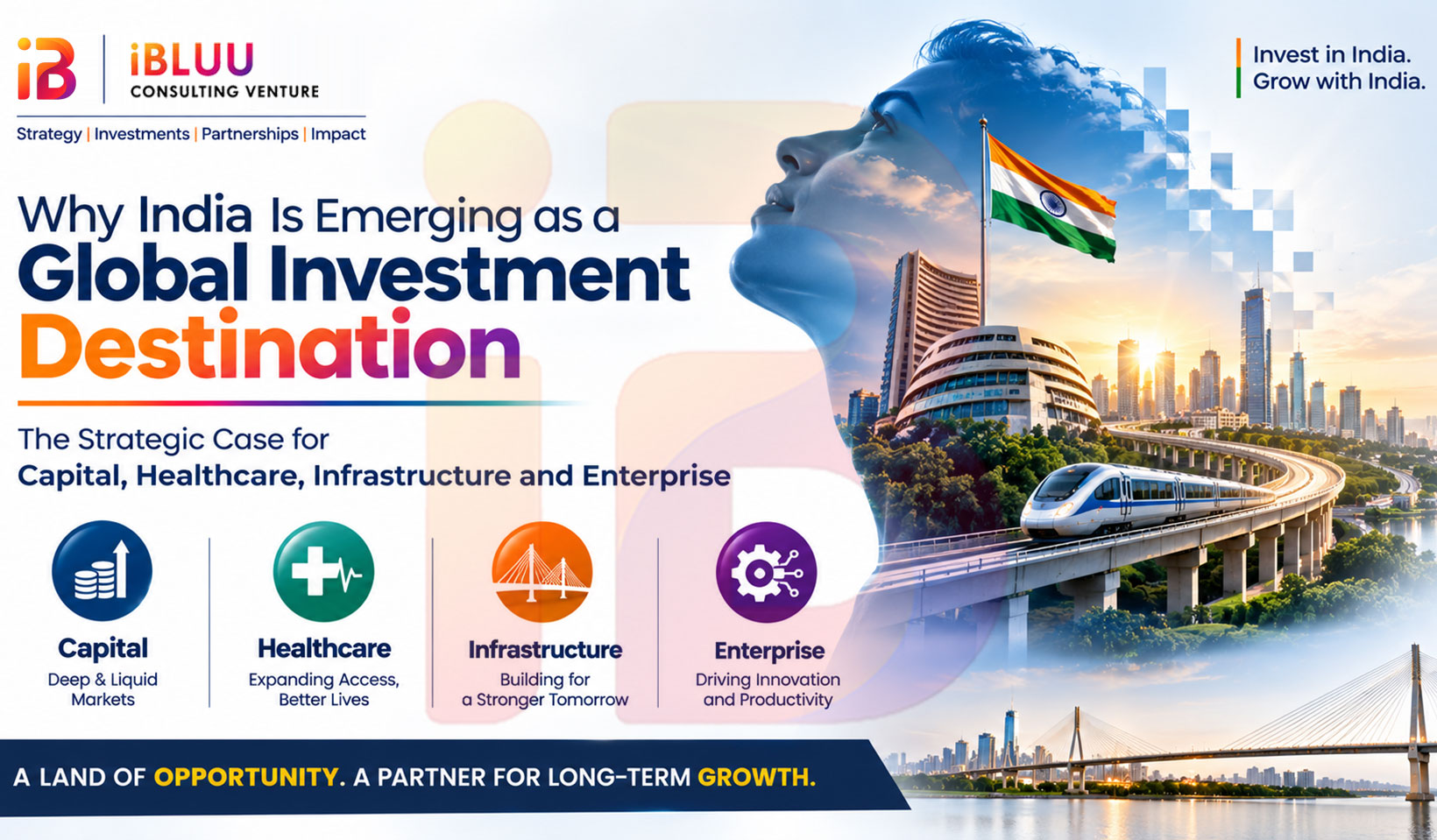
Why India Is Emerging as a Global Investment Destination: The Strategic Case for Capital, Healthcare, Infrastructure and Enterprise
India’s investment proposition is evolving beyond the advantages of scale and cost. A combination of expanding domestic demand, globally competitive professional capabilities, healthcare excellence, renewable-energy development, entrepreneurship and infrastructure investment is creating opportunities for international capital. The strategic question is no longer whether India offers growth, but where, how and with whom investors can participate in that growth.
1. The investment proposition: From market access to long-term value creation
Global investment decisions are being reshaped by a more complex economic environment. Geopolitical realignment, supply-chain diversification, technological disruption, energy transition, changing demographics and pressure on operating costs are compelling investors to reassess where they establish operations, deploy capital and build long-term partnerships.
In this environment, India is becoming an increasingly important destination for international investment.
Its proposition is not built on one advantage alone. It rests on the convergence of several structural factors:
- A population exceeding 1.4 billion, creating substantial domestic demand and a deep labour market.
- A large and increasingly skilled professional workforce across healthcare, engineering, technology, finance and management.
- Expanding physical and digital infrastructure.
- A growing startup and entrepreneurial ecosystem.
- Government programmes supporting manufacturing, renewable energy, innovation and infrastructure.
- Competitive operating costs across many business activities.
- Opportunities to serve domestic consumers while developing export-oriented capabilities.
For international investors, this creates a distinctive opportunity: India can function simultaneously as a consumer market, a production base, a services hub, a healthcare destination and a platform for regional and global expansion.
However, investment attractiveness should not be confused with investment certainty. Returns depend on sector selection, location, project structuring, regulatory compliance, financing, management capability and execution discipline.
The strongest investment proposition is therefore not simply to enter India. It is to identify the economic capabilities that India needs, determine where commercial demand is durable, and build businesses capable of meeting that demand profitably.
2. Healthcare: India’s growing position in global medical value travel
One of India’s most compelling international investment opportunities is healthcare.
Patients from countries including the United States, Canada, Australia, the United Kingdom and several other regions increasingly consider India for specialised medical treatment. The decision is often driven by a combination of treatment affordability, access to specialists, clinical capacity and the ability to coordinate treatment within a shorter timeframe.
This is not merely a medical tourism trend. It reflects a wider structural difference between healthcare systems, treatment costs and the availability of specialised services.
Why international patients choose India
1. Significant treatment-cost advantages
For selected procedures, Indian hospitals can offer treatment at substantially lower prices than comparable private healthcare providers in Western markets.
Industry estimates commonly indicate savings of approximately 60–80% for certain procedures, although the actual difference depends on the treatment, hospital, surgeon, medical complexity, insurance arrangements and post-operative requirements.
Illustrative examples include cardiac procedures, orthopaedic surgery, joint replacement, oncology treatment, organ transplantation where legally and medically appropriate, fertility treatment and advanced diagnostics.
These cost advantages are supported by lower operating costs, differences in professional compensation, medical supply chains, infrastructure expenses and the economics of delivering healthcare at scale.
Importantly, lower prices do not automatically imply lower clinical standards. Investors must assess the quality of individual institutions, medical teams, outcomes, accreditation and patient-safety systems.
2. Faster access to consultations and treatment
In some countries, particularly where publicly funded healthcare systems face capacity constraints, patients may experience substantial waiting periods for specialist consultations and non-emergency procedures.
India’s private hospital networks can often arrange specialist appointments, diagnostics and elective procedures much faster, sometimes within days, subject to clinical assessment and availability.
This advantage is particularly relevant for international patients seeking timely treatment.
However, it would be inaccurate to claim that every patient in India receives immediate treatment or that waiting lists do not exist. Availability varies by hospital, speciality, location and clinical urgency.
3. A substantial pool of experienced medical professionals
India has developed a large medical education and healthcare workforce. Many Indian doctors and specialists have also trained, undertaken fellowships or practised internationally.
A further advantage is the clinical exposure available in a country with a very large patient population. High patient volumes can provide specialists with extensive experience, although volume alone is not a substitute for measurable clinical outcomes, appropriate training and quality assurance.
The Government reported 818 medical colleges and 128,875 undergraduate medical seats in December 2025. It also reported approximately 42.94 lakh registered nursing personnel. These figures demonstrate the scale of India’s medical education and healthcare workforce, while also highlighting the importance of continued investment in quality, faculty, infrastructure and training.
4. Advanced hospitals and specialised treatment capabilities
India’s leading private healthcare institutions offer a broad range of advanced services, including:
- Cardiac sciences and cardiovascular surgery.
- Oncology and radiation therapy.
- Neurosciences and neurosurgery.
- Orthopaedics and joint replacement.
- Organ transplantation.
- Robotic and minimally invasive surgery.
- Fertility and reproductive medicine.
- Advanced diagnostics and precision medicine.
International accreditation, national quality certification, clinical governance and transparent reporting are important differentiators. Investors should verify the accreditation status of individual hospitals rather than assume that all facilities meet the same standards.
5. English-language communication and coordinated patient services
English is widely used in India’s tertiary healthcare institutions, particularly in major private hospital networks. This can simplify communication for patients from several international markets.
International patient departments also coordinate appointments, medical records, airport transfers, accommodation, interpreters where required and post-treatment support.
The resulting proposition is broader than the procedure itself: it is a coordinated medical journey.
The market opportunity
Industry estimates place India’s medical tourism market at approximately US$8.7 billion in 2025, with projections of US$16.2 billion by 2030. These are market estimates rather than official national accounts, and the definition of medical tourism can vary across research providers. Press Information Bureau+1
India medical tourism market
US$8.7bn
Estimated market, 2025
US$16.2bn
Projected market, 2030
Indicative growth trajectory based on industry estimates; not a guaranteed forecast or investment return.
Investment opportunities in healthcare
The opportunity extends well beyond constructing conventional hospitals.
| Investment area | Potential business model | Strategic rationale |
|---|---|---|
| Multispecialty hospitals | Greenfield or brownfield hospital development | Growing demand for tertiary and quaternary care |
| Specialty hospitals | Cardiac, oncology, orthopaedic and neurosciences centres | Focused clinical expertise and differentiated services |
| Medical colleges | Medical education institutions with teaching hospitals | Long-term demand for doctors and specialist training |
| Diagnostics | Imaging, pathology and integrated diagnostic networks | Earlier diagnosis and growing healthcare utilisation |
| Nursing and allied health | Nursing colleges and professional training institutions | Expanding demand for qualified healthcare personnel |
| Medical rehabilitation | Recovery centres, physiotherapy and post-operative care | Continuity of care after complex procedures |
| Healthcare technology | Hospital management, diagnostics, AI and telemedicine | Productivity, access and operational efficiency |
| Medical value travel | International patient facilitation and care coordination | Cross-border patient acquisition and service integration |
A particularly attractive investment model is the integrated healthcare ecosystem: a hospital supported by medical education, diagnostics, rehabilitation, specialist accommodation, digital patient services and international patient coordination.
Such a model can create multiple revenue streams while strengthening institutional capability.
Nevertheless, hospital investments are capital-intensive and require rigorous feasibility analysis. Bed capacity, occupancy, speciality mix, doctor recruitment, payer composition, working capital, regulatory approvals and time to stabilised operations must all be modelled before investment.
3. Solar and renewable energy: Investing in India’s energy transition
India’s energy transition is one of the most consequential infrastructure investment opportunities of the coming decade.
Rising electricity consumption, industrial expansion, urbanisation, electrification and the growth of data-intensive industries are increasing the importance of reliable, affordable and sustainable power.
India is responding through large-scale renewable-energy deployment, domestic manufacturing, grid expansion, rooftop solar, energy storage and emerging green-hydrogen capabilities.
As of 31 October 2026, India’s installed solar capacity stood at approximately 174.55 GW. Total renewable capacity, excluding large hydro, was approximately 251.15 GW. These figures demonstrate the scale already achieved, while the next phase will require investment not only in generation but also in the infrastructure needed to integrate and deliver electricity reliably. Ministry of New And Renewable Energy
Where the investment opportunities lie
| Investment segment | Potential opportunity | Key commercial considerations |
|---|---|---|
| Utility-scale solar | Development or acquisition of solar projects | Land, grid connectivity, tariffs, offtaker credit and financing |
| Commercial and industrial solar | Rooftop and captive power solutions | Customer creditworthiness, consumption profile and savings |
| Solar EPC | Engineering, procurement and construction | Execution capability, procurement and project margins |
| Solar manufacturing | Modules, cells, components and equipment | Technology, scale, domestic sourcing and global competitiveness |
| Battery storage | Standalone and co-located storage | Revenue model, battery costs, utilisation and degradation |
| Hybrid renewable energy | Solar-wind-storage combinations | Dispatchability, transmission and contract structure |
| Distributed energy | Rooftop, microgrids and decentralised systems | Customer acquisition, collections and maintenance |
| Green hydrogen | Production, infrastructure and industrial applications | Cost of renewable electricity, offtake and technology maturity |
The investment case is increasingly shifting from simply adding solar generation capacity to building an integrated energy ecosystem.
That ecosystem includes transmission, distribution, storage, power electronics, domestic manufacturing, digital monitoring, energy management and long-term power procurement.
Government policy and incentive programmes can improve project economics, but investors should not assume that every solar project automatically qualifies for subsidies, tax benefits or preferential tariffs. Eligibility, scheme conditions, domestic-content requirements and procurement rules must be assessed individually.
The next major opportunity in renewable energy will belong not only to those who generate electricity, but also to those who make clean energy reliable, dispatchable, affordable and commercially accessible.
4. Hospitality and tourism: Building infrastructure around India’s expanding mobility
India’s hospitality sector is supported by several demand drivers: domestic tourism, business travel, religious and cultural tourism, medical value travel, weddings, conferences, international visitors and the expansion of regional economic centres.
For investors, the opportunity extends beyond conventional hotels.
India requires a diversified hospitality ecosystem that can serve different customer segments, price points, locations and lengths of stay.
High-potential investment models
- Business hotels: Properties near commercial districts, industrial corridors, airports and technology hubs.
- Premium and luxury hospitality: Hotels and resorts serving international travellers, high-income domestic customers and destination tourism.
- Medical hospitality: Serviced apartments, recovery accommodation and family-oriented lodging near major hospitals.
- Wellness and Ayurveda retreats: Integrated wellness destinations combining hospitality with credible clinical and traditional wellness services.
- Religious and cultural tourism: Accommodation, transport and destination-management infrastructure around major pilgrimage and heritage locations.
- Extended-stay accommodation: Serviced residences for professionals, expatriates, medical travellers and corporate assignments.
- Convention and event infrastructure: Meeting facilities, exhibition venues and business-event hotels.
Medical hospitality deserves particular attention. International patients frequently travel with family members or caregivers and may require accommodation before treatment, during recovery and for follow-up appointments. This creates demand for accommodation that is more flexible and specialised than conventional hotel inventory.
What investors should measure
Hospitality investment must be evaluated through operating performance rather than headline room rates.
| Performance indicator | What it measures |
|---|---|
| Occupancy | Percentage of available rooms sold |
| ADR | Average daily room rate |
| RevPAR | Revenue per available room |
| GOP margin | Gross operating profit relative to revenue |
| EBITDA | Operating earnings before interest, tax, depreciation and amortisation |
| Payback period | Time required to recover invested capital |
Location, seasonality, distribution costs, staffing, energy consumption, brand fees and property ownership structure can materially change returns.
A hotel with high occupancy is not necessarily a strong investment if room rates are discounted, operating costs are excessive or debt servicing is unsustainable.
The opportunity is to develop hospitality assets around identifiable demand generators—not merely to add rooms to an already competitive market.
5. Small and medium-sized enterprises: Partnering with India’s next generation of businesses
India’s SME and startup landscape offers international investors a route into sectors where local knowledge, entrepreneurial agility and specialised capabilities can create meaningful competitive advantage.
Not every investment opportunity requires a large greenfield project. In many cases, strategic collaboration with an established Indian enterprise can provide faster market access, an existing customer base, operating infrastructure and experienced management.
India’s startup ecosystem has expanded substantially. By 31 March 2026, more than 2.23 lakh entities had been recognised under the Startup India programme, with over 23.36 lakh direct jobs reported. Recognition is not proof of commercial viability or active operations; investors must distinguish the cumulative recognised-startup count from the number of investable, revenue-generating businesses. Press Information Bureau+1
Collaboration opportunities
- Technology partnerships: Software, artificial intelligence, enterprise technology, cybersecurity and automation.
- Healthcare innovation: Health-tech platforms, diagnostics, hospital software and medical devices.
- Manufacturing partnerships: Component manufacturing, precision engineering, industrial automation and contract production.
- Agritech: Supply-chain technology, food processing, farm productivity and market access.
- Financial technology: Payments, financial infrastructure, lending technology and business financial management, subject to applicable regulation.
- Logistics and supply chain: Warehousing, fleet technology, fulfilment and distribution.
- Education and skills: Vocational education, professional training and digital learning.
International investment models
Foreign businesses can consider:
- Minority or majority equity investment, subject to applicable rules.
- Joint ventures with established Indian enterprises.
- Technology licensing and commercial partnerships.
- Distribution and market-access agreements.
- Contract manufacturing and strategic sourcing.
- Acquisition of operating businesses.
- Co-development of products for Indian and international markets.
The central diligence question is whether the business possesses a defensible commercial proposition.
Investors should examine revenue quality, customer concentration, gross margins, cash conversion, governance, intellectual property, founder dependency, working-capital requirements and the pathway to profitability.
India’s SME opportunity is not simply about finding inexpensive businesses. It is about identifying capable enterprises that can become stronger through capital, technology, professional management and access to international markets.
6. Regional Indian food chains: Taking local brands to international markets
India’s food and hospitality heritage represents a substantial commercial opportunity.
The country has a highly diverse food ecosystem, with regional cuisines, established local restaurant businesses, specialised food manufacturers, quick-service formats, traditional products and emerging consumer brands.
Many regional food businesses have built customer loyalty and local market recognition but have not yet developed the operational systems, brand architecture, supply chains and capital base required for national or international expansion.
This creates an opportunity for international investors and strategic partners.
Potential business models
- Investment in established regional restaurant chains.
- Joint ventures to expand Indian food brands into overseas markets.
- Franchise development and master-franchise agreements.
- Centralised kitchens and standardised food production.
- Packaged regional foods and ready-to-eat products.
- Frozen and convenience food manufacturing.
- Food technology, procurement and supply-chain platforms.
- Export-oriented food processing and distribution.
What makes a local food chain internationally scalable?
A strong regional reputation is a starting point, not a complete business model.
International expansion requires standardised recipes, food safety systems, supplier traceability, consistent product quality, reliable sourcing, trained management, brand protection and a replicable operating model.
Investors should evaluate:
- Same-store sales growth.
- Outlet-level EBITDA.
- Food and labour cost ratios.
- Rent-to-revenue ratios.
- Customer retention and repeat purchases.
- Supply-chain reliability.
- Franchise economics.
- Brand differentiation.
- Regulatory requirements in target export markets.
The strategic opportunity is to convert India’s regional culinary strengths into organised, scalable and internationally recognisable food businesses.
7. Retail and consumer businesses: Building for India’s expanding domestic market
India’s large population creates significant consumer-market potential, but population alone does not determine purchasing power.
The commercial opportunity emerges from the interaction of household income, urbanisation, changing consumption patterns, digital adoption, product accessibility and the growth of organised retail.
International entrepreneurs can establish or partner with businesses across:
- Apparel, footwear and lifestyle products.
- Personal care, beauty and wellness.
- Home furnishings and consumer durables.
- Packaged foods and beverages.
- E-commerce and direct-to-consumer brands.
- Omnichannel retail.
- Affordable premium products.
- Consumer technology and digital services.
A particularly important opportunity lies in building brands that understand India’s regional diversity.
Consumer preferences, price sensitivity, language, distribution economics and product-market fit can differ substantially between metropolitan markets, Tier-II cities and smaller urban centres.
A brand that succeeds in one city may not automatically scale across the country.
A disciplined route to market
A robust consumer-market entry strategy should begin with customer segmentation, product testing and unit economics. Businesses should establish repeat purchase behaviour and contribution margins before committing substantial capital to national expansion.
The critical metrics include customer acquisition cost, lifetime value, gross margin, inventory turnover, return rates, repeat purchase rate, fulfilment cost and channel profitability.
India’s consumer opportunity is not simply to sell more products. It is to build trusted brands, efficient distribution systems and sustainable customer relationships at scale.
8. Additional sectors with significant investment potential
The six priority sectors represent only part of India’s wider investment landscape. Several complementary industries deserve serious consideration.
| Sector | Investment opportunities | Strategic importance |
|---|---|---|
| Manufacturing | Electronics, components, engineering, industrial equipment | Supply-chain diversification and domestic production |
| Logistics | Warehousing, multimodal transport, cold chains | Lowering supply-chain costs and improving connectivity |
| Data centres | Hyperscale, colocation and edge infrastructure | Digital growth, cloud and AI workloads |
| Electric mobility | EV components, charging, fleet platforms | Transport electrification |
| Education | Universities, vocational training, professional education | Workforce development and skills |
| Agriculture and food processing | Storage, processing, packaging and export infrastructure | Productivity and value addition |
| Water and waste management | Treatment, recycling and resource recovery | Urban and industrial sustainability |
| Financial services | Fintech, insurance technology and business finance | Financial access and enterprise productivity |
| Aerospace and defence | Components, maintenance, manufacturing and technology | Industrial capability and strategic supply chains |
| Real estate and industrial parks | Industrial, logistics, commercial and mixed-use assets | Enabling business activity |
These sectors should not be treated as interchangeable investment opportunities. Each has distinct capital requirements, regulatory conditions, revenue models, operating risks and return horizons.
Their common feature is that they address structural requirements of a growing economy.
9. Why India? The structural advantages behind the investment opportunity
India’s attractiveness as an investment destination is supported by a combination of demographic, economic, institutional and operating factors. Their value, however, differs by sector and location.
9.1 A large domestic market and demographic depth
India’s population exceeds 1.4 billion, creating one of the world’s largest potential consumer markets.
This scale supports demand across healthcare, housing, food, education, mobility, financial services, consumer products and infrastructure.
India also has a comparatively young population, with a substantial working-age demographic. This provides a deep labour pool and creates opportunities for businesses serving both domestic and international markets.
However, investors must distinguish population size from effective demand. Income distribution, purchasing power, affordability, regional preferences and access to finance determine the commercially addressable market.
The opportunity lies in identifying the right customer segments—not assuming that every product has a billion potential buyers.
9.2 Competitive talent and operating costs
India offers access to professionals across medicine, engineering, software, finance, research, design, management, manufacturing and business services.
For many international companies, this can support a more competitive cost structure than establishing equivalent operations in higher-cost markets.
The advantage is particularly relevant in technology, business-process services, engineering, diagnostics, research, back-office operations and professional services.
But the phrase cheap workforce oversimplifies the opportunity. The more relevant proposition is access to skilled talent at competitive total operating costs.
Investors must account for differences in talent availability, experience, productivity, attrition, training requirements and compensation across cities and industries.
9.3 A broad and evolving policy framework
India has introduced multiple policy initiatives to support investment, manufacturing, infrastructure development, entrepreneurship, renewable energy and digitalisation.
Important programmes include:
- Make in India.
- Startup India.
- Production Linked Incentive (PLI) schemes in selected sectors.
- National Infrastructure Pipeline.
- PM Gati Shakti.
- National Green Hydrogen Mission.
- PM Surya Ghar: Muft Bijli Yojana.
- Digital India.
- Sector-specific healthcare, manufacturing and infrastructure initiatives.
The Foreign Direct Investment framework permits up to 100% foreign investment under the automatic route in many sectors and activities, subject to sector-specific conditions, exclusions and applicable laws. Healthcare and hotels and tourism-related activities have significant automatic-route provisions, but investors must verify the exact activity and current policy before committing capital. DPIIT+1
Government support can improve project viability, but subsidies and incentives should be treated as conditional benefits—not as the foundation of an otherwise weak investment case.
9.4 Competitive real estate and location choices
Compared with many major international business centres, several Indian cities offer relatively competitive commercial rents, industrial land costs and operating premises.
The opportunity is not limited to metropolitan markets. Tier-II and Tier-III cities may offer attractive combinations of workforce availability, industrial infrastructure, land costs and proximity to emerging demand centres.
However, lower rent does not necessarily mean lower total occupancy cost.
Investors should evaluate connectivity, power reliability, water availability, workforce access, logistics, local taxes, lease conditions, title quality and the cost of developing or adapting the premises.
The correct question is not simply where property is cheapest. It is where the total cost of operating a business is most competitive.
9.5 Access to professional expertise and advisory capabilities
India has a broad ecosystem of professionals in legal services, accounting, taxation, engineering, architecture, technology, project management, investment advisory and corporate services.
This can make it possible for businesses to access specialist support at competitive rates, particularly when compared with many higher-cost international markets.
For overseas investors, local expertise is particularly important in:
- Market-entry strategy.
- Company formation and structuring.
- Regulatory and tax compliance.
- Land and property due diligence.
- Project feasibility and financial modelling.
- Government approvals and statutory processes.
- Joint-venture structuring.
- Mergers, acquisitions and strategic partnerships.
Professional fees should not be assessed only on the basis of price. The quality of advice, relevant sector experience, independence, accountability and ability to execute are equally important.
9.6 Digital infrastructure and financial inclusion
India’s digital public infrastructure has created a significant foundation for commercial activity.
Digital identity, electronic payments, interoperable financial systems and online public services have helped businesses reach customers, facilitate transactions and reduce certain administrative frictions.
The expansion of digital payments, e-commerce and technology-enabled services creates opportunities in fintech, retail, logistics, healthcare, education and enterprise software.
For investors, this infrastructure can support business models that would be more difficult or expensive to scale in markets with fragmented digital systems.
9.7 Strategic position in global supply chains
Companies are reassessing production and sourcing strategies to manage concentration risk, improve supply-chain resilience and diversify manufacturing locations.
India’s scale, industrial base, engineering capabilities, domestic market and policy support position it as an important potential partner in this transition.
Opportunities exist in electronics, pharmaceuticals, automotive components, renewable-energy equipment, industrial machinery, speciality chemicals and other manufacturing segments.
Yet supply-chain diversification requires more than competitive labour costs. Quality standards, delivery reliability, component ecosystems, logistics, technology access and regulatory predictability are decisive.
India’s strongest competitive advantage is the combination of domestic market scale and the potential to build internationally competitive production and service capabilities.
10. Investment attractiveness in numbers: What the indicators tell us
The following indicators provide a snapshot of India’s investment ecosystem. They are not a substitute for sector-specific due diligence, and the dates and definitions differ across datasets.
| Indicator | Reported position | Investment relevance |
|---|---|---|
| Population | More than 1.4 billion | Domestic demand and workforce scale |
| Medical colleges | 818, December 2025 | Healthcare education capacity |
| Undergraduate medical seats | 128,875, December 2025 | Medical workforce development |
| Registered nursing personnel | Approximately 42.94 lakh, December 2025 | Healthcare delivery workforce |
| Medical tourism market | US$8.7bn estimated, 2025 | International healthcare demand |
| Medical tourism market | US$16.2bn projected, 2030 | Potential market expansion |
| Installed solar capacity | 174.55 GW, 31 October 2026 | Renewable-energy deployment |
| Recognised startups | More than 2.23 lakh, 31 March 2026 | Entrepreneurial ecosystem |
| Startup-generated direct jobs | More than 23.36 lakh, 31 March 2026 | Enterprise and employment activity |
| Gross FDI inflows | US$94.53bn, FY2025–26 | International investment activity |
Press Information Bureau+4
The FDI figure deserves particular attention. Gross FDI inflows measure investment entering India before accounting for repatriation and disinvestment. They should not be confused with net FDI, which can be materially lower. Portfolio investment is also a different category and should not be combined with long-term direct investment when assessing project-level investor commitment.
The figures indicate economic scale and activity. They do not establish that every sector, company or project offers attractive returns.
11. The financial case: How investors should evaluate opportunities
A credible investment thesis must move from macroeconomic attractiveness to project-level economics.
India’s lower operating costs can improve the economics of selected business models, but the final investment decision should be based on cash flows, risk-adjusted returns and capital efficiency.
Core financial metrics
| Metric | Why it matters |
|---|---|
| Total project cost | Establishes the full capital requirement, including contingencies |
| Capital expenditure (CAPEX) | Measures the investment needed to build or acquire assets |
| Operating expenditure (OPEX) | Determines recurring cost competitiveness |
| EBITDA margin | Evaluates operating profitability |
| Net present value (NPV) | Measures the present value of expected project cash flows |
| Internal rate of return (IRR) | Estimates the project’s annualised return |
| Debt service coverage ratio (DSCR) | Tests the capacity to service debt |
| Working capital cycle | Measures cash tied up in operations |
| Payback period | Indicates the time required to recover invested capital |
| Return on invested capital (ROIC) | Measures how efficiently capital generates operating returns |
Sector-specific financial benchmarking
Healthcare: Model occupancy ramp-up, revenue per occupied bed, speciality mix, doctor compensation, payer mix, receivable days, capex per bed and time to stabilisation.
Solar: Assess project cost per MW, generation yield, degradation, tariff, power-purchase agreement (PPA), counterparty credit, transmission charges, curtailment and financing costs.
Hospitality: Model occupancy, ADR, RevPAR, seasonality, channel commissions, payroll, energy costs, property ownership and management fees.
Startups and SMEs: Examine customer acquisition cost, lifetime value, gross margin, recurring revenue, customer concentration, cash runway and the path to sustainable profitability.
Food chains: Evaluate outlet-level EBITDA, food cost, wastage, labour cost, rent, same-store sales, franchise economics and supply-chain consistency.
Retail: Analyse inventory turnover, gross margin, fulfilment costs, customer retention, return rates, store productivity and contribution margin by channel.
A project should not be approved simply because its projected IRR appears attractive. The assumptions behind the model must be tested against realistic demand, execution timelines, cost escalation, financing conditions and downside scenarios.
Illustrative scenario modelling
Every investment proposal should be tested under at least three operating scenarios.
| Variable | Downside case | Base case | Upside case |
|---|---|---|---|
| Project cost | 10–15% above budget | Approved budget | At or below budget |
| Project commissioning | 6–12 months delayed | Planned timeline | Early commissioning |
| Revenue ramp-up | Slower than forecast | Expected demand | Faster customer adoption |
| Operating costs | 10% above base assumption | Budgeted costs | Improved efficiency |
| Financing | Higher borrowing cost | Expected financing | More favourable financing |
| Cash flow | Delayed or constrained | Forecast cash generation | Stronger conversion |
These are proposed stress-test assumptions, not predictions about Indian market performance. Actual sensitivity ranges should reflect the sector, project location, contractual structure and financing plan.
Investors should also test combinations of adverse events. A construction delay accompanied by cost escalation and a slower revenue ramp-up can have a much greater impact than any one variable considered independently.
The objective of financial modelling is not to prove that an investment will succeed. It is to understand precisely what could prevent it from succeeding—and whether the returns justify those risks.
12. The risks investors must understand before entering India
A balanced investment strategy must recognise that India is a large and diverse market, not a uniform business environment.
Its opportunities are substantial, but investors must address structural, commercial, regulatory and execution risks.
| Risk category | Potential challenge | Recommended mitigation |
|---|---|---|
| Regulatory complexity | Different central, state and local requirements | Sector-specific legal and regulatory diligence |
| Land and property | Title defects, zoning restrictions and approval delays | Independent title, land-use and encumbrance verification |
| Project execution | Construction delays and cost overruns | Experienced EPC partners, milestone controls and contingencies |
| Infrastructure | Power, water, transport and grid constraints | Location-level infrastructure assessment |
| Talent | Skill shortages, attrition and uneven availability | Workforce planning, training and retention programmes |
| Financing | Interest-rate changes and refinancing exposure | Conservative leverage and downside debt modelling |
| Currency | Rupee volatility affecting foreign-currency returns | Appropriate hedging and currency-matched financing |
| Demand | Slower customer adoption or pricing pressure | Market validation and phased investment |
| Counterparty | Delayed payments or weak offtaker credit | Credit assessment, contractual safeguards and diversification |
| Governance | Weak internal controls or unreliable reporting | Independent audits, board oversight and compliance systems |
| Geopolitical and trade | Tariffs, export restrictions and supply-chain disruption | Market diversification and scenario planning |
Geopolitical considerations
India’s investment proposition is also influenced by the changing international economic environment.
Supply-chain diversification, strategic competition, energy security, technology access and evolving trade relationships are reshaping global investment decisions.
India can benefit from these shifts as businesses seek additional manufacturing locations, services capabilities and consumer markets.
However, international investors should not assume that geopolitical alignment guarantees commercial success. Trade policy, tariffs, export controls, sanctions exposure, local-content requirements and international regulatory changes can affect individual sectors and projects.
A sound investment strategy should therefore assess India not only as a domestic market, but also as part of the investor’s wider international operating and supply-chain architecture.
13. Market entry: How international investors should approach India
The most effective market-entry strategies begin with commercial evidence, not assumptions.
A structured approach can reduce execution risk and help investors identify opportunities that match their capital, capabilities and return requirements.
Phase 1: Strategic opportunity assessment
- Identify target sectors and customer segments.
- Assess market size, competition and demand.
- Evaluate state-level and city-level opportunities.
- Understand foreign investment rules and sectoral restrictions.
- Identify potential local partners and acquisition targets.
Phase 2: Commercial and financial diligence
- Validate revenue assumptions and customer demand.
- Review company financials and operating performance.
- Assess management capability and governance.
- Verify land, licences, contracts and statutory approvals.
- Prepare project-level financial models and sensitivity analysis.
Phase 3: Structuring and partnership development
- Determine the appropriate investment structure.
- Assess joint ventures, acquisitions and strategic alliances.
- Establish governance and decision-making rights.
- Define capital commitments and funding milestones.
- Establish risk allocation and contractual protections.
Phase 4: Execution and operational establishment
- Complete applicable registrations and approvals.
- Secure suitable land, property or operating facilities.
- Appoint project and operational leadership.
- Establish procurement, technology and compliance systems.
- Implement project monitoring and financial controls.
Phase 5: Scale and international expansion
- Evaluate performance against investment assumptions.
- Improve productivity and operating margins.
- Expand into additional regions and customer segments.
- Develop export and international distribution channels.
- Reassess capital allocation and growth opportunities.
Choosing the right Indian location
The choice of location can materially influence project economics.
| Business requirement | Location assessment priorities |
|---|---|
| Hospitals and medical colleges | Population catchment, specialist availability, accessibility and healthcare gaps |
| Solar projects | Solar resource, land, grid connectivity, transmission and offtaker |
| Hospitality | Tourism demand, business activity, transport and seasonality |
| Manufacturing | Industrial infrastructure, suppliers, logistics and skilled labour |
| Technology startups | Talent, ecosystem, connectivity and operating costs |
| Food chains | Customer density, purchasing power, supply chain and brand fit |
| Retail | Catchment income, footfall, competition and distribution |
Investors should not select locations solely because land or rent is inexpensive. The right location is the one that produces the strongest combination of demand, operating efficiency, connectivity, talent and risk-adjusted returns.
14. Three investment horizons: Where the opportunity may develop
India’s investment landscape can be approached through three broad time horizons. These are strategic planning categories, not guaranteed market forecasts.
Near term
0–2 years: Establish market presence
Focus on acquisitions, SME partnerships, commercial and industrial solar, diagnostics, technology services, consumer businesses and operating hospitality assets.
Strategic priority: Enter through validated demand and manageable execution risk.
Medium term
3–5 years: Build and scale operating platforms
Develop specialty hospitals, medical education, hotel portfolios, manufacturing capabilities, food-chain networks, renewable-energy assets and technology-enabled businesses.
Strategic priority: Build repeatable operating models and scalable revenue streams.
Long term
5–10 years: Develop strategic economic capabilities
Participate in integrated healthcare ecosystems, energy storage, advanced manufacturing, industrial infrastructure, international consumer brands and export-oriented platforms.
Strategic priority: Build durable assets, institutional capabilities and long-term competitive advantage.
The appropriate horizon depends on the sector’s capital intensity, regulatory requirements, demand maturity and expected time to cash-flow stability.
15. Why strategic partnerships will determine the quality of investment outcomes
International investors entering India often bring capital, technology, global market access, management systems and international operating experience.
Indian partners can contribute local market knowledge, customer relationships, distribution networks, regulatory familiarity, operating capabilities and established business infrastructure.
When these strengths are combined effectively, the result can be more valuable than either party’s contribution in isolation.
However, a partnership must be designed around clearly defined commercial objectives.
A robust partnership framework should address:
- Capital contribution and funding responsibilities.
- Ownership and management control.
- Technology transfer and intellectual property.
- Operational responsibilities and performance standards.
- Financial reporting and audit rights.
- Regulatory compliance and governance.
- Dispute resolution and exit provisions.
- Expansion strategy and future capital requirements.
The right partner is not necessarily the largest company or the most prominent name. It is the partner whose capabilities, incentives, governance and commercial objectives are aligned with the investment.
Capital opens the door. Capability builds the business. Execution determines the return.
16. The iBluu perspective: Connecting global capital with Indian capability
At iBluu Corporations, the investment opportunity in India is viewed through a broader strategic framework: the convergence of capital, infrastructure, enterprise, technology and institutional capability.
The objective is not simply to identify businesses seeking investment or investors seeking opportunities. It is to develop commercially viable connections between the two.
This requires understanding the complete investment environment—from sector fundamentals and project feasibility to financial structuring, strategic partnerships, execution requirements and long-term commercial potential.
The analytical depth of this article itself has been shaped by the strategic lens of J Parasher, Founder and Managing Director of iBluu Consulting Venture (iBCV), a venture of iBluu Corporations, whose work consistently focuses on national capability building, global industrial benchmarking, and long-horizon economic transformation. His perspective reframes consulting not as a sectoral play, but as a strategic economic system with export potential, innovation leverage, and geopolitical relevance.
iBluu’s areas of strategic focus include:
- Investment advisory and opportunity assessment.
- Strategic consulting and business transformation.
- Infrastructure and project structuring.
- Domestic and cross-border business alliances.
- International partnerships and market-entry strategy.
- Government engagement and institutional coordination.
- Technology advisory and digital transformation.
- Mergers, acquisitions and strategic growth opportunities.
The objective is to connect international capital with credible Indian enterprises and projects, while helping businesses develop the structures, partnerships and operating capabilities required for sustainable growth.
Further information: iBluu Corporations on LinkedIn.
17. Conclusion: India’s opportunity is bigger than market growth
India’s emergence as a major investment destination is not the result of one sector, one policy initiative or one economic advantage.
It reflects a broader transformation involving demographics, healthcare, infrastructure, energy, entrepreneurship, manufacturing, technology, consumption and international economic integration.
Healthcare illustrates the opportunity particularly clearly. International patients seeking affordable and timely treatment are creating demand for hospitals, diagnostics, medical education, rehabilitation and specialised hospitality. The same professional capabilities and operating-cost advantages that support this ecosystem can also strengthen India’s position across technology, manufacturing, professional services and enterprise development.
Renewable energy is creating opportunities to build the infrastructure required for industrial expansion and energy security. Hospitality is responding to growing domestic and international mobility. SMEs and startups offer opportunities for investment, collaboration and innovation. Regional food businesses and consumer brands have the potential to scale beyond their local markets. Manufacturing, logistics and digital infrastructure can further strengthen India’s role in global value chains.
But the investment proposition must remain grounded in commercial discipline.
India is not a risk-free market. Its complexity requires careful selection of locations, credible partners, regulatory understanding, robust financial modelling and professional execution.
For investors willing to undertake that work, the opportunity is not limited to participating in an expanding economy. It is to build the enterprises, infrastructure and capabilities that will support its next phase of development.
The most important strategic question is therefore not simply how much capital can enter India.
It is how effectively that capital can be converted into productive assets, competitive businesses, stronger institutions and sustainable economic value.
India’s next investment opportunity will not be defined by capital alone. It will be defined by what capital enables the country to build.
Think beyond market entry. Invest in capability. Build for scale. Create value that travels beyond borders.
Disclaimer: This article is intended for general information, strategic discussion and business insight. It does not constitute investment advice, a securities recommendation, legal advice, tax advice, medical advice or an offer or solicitation to invest in any business, company or project.
Market sizes, projections, policy information and economic indicators are based on estimates or reported data available at the time of preparation. Projections are not guarantees of future performance. Actual market conditions, project costs, regulatory requirements and investment outcomes may differ.
Foreign investors should independently verify the applicable Foreign Direct Investment policy, sectoral conditions, statutory approvals, tax implications, foreign-exchange requirements and other regulatory obligations before making an investment. Healthcare investments require particular attention to clinical governance, accreditation, patient safety, professional qualifications and applicable medical regulations.
All investment decisions should be supported by independent legal, financial, technical, commercial and regulatory due diligence, including project-specific financial modelling and risk assessment.
iBluu Corporations and the author make no representation or warranty regarding the accuracy, completeness or future realisation of any market projection or investment opportunity discussed in this article.