+91 945 889 6091
  infodesk@ibluu.com
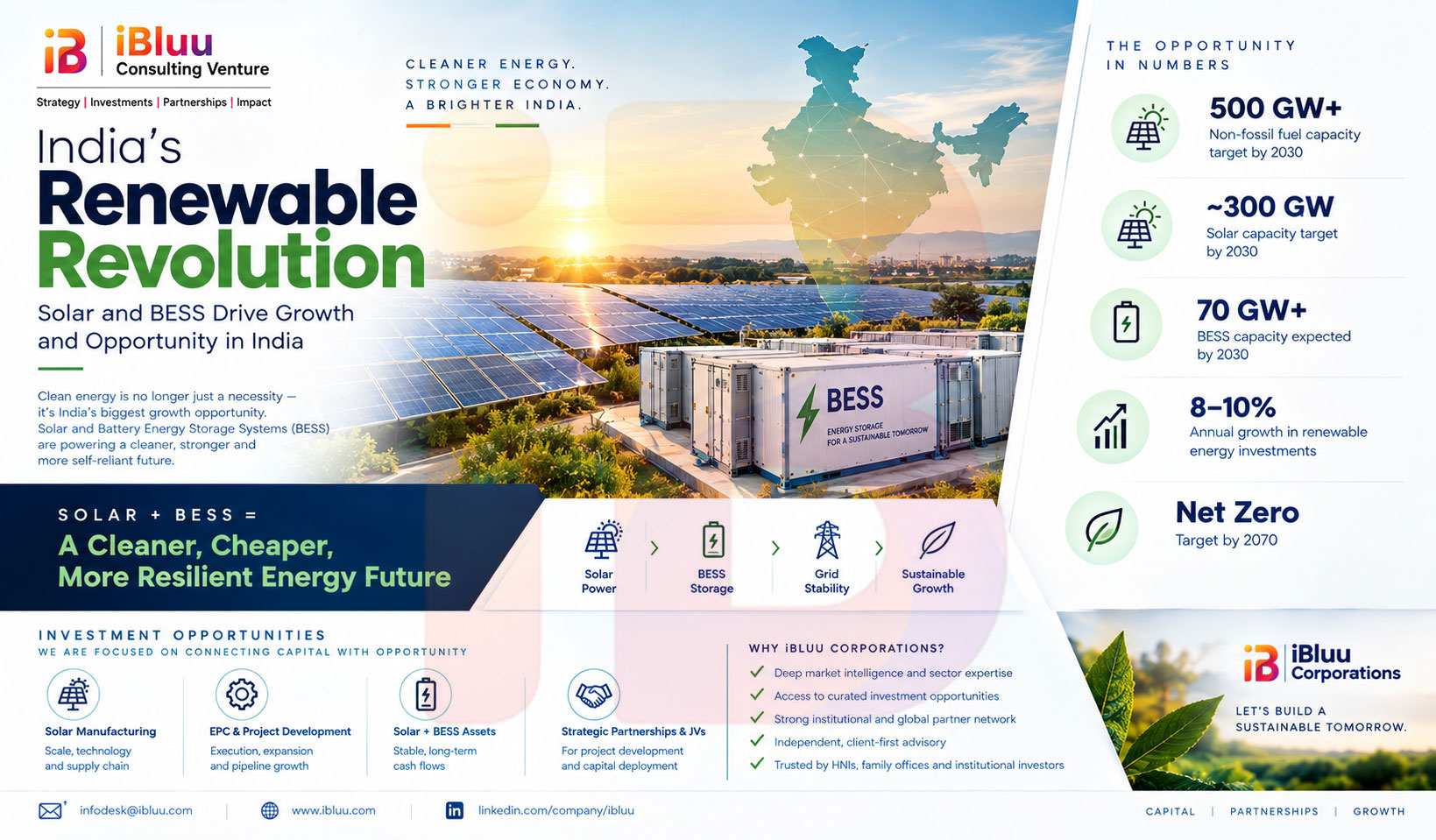
India’s Renewable Revolution: Solar and BESS Drive Growth and Opportunity in India
From Solar Scale to Energy-System Intelligence
India’s renewable-energy story has entered a new phase.
The first phase was about capacity creation: build solar parks, add gigawatts, reduce the cost of generation and expand access to clean electricity.
The next phase is fundamentally different.
It is about building an energy system capable of absorbing, storing, dispatching and monetising renewable power at scale.
Solar is becoming the generation engine. Battery Energy Storage Systems (BESS) are becoming the flexibility engine. Transmission, grid infrastructure, power markets, digital controls, manufacturing and project-finance architecture are becoming the connective tissue.
As of 31 August 2026, India had approximately 168.04 GW of installed solar capacity, including 123.99 GW of ground-mounted solar, 32.59 GW of grid-connected rooftop solar, 4.83 GW of solar components within hybrid projects and 6.63 GW of off-grid solar. Total renewable-energy capacity including large hydro stood at approximately 295.55 GW, while total non-fossil capacity—including nuclear—stood at approximately 304.33 GW.
India had already crossed 300 GW of non-fossil installed capacity by July 2026, putting the country at more than 60% of its 500 GW non-fossil capacity objective for 2030.
That changes the investment thesis.
India is no longer simply adding renewable generation. It is beginning to build renewable-energy infrastructure as an integrated economic system.
And that creates a much larger opportunity.
The Numbers Are Moving. The Opportunity Is Moving Faster.
The scale of India’s renewable transition is becoming difficult to characterise as merely an environmental programme.
It is now an infrastructure, industrial, capital-allocation and energy-security story.
India’s renewable-energy position — 31 August 2026
| Indicator | Capacity / Position |
|---|---|
| Solar power | 168.04 GW |
| Ground-mounted solar | 123.99 GW |
| Grid-connected rooftop solar | 32.59 GW |
| Solar component in hybrid projects | 4.83 GW |
| Off-grid solar | 6.63 GW |
| Wind power | 58.52 GW |
| Total RE excluding large hydro | 243.49 GW |
| Large hydro | 52.06 GW |
| Total renewable energy incl. large hydro | 295.55 GW |
| Total non-fossil capacity incl. nuclear | 304.33 GW |
The trajectory is equally important.
India added 37.95 GW of solar capacity during 2025 alone, while the country crossed the 50% non-fossil share of installed electricity capacity in 2025—more than five years ahead of the original NDC timeline.
The 2030 target therefore should not be viewed simply as a capacity race.
The harder question is:
Can India convert renewable capacity into reliable, dispatchable and economically competitive power?
That is where BESS enters the equation.
Solar Was the Beginning. Storage Is the Multiplier.
Solar has one structural limitation: it produces power when sunlight is available, not necessarily when electricity demand is highest.
That creates the classic renewable-energy mismatch:
generation curve ≠ demand curve.
A grid with increasing solar penetration therefore needs flexibility.
BESS can shift electricity across time, support peak demand, improve renewable utilisation, reduce curtailment, provide ancillary services and potentially defer some network investments.
This is why the investment opportunity is moving from:
Solar generation → Solar + Storage → Firm & Dispatchable Renewable Energy → Integrated Energy Infrastructure.
India’s official planning framework estimates a BESS requirement of approximately 34.72 GWh by FY2026–27, increasing to approximately 236.22 GWh by FY2031–32. Including pumped storage, total energy-storage requirements are projected at approximately 411.4 GWh by 2031–32.
The capital requirement is substantial. The projected BESS requirement alone by 2031–32 has been associated with an estimated investment requirement of approximately ₹3.49 lakh crore. Pumped storage adds another estimated ₹1.29 lakh crore.
Meanwhile, industry tracking indicates a BESS project pipeline of approximately 92 GWh, illustrating how quickly the market is moving from policy ambition toward project development.
The strategic implication is clear:
Storage is not an accessory to renewable energy anymore. It is becoming part of the renewable-energy asset itself.
Rajasthan: India’s Solar Capital Is Becoming an Energy-Systems Capital
Rajasthan has established an extraordinary lead in utility-scale solar.
As of 31 August 2026, the state had approximately 44.37 GW of solar capacity, comprising roughly 38.90 GW of large ground-mounted solar, 2.32 GW of rooftop solar, 2.28 GW of solar components within hybrid projects and 0.87 GW of off-grid solar.
This is materially higher than the 42.1 GW July figure sometimes cited in market commentary because the latest official August dataset captures subsequent additions and uses a broader location-based state accounting framework.
Rajasthan’s renewable position
| Metric | August 2026 |
|---|---|
| Solar | 44.37 GW |
| Wind | 5.69 GW |
| Total RE incl. large hydro | 50.72 GW |
Rajasthan’s advantage is structural.
It combines:
- high solar irradiation;
- enormous land availability;
- large-scale solar-park development experience;
- proximity to major renewable corridors;
- growing transmission infrastructure;
- an established developer and EPC ecosystem;
- strong utility-scale project execution capability.
But the next opportunity is not simply another wave of solar parks.
It is solar-plus-storage.
The state is increasingly positioned to develop:
Solar → Hybrid → BESS → Firm power → Green industrial clusters.
Recent project activity demonstrates this transition. A major 2026 development in Bikaner involved commissioning of solar capacity alongside a large BESS component, reinforcing the direction of travel from pure generation toward integrated renewable-energy assets.
The strategic opportunity in Rajasthan
For investors and developers, the opportunity extends beyond generation.
It includes:
- BESS deployment;
- renewable-plus-storage PPAs;
- FDRE projects;
- transmission-linked renewable assets;
- green industrial parks;
- renewable-powered manufacturing;
- data-centre energy supply;
- green hydrogen and derivatives;
- module, inverter and electrical-equipment manufacturing;
- asset aggregation and operating-platform strategies.
The question for Rajasthan is no longer whether it can generate solar power.
The question is whether it can transform solar abundance into firm, bankable and strategically located energy.
Madhya Pradesh: From Solar Parks to Integrated Renewable Infrastructure
Madhya Pradesh is emerging as another major renewable-energy platform.
As of 31 August 2026, the state had approximately 6.59 GW of solar capacity, including about 5.34 GW of ground-mounted solar, 1.06 GW of rooftop solar, 0.20 GW of hybrid solar and 0.66 GW of off-grid solar.
That is above the approximately 5.86 GW January figure cited in the original brief and approximately 6.2 GW July figure.
The more important development, however, is not the additional solar capacity.
It is the state’s movement toward solar-plus-storage and PPP-led renewable infrastructure.
In June 2026, Madhya Pradesh commissioned approximately 950 MW across the Neemuch and Shajapur solar parks and signed a PPA for the 440 MW Morena Solar-Plus-Storage Project.
The Morena project is particularly significant because it moves renewable procurement beyond the traditional daytime solar model.
The project was designed to combine solar generation with battery storage to provide power beyond the solar-generation window. Regulatory proceedings identify the project as a grid-connected solar PV project with BESS capable of providing 440 MWh of peak supply.
The state is also developing a broader pipeline.
In September 2026, an initiative involving three renewable-energy PPP projects, including a solar-generation and BESS facility at Shajapur, was structured with the objective of attracting up to US$1 billion of private investment. The Shajapur project is intended to support peak demand and grid stability.
This is strategically important.
Madhya Pradesh is moving from:
land + solar resource
toward:
land + renewable generation + storage + transmission + PPP capital + industrial demand.
That is a fundamentally more valuable infrastructure proposition.
The State Opportunity Map: India’s Renewable Economy Is Not One Market
India’s renewable opportunity cannot be understood through Rajasthan and Madhya Pradesh alone.
The next decade will create differentiated state-level investment clusters.
The states will not compete on exactly the same variables.
Some will win through land and solar intensity.
Some through industrial demand.
Some through manufacturing.
Some through wind-solar complementarity.
Some through distributed generation.
And some through storage, transmission and demand aggregation.
Solar capacity across the major renewable-energy states
| State | Solar capacity — 31 Aug 2026 | Strategic renewable-energy proposition |
|---|---|---|
| Rajasthan | 44.37 GW | Utility-scale solar, hybrid, BESS, green industry |
| Gujarat | 34.88 GW | Solar + wind + manufacturing + ports + green hydrogen |
| Maharashtra | 20.40 GW | Solar + industrial/C&I demand + storage |
| Tamil Nadu | 14.35 GW | Solar + wind + manufacturing + industrial demand |
| Karnataka | 12.01 GW | Solar + wind + hybrid + technology-led demand |
| Andhra Pradesh | 8.36 GW | Large-scale solar + land + industrial corridors |
| Madhya Pradesh | 6.59 GW | Solar parks + BESS + PPP + emerging storage hub |
| Telangana | 5.17 GW | Distributed/utility solar + industrial and urban demand |
| Uttar Pradesh | 6.54 GW | Rooftop + utility solar + massive distributed demand |
These numbers should not be read as a ranking of investment attractiveness.
They describe different market architectures.
And that distinction matters.
Gujarat: Renewable Energy Meets Industrial Scale
Gujarat had approximately 34.88 GW of solar capacity as of August 2026, alongside approximately 16.72 GW of wind capacity.
Its strategic advantage is not solar alone.
It is the combination of:
renewable resources + industrial demand + ports + manufacturing + transmission + green-hydrogen ambition.
Gujarat therefore has the potential to become one of India’s most integrated renewable-energy ecosystems.
Its investment opportunity extends across:
- solar and wind hybrids;
- BESS;
- renewable-powered industrial parks;
- green hydrogen;
- electrolyser manufacturing;
- solar and battery manufacturing;
- ports and logistics;
- C&I renewable procurement;
- energy-intensive manufacturing.
The Gujarat thesis is therefore less about adding isolated solar plants and more about integrating renewable power with industrial competitiveness.
Maharashtra: The Demand-Side Powerhouse
Maharashtra had approximately 20.40 GW of solar capacity as of August 2026 and more than 33.28 GW of total renewable capacity including large hydro.
Its strategic advantage is different from Rajasthan.
Maharashtra has enormous electricity demand from:
- manufacturing;
- financial services;
- data centres;
- commercial real estate;
- urban infrastructure;
- logistics;
- transport;
- industrial clusters.
That makes the state particularly relevant for C&I renewable power, open-access structures, captive and group-captive models, storage and demand-side energy solutions.
The investment proposition therefore increasingly becomes:
renewable generation + storage + contracted industrial demand.
That can be structurally different from a pure merchant solar strategy.
Uttar Pradesh: The Distributed Solar and Energy-Demand Giant
Uttar Pradesh had approximately 6.54 GW of solar capacity as of August 2026.
But capacity alone understates the state’s importance.
Its population, industrialisation, urbanisation, agricultural demand and enormous residential electricity base create a very different renewable-energy opportunity.
The PM Surya Ghar programme is accelerating residential rooftop adoption nationally, and Uttar Pradesh has emerged as the leading state for residential rooftop additions, with approximately 228.95 MW contributed under the programme by August 2026.
UP therefore presents a multi-layer renewable opportunity:
utility-scale solar + rooftop solar + agricultural solarisation + distributed storage + industrial power + grid modernisation.
The future opportunity is likely to be less concentrated in giant solar parks and more distributed across millions of demand points.
Andhra Pradesh: Land, Scale and Industrial Opportunity
Andhra Pradesh had approximately 8.36 GW of solar capacity as of August 2026.
The state’s opportunity is shaped by:
- large land availability;
- solar resource;
- renewable-energy development zones;
- industrial corridors;
- ports and logistics;
- manufacturing ambitions;
- potential renewable-powered industrial demand.
The investment thesis is particularly relevant for large utility-scale projects and renewable-energy infrastructure linked to industrial expansion.
The strategic opportunity is to move beyond electricity generation and create renewable-energy-backed industrial capacity.
Tamil Nadu: The Solar-Wind-Industrial Triangle
Tamil Nadu had approximately 14.35 GW of solar capacity and more than 12.32 GW of wind capacity as of August 2026.
That combination makes Tamil Nadu structurally different from a solar-dominant state.
The opportunity lies in the complementarity of:
solar + wind + storage + industrial demand.
Tamil Nadu’s manufacturing ecosystem further increases the value of renewable power for:
- electronics;
- automobiles and EVs;
- engineering;
- textiles;
- industrial manufacturing;
- data infrastructure.
The next-generation opportunity is therefore hybridisation.
Instead of designing renewable assets around a single resource, developers can increasingly optimise portfolios around time-of-day generation, storage and industrial load profiles.
Karnataka: Renewable Power Meets Technology and Manufacturing
Karnataka had approximately 12.01 GW of solar capacity and 8.97 GW of wind capacity as of August 2026.
Its distinctive advantage is the combination of renewable resources with a high-value technology and industrial economy.
Bengaluru’s technology ecosystem creates demand for increasingly sophisticated energy solutions.
The opportunity therefore extends into:
- renewable-plus-storage;
- data centres;
- technology campuses;
- C&I power;
- green manufacturing;
- energy-management software;
- grid flexibility;
- distributed energy systems.
Karnataka demonstrates why the renewable-energy market is no longer only about land and irradiation.
The value of renewable power increasingly depends on where the electricity is consumed.
Telangana: From Solar Capacity to Urban and Industrial Energy Intelligence
Telangana had approximately 5.17 GW of solar capacity as of August 2026.
The state’s opportunity is closely linked to:
- Hyderabad’s technology economy;
- data centres;
- pharmaceuticals;
- manufacturing;
- commercial infrastructure;
- urban electricity demand.
For Telangana, BESS can become particularly relevant where electricity reliability, peak demand management and high-value commercial loads intersect.
The opportunity is therefore increasingly about energy quality and energy flexibility, not simply renewable generation.
The Real Investment Shift: From Megawatts to Megawatt-Hours
One of the biggest mistakes investors can make is to evaluate renewable energy exclusively through installed MW.
MW tells us how much power an asset can generate.
MWh tells us how much energy can be delivered over time.
And dispatchability determines when that energy can actually be delivered.
This distinction becomes critical as renewable penetration rises.
A solar asset without storage has one revenue profile.
A solar-plus-BESS asset has another.
A hybrid renewable asset has another.
A firm-and-dispatchable renewable asset has another.
And an integrated renewable asset backed by contracted industrial demand can have a fundamentally different risk-return structure.
The investment conversation must therefore move from:
capacity → generation → tariff
toward:
capacity → utilisation → dispatchability → contracted demand → storage → grid access → cash-flow quality.
The BESS Opportunity: A New Infrastructure Asset Class
BESS is likely to create an entirely new layer of renewable-energy investment.
Its applications include:
1. Renewable energy shifting
Store daytime solar and discharge during evening peaks.
2. Peak-demand management
Supply electricity when system demand rises.
3. Grid balancing
Support frequency and system stability.
4. Renewable firming
Convert intermittent generation into a more predictable supply profile.
5. Transmission optimisation
Potentially reduce congestion and improve utilisation of existing infrastructure.
6. C&I energy management
Support factories, data centres, commercial buildings and industrial clusters.
7. Ancillary services
Create additional revenue opportunities as market mechanisms mature.
8. Merchant storage
Potentially allow storage assets to optimise across multiple market opportunities, subject to regulatory and market design evolution.
This is why the BESS market should not be treated merely as a battery procurement market.
It is an infrastructure-finance market, a power-market market and a technology market simultaneously.
The Capital Stack Is Changing
Renewable infrastructure increasingly requires more sophisticated capital structures.
The capital stack can include:
Equity → strategic investors → infrastructure funds → green bonds → project finance → development finance → concessional capital → viability-gap support → long-term PPAs.
For BESS, financing becomes particularly sensitive to:
- contracted revenue;
- utilisation;
- battery degradation;
- augmentation requirements;
- warranty structure;
- technology risk;
- replacement cycles;
- market-access rules;
- ancillary-service revenues;
- merchant-price exposure.
The headline tariff is therefore insufficient.
An investor should ask:
What is the quality, duration and diversification of the underlying cash flow?
That is the real investment question.
Manufacturing: The Renewable Opportunity Is Bigger Than Power Generation
India’s renewable revolution is also becoming a manufacturing revolution.
Solar expansion creates demand for:
- wafers;
- cells;
- modules;
- inverters;
- transformers;
- switchgear;
- cables;
- trackers;
- mounting structures;
- power electronics.
BESS creates another industrial ecosystem:
- cells;
- battery packs;
- racks;
- battery-management systems;
- power-conversion systems;
- thermal-management systems;
- energy-management systems;
- fire and safety systems;
- recycling and second-life applications.
The strategic prize is therefore not merely installing renewable capacity.
It is capturing more of the value chain surrounding that capacity.
This is where India’s renewable strategy intersects with industrial policy, supply-chain resilience and energy security.
Jobs: Renewable Energy Is Becoming a Regional Economic Multiplier
The employment effect is already significant.
The renewable-energy economy creates direct and indirect employment across:
- project development;
- land acquisition and site preparation;
- civil construction;
- electrical engineering;
- EPC;
- module installation;
- commissioning;
- operations and maintenance;
- logistics;
- manufacturing;
- software;
- project finance;
- legal and regulatory services;
- environmental services;
- safety;
- asset management.
Solar alone was estimated to support approximately 304,340 solar PV jobs in India in 2024, including around 127,230 rooftop jobs and 177,110 utility-scale jobs, with additional employment associated with off-grid solar.
Looking forward, an independent 2026 workforce assessment estimated that India’s clean-energy targets could generate more than 4.4 million full-time-equivalent jobs by 2030, with rooftop solar potentially accounting for around 43% of those jobs.
This is especially important for Rajasthan and Madhya Pradesh.
The renewable economy is creating demand for:
Solar technicians → electrical engineers → commissioning specialists → O&M engineers → BESS technicians → BMS engineers → inverter engineers → project managers → energy-market specialists → digital-energy professionals.
The skills transition is itself becoming an investment opportunity.
India has consequently extended its renewable-energy human-resource development programme through 2030–31, including training, scholarships, research, education infrastructure and digital platforms connecting trained manpower with employers.
The Hidden Bottleneck: India Does Not Have a Solar Problem. It Has a System-Integration Challenge.
India can build solar panels.
It can develop solar parks.
It can raise capital.
It can award PPAs.
The harder challenge is integrating rapidly increasing renewable generation into a power system where:
- demand is geographically uneven;
- generation is concentrated in resource-rich regions;
- transmission capacity takes time to build;
- storage is still scaling;
- distribution utilities face financial constraints;
- curtailment can erode project economics;
- power-market structures are evolving.
Recent grid data has already demonstrated the issue: transmission constraints have contributed to renewable curtailment, highlighting the need to develop generation, transmission and storage as a coordinated system rather than as separate investment silos.
The implication for investors is straightforward:
A cheap solar project without evacuation certainty is not a cheap project.
The New Renewable-Energy Investment Scorecard
A sophisticated investment committee should evaluate projects across at least ten dimensions.
| Investment Variable | Core Question |
|---|---|
| Solar resource | What is the long-term generation profile? |
| Land | Is land legally, technically and environmentally bankable? |
| Evacuation | Is transmission capacity available when required? |
| PPA | Who is the offtaker and what is the payment-security architecture? |
| Tariff | Is the tariff sustainable under realistic assumptions? |
| Storage | What is the required MW/MWh configuration? |
| Degradation | What happens to usable storage capacity over time? |
| Financing | Can the project sustain required DSCR and refinancing assumptions? |
| Curtailment | What is the realistic curtailment exposure? |
| Exit | Who will buy the asset or platform and at what valuation framework? |
This is where the renewable-energy market begins to look less like a commodity-generation market and more like institutional infrastructure investing.
Five Risks That Will Separate Winners From Capacity Builders
1. Grid and transmission risk
Generation capacity can be constructed faster than transmission infrastructure.
2. Offtaker and payment risk
A low tariff does not automatically produce a low-risk project.
Counterparty quality matters.
3. Technology risk
BESS investors must evaluate cell chemistry, thermal management, degradation, warranty, augmentation and fire-safety architecture—not simply headline battery price.
4. Regulatory and market-design risk
Storage revenue models, ancillary markets, open-access rules and power-market structures will continue evolving.
5. Capital-cost risk
Renewable infrastructure is highly sensitive to interest rates, debt availability, refinancing spreads and construction delays.
The strongest projects will therefore not necessarily be those with the lowest headline tariff.
They will be those with the strongest risk-adjusted cash-flow architecture.
India’s Renewable Revolution: Three Scenarios to 2030
Scenario I — Capacity-Led Expansion
Solar and wind continue to expand rapidly, but storage and transmission lag.
Outcome: significant renewable capacity, but higher curtailment and weaker utilisation in some markets.
Scenario II — Integrated Energy-System Acceleration
Solar, wind, BESS, pumped storage, transmission and industrial demand expand together.
Outcome: renewable power becomes increasingly dispatchable, reliable and commercially valuable.
Scenario III — Industrial Renewable Transformation
Renewable energy becomes the foundation for green manufacturing, data centres, advanced industry, hydrogen, export-oriented production and energy-intensive infrastructure.
Outcome: renewable energy evolves from an electricity sector into a national industrial competitiveness platform.
The third scenario represents the largest economic transformation—but it requires coordinated capital, infrastructure, policy and execution.
Where Investors Should Look Next
The opportunity set is widening across five layers.
Layer 1 — Generation
Utility-scale solar, wind, hybrid and distributed generation.
Layer 2 — Storage
Standalone BESS, solar-plus-storage, FDRE and hybrid storage assets.
Layer 3 — Grid Infrastructure
Transmission, substations, grid management, power electronics and digital control.
Layer 4 — Manufacturing
Cells, modules, inverters, battery systems, power electronics and associated equipment.
Layer 5 — Renewable-Powered Industry
Data centres, manufacturing, logistics, green hydrogen, industrial parks and other high-load infrastructure.
The greatest value creation may ultimately occur where these layers intersect.
The future renewable-energy winner may not be the company generating the cheapest solar electricity. It may be the platform that controls the relationship between generation, storage, grid access, capital and industrial demand.
Rajasthan and Madhya Pradesh: A New Strategic Corridor?
Rajasthan and Madhya Pradesh should not be analysed independently.
Their geographic proximity, renewable resources, land availability and evolving transmission infrastructure create the possibility of a broader Central-Western Renewable Energy Corridor.
Rajasthan can provide enormous solar generation.
Madhya Pradesh can increasingly combine generation with storage and emerging PPP structures.
Together with Gujarat and Maharashtra, the region can form a powerful renewable-energy ecosystem connecting:
generation → storage → transmission → industrial demand → capital → manufacturing.
That creates an opportunity far larger than individual projects.
It creates the possibility of regional energy architecture.
The 2030 Question Is Not “How Much Solar?”
India’s 500 GW non-fossil ambition is an enormous milestone.
But the next strategic benchmark should be more sophisticated.
It should ask:
How much renewable electricity can India deliver when and where the economy needs it?
That requires:
Solar + Wind + BESS + Pumped Storage + Transmission + Digital Grid + Flexible Demand + Industrial Offtake.
India has already demonstrated that it can build renewable capacity at extraordinary speed.
The next test is whether it can build the architecture around that capacity.
That is where the largest investment opportunities may emerge.
iBluu Perspective: Renewable Energy as Strategic Economic Infrastructure
The analytical lens behind this article has been shaped by J Parasher, Founder and Managing Director of iBluu Consulting Venture (iBCV), a venture of iBluu Corporations, whose strategic perspective focuses on national capability building, global industrial benchmarking and long-horizon economic transformation.
From this perspective, renewable energy should not be viewed simply as a power-generation vertical.
It is an interconnected economic system.
Energy → Infrastructure → Industry → Capital → Technology → Employment → Competitiveness → Global Scale.
The opportunity for India is therefore much larger than replacing conventional electricity with solar power.
It is to build an energy architecture capable of supporting the next generation of:
- advanced manufacturing;
- digital infrastructure;
- data centres;
- semiconductor ecosystems;
- electric mobility;
- green hydrogen;
- industrial corridors;
- export-oriented enterprises;
- globally competitive Indian companies.
For investors, developers and strategic partners, the opportunity is consequently shifting from owning renewable capacity to building renewable-energy platforms.
At iBluu, this strategic lens translates into an integrated approach across investment identification, project and capital structuring, strategic partnerships, infrastructure opportunities, renewable-energy mandates and long-horizon growth architecture.
The central thesis is simple:
India’s renewable revolution is no longer about generating more electricity. It is about building the energy system that will power India’s next industrial revolution.
And the most consequential opportunities may emerge where solar meets storage, storage meets infrastructure, infrastructure meets industry, and capital meets execution.
The Bottom Line
India’s renewable-energy market has crossed an important threshold.
Solar has achieved scale.
BESS is moving toward commercial deployment.
Transmission is becoming a strategic priority.
Manufacturing is expanding.
Industrial demand is rising.
And capital is increasingly searching for infrastructure opportunities capable of delivering long-duration growth.
Rajasthan has demonstrated what solar scale can look like.
Madhya Pradesh is demonstrating how solar can evolve into solar-plus-storage and PPP-led infrastructure.
Gujarat is combining renewable energy with industrial scale.
Maharashtra is linking renewable power with concentrated demand.
Tamil Nadu and Karnataka are demonstrating the value of solar-wind complementarity.
Uttar Pradesh is opening a massive distributed-energy opportunity.
Andhra Pradesh is building around land, infrastructure and industrial expansion.
Telangana is linking renewable energy with technology-led demand.
The next chapter will be defined by integration.
The first renewable revolution was about capacity.
The second will be about flexibility.
The third will be about industrial transformation.
India is entering that third chapter.
The strategic question is no longer whether the renewable opportunity exists.
It is who will build the platforms, infrastructure, capital structures and partnerships capable of capturing it at scale.
Disclaimer: This article is intended solely for strategic, educational and informational purposes. Renewable-energy capacity, project pipelines, tariffs, policies, regulations, financing conditions, technology costs and investment opportunities can change materially over time and vary by state, project and contractual structure. Capacity figures presented in the article are based primarily on the latest available official state-wise data as of 31 August 2026, while project-specific developments are referenced according to their respective announced timelines. Any investment, acquisition, financing, development or partnership decision should be undertaken only after independent technical, financial, legal, regulatory, tax, environmental and commercial due diligence. Nothing in this article constitutes investment advice, a securities recommendation, a financing commitment or a guarantee of project returns.