+91 945 889 6091
  infodesk@ibluu.com
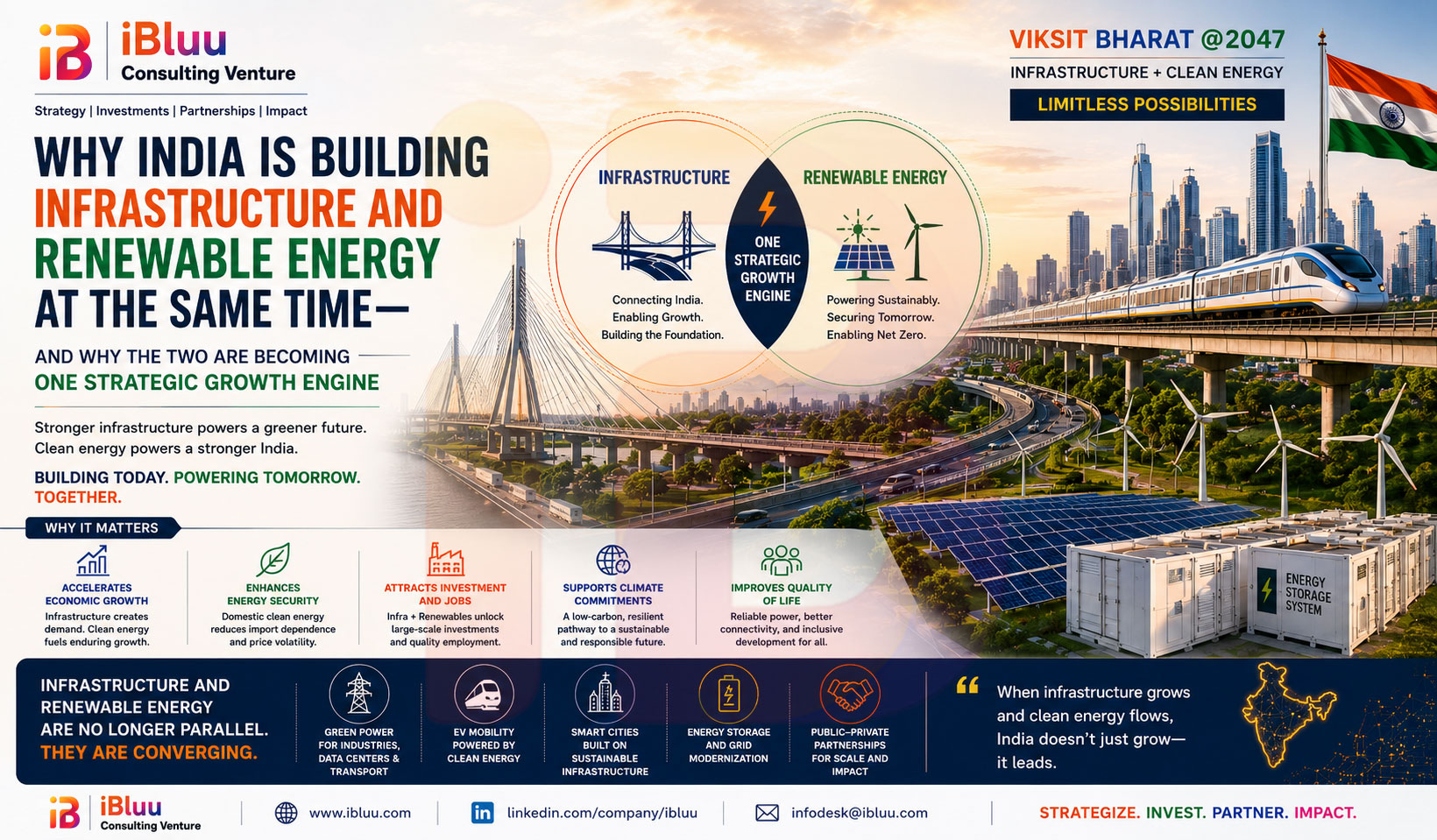
Why India Is Building Infrastructure and Renewable Energy at the Same Time — And Why the Two Are Becoming One Strategic Growth Engine
India’s infrastructure and renewable-energy push is not happening on two separate tracks. Together, they are creating the physical, digital and energy architecture required for the next phase of industrialisation, urbanisation and global competitiveness.
India is entering an unusual phase of economic development: it must expand the physical economy while simultaneously transforming the energy system that powers it.
That is why highways, railways, ports, airports, logistics corridors, industrial parks, cities, transmission networks, renewable-energy projects, battery storage and digital infrastructure are increasingly being planned as interconnected components of one larger economic system.
The underlying logic is straightforward:
Infrastructure creates economic capacity. Energy powers that capacity. Renewable energy increasingly determines whether that growth is affordable, secure and globally competitive.
This convergence is becoming particularly important as India confronts three simultaneous forces: rapidly rising electricity demand, accelerated industrialisation and the transition toward lower-carbon energy.
India’s electricity demand is forecast by the International Energy Agency (IEA) to grow at an average 6.4% annually through 2030, adding more than 570 TWh of annual consumption over the next five years. Industry, cooling, households, agriculture and transport electrification will all contribute to this expansion.
At the same time, India has already crossed 300.5 GW of non-fossil installed power capacity, including 164.6 GW of solar, as of 31 July 2026. Non-fossil sources now represent more than 54% of installed generation capacity.
The strategic implication is profound:
India cannot build the next economy without simultaneously building the energy system capable of sustaining it.
1. The Real Story: India Is Building Two Economies at Once
The conventional interpretation is that India is investing in infrastructure to accelerate economic growth while investing in renewable energy to meet climate objectives.
That interpretation is incomplete.
The infrastructure programme is about productive capacity.
The renewable-energy programme is increasingly about energy security, industrial competitiveness and economic resilience.
India’s public capital expenditure has risen from approximately ₹2 lakh crore in FY2014–15 to ₹12.2 lakh crore in FY2026–27. The Union government’s effective capital expenditure, including grants for creation of capital assets, is estimated at ₹17.15 lakh crore, equivalent to 4.4% of GDP.
This spending creates roads, railways, airports, urban infrastructure and other productive assets.
But every new industrial corridor needs electricity.
Every data centre needs electricity.
Every metro system needs electricity.
Every EV requires electricity.
Every semiconductor facility, manufacturing cluster, warehouse and modern hospital requires reliable power.
Infrastructure without energy becomes stranded capacity. Energy without infrastructure becomes stranded generation.
That is why the two investment cycles are converging.
2. India’s Next Growth Constraint Is Not Merely Roads or Power Plants — It Is System Capacity
India has historically focused on increasing generation capacity.
The next challenge is more sophisticated:
Can electricity be generated, transmitted, stored and delivered exactly where and when economic activity requires it?
This changes the infrastructure equation.
A solar plant in Rajasthan is not economically sufficient merely because it can generate inexpensive electricity.
India also needs:
- transmission corridors;
- substations;
- inter-state connectivity;
- intra-state networks;
- energy storage;
- grid-management systems;
- forecasting and balancing capabilities;
- distribution infrastructure;
- digital monitoring;
- flexible generation.
The government has planned transmission infrastructure capable of integrating more than 500 GW of non-fossil capacity by 2030 and more than 600 GW by 2032. Under the National Electricity Plan, the transmission network at 220 kV and above is projected to expand to 6.48 lakh circuit kilometres by 2031–32, while transformation capacity is expected to reach 2,345 GVA.
This is not a supporting activity around renewable energy.
Transmission itself is becoming strategic energy infrastructure.
3. Renewable Energy Is Becoming Industrial Infrastructure
India’s renewable-energy transition is moving beyond the traditional objective of adding clean generation.
It is becoming embedded in the country’s industrial strategy.
Solar and wind can reduce exposure to imported fossil-fuel price volatility. Domestic renewable generation can support long-term power procurement for industry. Green electricity can underpin green hydrogen, electric mobility, data centres and low-carbon manufacturing.
The scale of the transition is already visible.
India’s solar capacity has expanded from approximately 2.8 GW in March 2014 to 164.6 GW by July 2026. During FY2025–26 alone, India added a record 55.29 GW of non-fossil capacity, including approximately 44.6 GW of solar and 6 GW of wind.
The country’s 2030 target remains 500 GW of installed non-fossil capacity.
But the strategic objective is larger than the number.
It is about building an energy platform capable of supporting India’s next industrial cycle.
4. The Electricity Demand Shock Is Coming From Economic Modernisation
India’s future electricity requirement will not be driven by one sector.
It will come from the simultaneous expansion of multiple electricity-intensive activities.
Five structural demand engines
1. Industrialisation
Factories, manufacturing clusters, warehouses and processing facilities require reliable and increasingly high-quality power.
2. Urbanisation
Urban populations consume more electricity through cooling, buildings, transportation, water systems and digital services.
3. Electrification of transport
EVs transfer energy demand from petroleum infrastructure to the electricity system.
4. Digital infrastructure
Data centres, cloud infrastructure and AI computing are creating new concentrations of electricity demand.
5. Cooling
Rising incomes and increasing temperatures are making air-conditioning one of India’s most important electricity-demand drivers.
IEA estimates that cooling could account for more than 20% of India’s electricity-demand growth through 2030.
The consequence is clear:
India needs more electricity—but it also needs better electricity infrastructure.
5. Why Renewable Energy Alone Is Not Enough
This is where the infrastructure story becomes more sophisticated.
Solar generation is strongest during daylight hours.
Electricity demand does not follow the same curve.
Peak demand increasingly occurs when households, commercial establishments and industries require power after solar output begins declining.
Therefore, simply installing more solar capacity does not automatically create a fully flexible power system.
India increasingly requires an architecture combining:
Generation + Transmission + Storage + Digital Grid + Flexible Demand
Battery Energy Storage Systems (BESS), pumped-storage hydro, stronger transmission networks and advanced grid-management systems are therefore becoming essential complements to renewable generation.
India’s planning framework anticipates approximately 99 GW of BESS and 62 GW of pumped-storage capacity by 2034–35.
This is a major investment signal.
The future renewable-energy market will increasingly reward companies that can provide firm, dispatchable and grid-integrated clean power, rather than simply megawatts of intermittent generation.
6. The Green Energy Corridor Is the Missing Link
One of India’s most strategically important infrastructure programmes is therefore not a highway.
It is the electricity highway.
The Green Energy Corridor is designed to connect renewable-rich regions with demand centres.
Under the current programme, transmission systems are being developed to evacuate renewable power from major producing states.
Government data indicates that the Green Energy Corridor programme has sanctioned approximately 17,686 circuit kilometres of transmission lines and 47,177 MVA of substations for evacuation of 44 GW of renewable capacity; significant portions are already commissioned.
The logic is compelling:
Renewable generation creates supply. Transmission creates market access. Storage creates flexibility.
Without all three, the economics of large-scale renewable deployment weaken.
7. Infrastructure and Renewable Energy Are Creating a Reinforcing Investment Cycle
The relationship is not one-directional.
Infrastructure stimulates renewable-energy demand.
Renewable energy simultaneously creates demand for new infrastructure.
Consider the chain:
Industrial corridor → new factories → higher electricity demand → renewable procurement → transmission expansion → storage requirement → manufacturing investment → logistics demand → new infrastructure.
This creates a powerful multiplier.
A new renewable project generates demand for:
- modules;
- inverters;
- transformers;
- cables;
- batteries;
- substations;
- transmission;
- EPC services;
- financing;
- land;
- logistics;
- operations and maintenance.
Meanwhile, new industrial infrastructure creates long-term demand for electricity.
The two investment cycles reinforce each other.
8. India Is Moving From Project Infrastructure to Integrated Infrastructure
This is arguably the most important structural change.
The old model was:
Build a road.
Build a power plant.
Build an industrial park.
The emerging model is:
Design the economic ecosystem.
An industrial corridor increasingly needs:
Transport + Power + Renewable Energy + Storage + Water + Digital Connectivity + Logistics + Urban Infrastructure
Similarly, a modern city requires:
Mobility + Distributed Energy + EV Charging + Digital Infrastructure + Water + Waste Management + Cooling + Resilient Power
And a data-centre ecosystem requires:
Land + Grid Connectivity + Renewable Power + Storage + Fibre + Water + Cooling + Transmission + Reliability
This is why infrastructure and renewable energy are increasingly becoming inseparable from strategic planning.
9. The Investor Opportunity Is Moving Up the Value Chain
For investors, this convergence creates a broader opportunity set.
The opportunity is no longer limited to owning solar farms.
It increasingly includes:
| Investment Segment | Strategic Role |
|---|---|
| Solar PV | Low-cost renewable generation |
| Wind | Complementary generation profile |
| Hybrid RE | Better utilisation and generation diversity |
| BESS | Peak shifting and grid flexibility |
| Pumped Storage | Long-duration flexibility |
| Transmission | Renewable evacuation and grid expansion |
| Green Hydrogen | Industrial decarbonisation |
| EV Charging | Transport electrification |
| Renewable-powered Data Centres | Digital infrastructure |
| Industrial Green Power | Corporate decarbonisation |
| Energy-as-a-Service | Distributed energy solutions |
This creates opportunities across development, EPC, investment, infrastructure funds, technology, manufacturing and advisory services.
The strongest businesses may ultimately be those that connect several of these layers.
10. The Geopolitical Dimension: Energy Security Is Economic Security
India’s renewable push is also a strategic response to global energy volatility.
Imported fossil fuels expose economies to:
- commodity-price shocks;
- geopolitical disruptions;
- shipping constraints;
- foreign-exchange pressures;
- supply-chain instability.
Domestic renewable generation cannot eliminate all energy-import exposure.
But it can reduce structural vulnerability.
That matters increasingly in a world where energy security, industrial policy and geopolitical strategy are converging.
Renewable energy is therefore not simply an environmental asset. It is becoming a strategic economic asset.
11. Renewable Energy Is Also Becoming a Competitiveness Strategy
Global manufacturing increasingly faces pressure to reduce carbon intensity.
Multinational companies are increasingly evaluating:
- renewable electricity availability;
- carbon intensity;
- supply-chain resilience;
- grid reliability;
- green-power procurement;
- access to low-carbon industrial ecosystems.
India therefore has an opportunity to transform renewable energy from a climate programme into a competitive advantage for manufacturing and exports.
The country that can offer:
competitive power + reliable infrastructure + low-carbon electricity + skilled labour + logistics + market scale
will have a stronger proposition for global capital.
That is why India’s infrastructure and renewable-energy investments should be viewed through the lens of industrial competitiveness, not merely public expenditure.
12. The Data Centre, AI and Digital Economy Will Accelerate the Convergence
The next wave could be even more electricity-intensive.
AI infrastructure requires enormous computing capacity.
Data centres require reliable, high-quality power around the clock.
This creates a new investment equation:
AI → Data Centres → Electricity Demand → Renewable Power → Storage → Transmission → New Infrastructure
India’s ability to attract global digital infrastructure investment will therefore depend partly on whether it can provide sufficient reliable, scalable and increasingly low-carbon electricity.
The energy system is becoming part of the digital infrastructure proposition.
13. What Could Go Wrong? The Transition Has Real Risks
A strategic investment thesis must also confront the downside.
Grid congestion
Renewable generation can grow faster than transmission capacity.
Storage economics
Battery costs, degradation, replacement cycles and financing structures materially affect project returns.
Land and permitting
Large infrastructure projects can face delays involving land acquisition, environmental approvals and local stakeholder management.
DISCOM credit risk
Payment security remains important for renewable projects selling power to distribution companies.
Supply-chain dependence
Solar modules, batteries, critical minerals and power-electronics supply chains remain strategically important.
Financing costs
Infrastructure is capital intensive. Higher interest rates can materially affect project IRRs and tariffs.
Curtailment
Generation without adequate evacuation capacity can reduce asset utilisation.
Execution risk
India’s infrastructure ambitions require extraordinary coordination among central agencies, states, utilities, developers and private capital.
The answer is not to slow the transition.
It is to build better systems around it.
14. The Strategic Scorecard
India’s infrastructure–renewable convergence can be viewed through five strategic objectives:
| Objective | Infrastructure Requirement | Renewable/Energy Requirement |
|---|---|---|
| Industrial Growth | Corridors, logistics, urban infrastructure | Reliable competitive power |
| Energy Security | Transmission and grid | Domestic renewable generation |
| Decarbonisation | Electrified transport and cities | Solar, wind, storage |
| Digital Economy | Data centres and fibre | 24/7 reliable clean power |
| Global Competitiveness | Ports, roads, rail and industrial zones | Low-carbon industrial energy |
The conclusion is powerful:
India is not building infrastructure and renewable energy simultaneously by coincidence.
It is building them simultaneously because the economy increasingly requires both to function effectively.
15. The Next Phase: From Megawatts and Kilometres to Economic Systems
India has already demonstrated that it can build at scale.
The next challenge is to build intelligently at scale.
That means integrating:
Energy with industry.
Infrastructure with cities.
Renewables with storage.
Transport with electrification.
Digital infrastructure with clean power.
Capital with long-term economic outcomes.
The country’s renewable-energy expansion has already crossed a major threshold. With 300.5 GW of non-fossil capacity installed by July 2026, India has moved beyond the question of whether the transition can happen. The strategic question is now how efficiently the country can integrate that capacity into a rapidly expanding economy.
The IEA expects India’s electricity demand to continue expanding at 6.4% annually through 2030, while solar generation is forecast to grow at roughly 24% annually over the period.
That combination creates an extraordinary infrastructure investment runway.
The Larger Investment Thesis
The most important point is easy to miss.
India’s infrastructure boom and renewable-energy boom are not two independent investment themes.
They are becoming one.
The highway connects the industrial corridor.
The industrial corridor creates electricity demand.
The renewable plant supplies the electricity.
The transmission network moves it.
The battery stores it.
The EV consumes it.
The data centre demands it.
The smart city manages it.
And capital finances the entire ecosystem.
That is the architecture of India’s next economic cycle.
For investors, developers, EPC companies, technology providers and strategic partners, the opportunity therefore lies beyond individual projects.
It lies in understanding where infrastructure, energy, technology, industrialisation and capital intersect.
India’s next growth phase will not simply require more infrastructure.
It will require infrastructure that is energy-secure, digitally enabled, low-carbon, financially viable and strategically integrated.
That is why India is building infrastructure and renewable energy together.
Because the future economy cannot afford to build its physical foundation first and figure out its energy foundation later.
The two foundations must rise together.
A Strategic Perspective from J Parasher
The analytical lens of J Parasher, Founder and Managing Director of iBluu Consulting Venture (iBCV), a venture of iBluu Corporations, views India’s infrastructure and energy transition through the broader framework of national capability building, global industrial benchmarking and long-horizon economic transformation.
From this perspective, renewable energy is not merely another infrastructure vertical. It is becoming a strategic enabler of industrial competitiveness, energy resilience, investment attraction and India’s positioning within the global economy.
The larger opportunity is therefore not simply to build more assets.
It is to build an interconnected economic system in which infrastructure, energy, technology and capital reinforce one another.
That is where India’s next competitive advantage could emerge.
India is not merely building the infrastructure for growth. It is building the infrastructure of its next economic identity.
Disclaimer: This article is intended for strategic and informational purposes only and does not constitute investment, financial, legal, tax or project-specific advice. Infrastructure and renewable-energy projects are subject to regulatory, commercial, financing, execution, technology, grid, land and market risks. Investors and project participants should undertake independent due diligence before making investment or commercial decisions.