+91 945 889 6091
  infodesk@ibluu.com
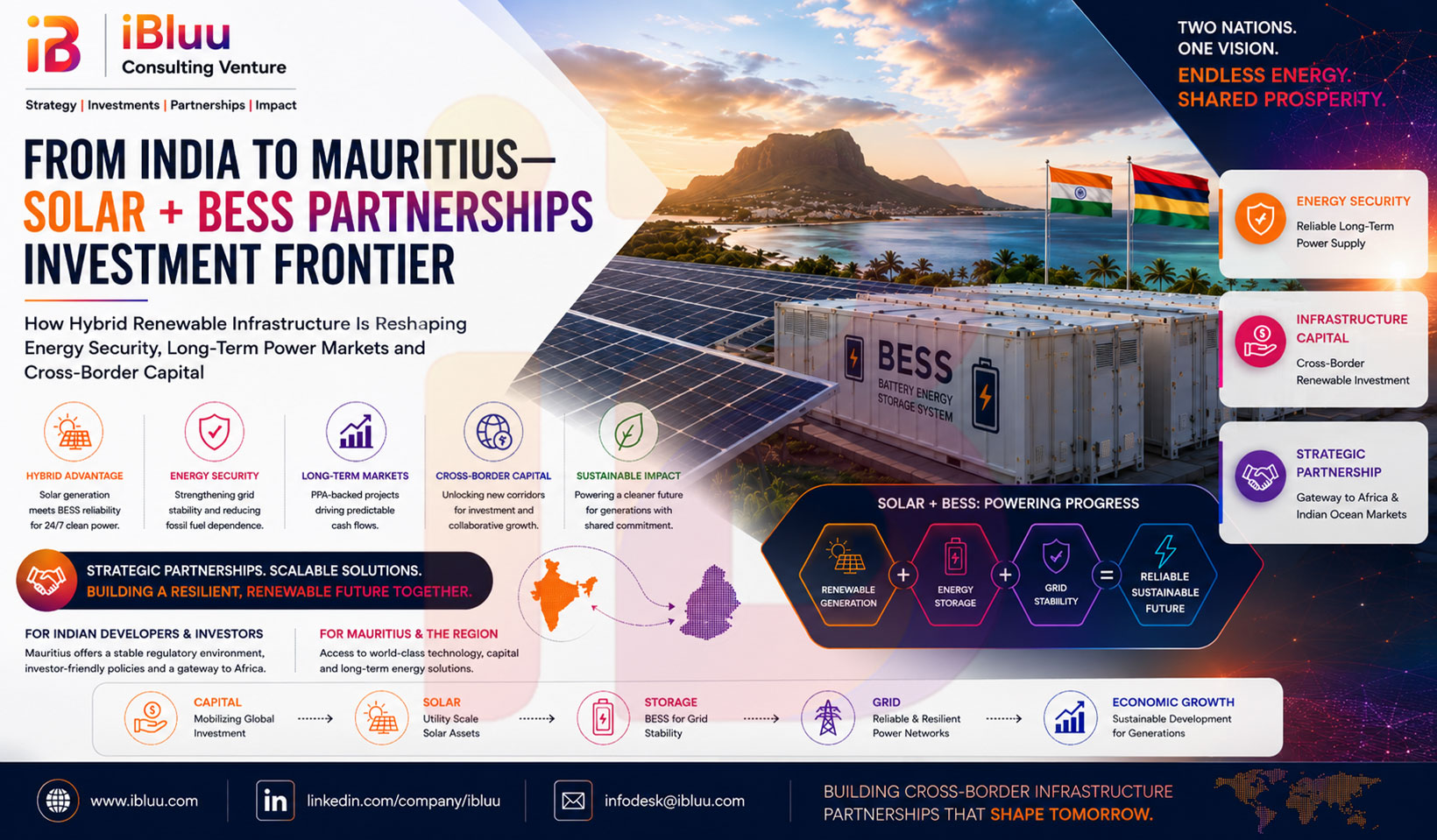
The Strategic Rise of Solar + BESS PPA Projects in Mauritius: A Strategic Investment Gateway for Indian Developers, Infrastructure Capital and Global Energy Partnerships
From Standalone Solar Assets to Bankable, Dispatchable Renewable-Energy Infrastructure
Mauritius is entering a more consequential phase of its energy transition.
For years, solar development in island economies was primarily viewed through a simple lens: replace imported fossil-fuel generation with domestic renewable electricity. That equation is now changing. As solar penetration increases, the strategic challenge is no longer limited to generating more clean power. The larger challenge is determining when renewable electricity is delivered, how reliably it can be dispatched and whether the electricity system can absorb a growing share of variable generation without compromising grid stability.
This is where Solar PV + Battery Energy Storage Systems (BESS) are becoming increasingly important.
Mauritius is gradually developing a broader hybrid-energy ecosystem comprising utility-scale solar projects, solar-plus-storage facilities, distributed-generation programmes, rooftop solar schemes, grid-scale battery investments and new renewable-energy procurement initiatives. The market is therefore evolving beyond individual projects and toward an integrated energy architecture in which solar generation, storage, grid flexibility and long-term power-purchase arrangements operate as interconnected components.
For Indian renewable-energy developers, investors, EPC companies, battery suppliers, engineering firms and infrastructure advisers, Mauritius represents more than a small overseas solar market. It may become a strategically relevant platform for demonstrating how India’s renewable-energy capabilities can be exported into island economies and other emerging markets.
The opportunity, however, must be assessed with discipline.
Mauritius offers a relatively stable institutional environment, strong renewable-energy ambitions, a government-owned electricity utility, long-term procurement mechanisms and close economic links with India. At the same time, the market has structural limitations: restricted land availability, island logistics, dependence on imported equipment, exposure to extreme weather, a relatively small electricity system and potential currency mismatches between project revenues, capital expenditure and financing obligations.
The investment question is therefore not:
“Is Mauritius large enough to justify international participation?”
The more strategic question is:
“Can Mauritius provide a bankable and scalable entry point into the next generation of hybrid renewable-energy markets?”
The answer may be yes—but only for participants that understand the difference between building a solar plant and developing a long-term, dispatchable energy business.
Executive Summary
Mauritius has established ambitious renewable-energy objectives and is expanding the role of solar power, battery storage and distributed renewable generation in its electricity system. The country’s energy transition is driven by several structural priorities:
- Reducing dependence on imported fossil fuels;
- Strengthening national energy security;
- Increasing renewable electricity generation;
- Managing rising electricity demand;
- Improving grid flexibility;
- Supporting long-term decarbonisation;
- Reducing exposure to global fuel-price volatility.
Mauritius has articulated a target of increasing renewable energy’s share of the electricity mix to 60% by 2030, while its national energy strategy continues to place greater emphasis on solar generation, energy storage, grid modernisation and distributed-energy systems. The country’s Renewable Energy Roadmap 2030 provides the strategic framework for expanding renewable capacity across multiple technologies and project models.
The market should not be viewed as one project or one procurement opportunity. It includes several interconnected segments:
| Mauritius Renewable-Energy Segment | Primary Development Model | Strategic Relevance |
|---|---|---|
| Utility-scale solar PV | EPC, IPP and long-term energy-sale arrangements | Large-scale renewable generation |
| Solar PV + BESS hybrid projects | PPA/IPP and competitive procurement | Firm and dispatchable renewable energy |
| Grid-scale BESS | Utility-led procurement and EPC | Grid stability and renewable integration |
| Distributed commercial solar | Private investment and energy-supply arrangements | Lower-cost electricity and corporate decarbonisation |
| Rooftop solar | Net-metering, self-consumption and public schemes | Consumer participation and distributed generation |
| Public-sector solar | Government-supported EPC and energy-supply models | Public-sector decarbonisation |
| Small-scale renewable projects | Scheme-based development | Local energy participation |
| Future hybrid-energy programmes | Competitive procurement and PPP-oriented structures | Long-term market expansion |
Mauritius’ opportunity is therefore best understood as a renewable-energy ecosystem, not as a single tender.
The emergence of Solar + BESS is particularly important because storage changes the commercial character of solar power. A conventional solar project produces electricity when sunlight is available. A hybrid project can store part of that energy and deliver it during periods defined by grid requirements or contractual obligations.
This creates a shift:
Solar produces renewable electricity. Solar + BESS produces renewable electricity with greater control over timing, reliability and dispatch.
For developers, the transition creates new revenue opportunities—but also introduces new technical, financial and contractual risks.
1. Mauritius’ Renewable-Energy Transition: Why Solar + BESS Is Becoming Strategic
Mauritius is an island economy with limited domestic fossil-fuel resources. A significant dependence on imported energy exposes the country to international commodity prices, shipping disruptions, foreign-exchange pressures and geopolitical uncertainty.
Renewable energy can reduce this exposure.
Solar power is particularly attractive because it can be deployed across utility-scale facilities, commercial properties, public infrastructure and residential rooftops. However, higher solar penetration creates operational challenges.
Solar generation is concentrated during daylight hours. Electricity demand does not necessarily follow the same pattern. Demand may remain elevated during evening periods when solar output declines.
Without adequate flexibility, a grid with increasing solar capacity may face:
- Rapid changes in generation;
- Greater balancing requirements;
- Renewable-energy curtailment;
- Frequency-management challenges;
- Evening supply constraints;
- Higher dependence on conventional generation after sunset.
Battery storage can help address these challenges.
A BESS can absorb electricity during periods of high renewable production and release electricity when the system requires additional supply. It can also provide fast-response grid services, depending on technical design and market rules.
For Mauritius, storage is therefore not merely an additional technology. It is an infrastructure tool capable of supporting a larger renewable-energy system.
The strategic transition is not from fossil fuels to solar. It is from inflexible electricity infrastructure to intelligent, flexible and increasingly dispatchable clean-energy systems.
2. Mauritius Solar + BESS Business Model Explained
A conventional solar project generally follows a straightforward value chain:
Solar resource → PV generation → Grid delivery or on-site consumption → Electricity revenue
A Solar + BESS project introduces an additional layer:
Solar resource → PV generation → Battery charging → Controlled storage → Scheduled discharge → Contracted electricity revenue
The battery does not generate electricity. It changes the timing and operational value of electricity.
This distinction has major commercial consequences.
In a solar-only project, the principal investment variables include:
- Solar irradiation;
- Installed capacity;
- Plant generation;
- Performance ratio;
- Curtailment;
- Tariff;
- Plant availability;
- Operations and maintenance costs.
In a Solar + BESS project, investors must additionally evaluate:
- Battery power capacity in MW;
- Battery energy capacity in MWh;
- Storage duration;
- Charging and discharge profile;
- Round-trip efficiency;
- Annual cycling;
- Depth of discharge;
- Battery degradation;
- State-of-charge management;
- Capacity augmentation;
- Battery replacement;
- Dispatch obligations;
- Availability guarantees;
- Performance warranties.
The hybrid project is therefore a more complex infrastructure asset.
Its value is determined not only by how much electricity it generates, but by when electricity is delivered, how consistently it meets contractual obligations and how efficiently the battery performs over its operating life.
3. PPA, IPP and EPC Models: Understanding the Commercial Structure
Mauritius’ renewable-energy market can involve different commercial models. Developers should distinguish carefully between them.
3.1 Long-term PPA or IPP model
Under an Independent Power Producer model, the developer generally:
- Develops the project;
- Secures land and permits, depending on contractual allocation;
- Arranges project financing;
- Constructs or appoints an EPC contractor;
- Owns or operates the asset;
- Sells electricity under a long-term energy-sale agreement or PPA.
The PPA may provide long-term revenue visibility, but its bankability depends on the detailed allocation of risks.
Key questions include:
- Is the tariff fixed or indexed?
- Is payment made for delivered energy, available capacity or both?
- Is the arrangement take-or-pay?
- Who bears curtailment risk?
- Are battery dispatch requirements clearly defined?
- What happens if the grid cannot accept electricity?
- Is there payment security?
- Are change-in-law protections available?
- What is the termination-compensation framework?
3.2 EPC model
Under an EPC structure, the contractor generally:
- Designs the project;
- Procures equipment;
- Constructs and commissions the facility;
- Delivers the project to the asset owner.
The EPC contractor may earn revenue through construction payments rather than long-term electricity sales.
EPC participation can provide:
- Lower long-term market exposure;
- Defined construction revenue;
- Potentially faster capital recycling.
However, EPC contracts can expose contractors to:
- Fixed-price risk;
- Construction delays;
- Supply-chain volatility;
- Performance guarantees;
- Liquidated damages;
- Warranty obligations.
3.3 Hybrid commercial structures
Some projects may combine elements of:
- EPC;
- Long-term operations and maintenance;
- Developer ownership;
- Utility procurement;
- Government-supported financing;
- Private investment;
- Strategic partnerships.
The appropriate model depends on the investor’s risk appetite, financing capacity, technical expertise and long-term strategic objectives.
4. Potential Revenue Streams in Mauritius Solar + BESS Projects
The revenue structure of a hybrid project should be derived from the applicable contract—not assumed from international storage markets.
Potential revenue sources may include the following.
4.1 Contracted electricity revenue
This is likely to remain the primary source of income for utility-scale PPA projects.
Revenue may depend on:
- Contracted tariff;
- Energy delivered;
- Contracted availability;
- Scheduled delivery;
- Plant performance;
- PPA tenure;
- Payment terms.
Long-term contracted revenue can support project financing if the PPA is considered sufficiently bankable.
4.2 Firm or dispatchable renewable-energy value
Battery storage may allow solar energy to be delivered during specified periods rather than only during daylight hours.
This can increase the strategic value of renewable electricity because the project becomes more responsive to grid requirements.
4.3 Peak-period electricity value
Where tariffs or contractual obligations recognise time-of-delivery value, storage can enable the project to shift renewable electricity toward higher-demand periods.
However, investors should not assume time-of-use revenue unless it is expressly incorporated into the commercial framework.
4.4 Capacity or availability payments
Certain hybrid structures may compensate projects for maintaining contracted capacity or availability.
The availability framework must be examined carefully because battery degradation may affect long-term compliance.
4.5 Grid-support services
Depending on future market rules, BESS may provide:
- Frequency response;
- Voltage support;
- Fast reserve;
- Ramp-rate control;
- Grid balancing;
- Renewable-energy smoothing.
These services should be treated as potential upside unless a clear contractual payment mechanism exists.
4.6 Environmental attributes
Renewable-energy certificates, carbon credits or related environmental attributes may provide additional value if recognised under the relevant legal and contractual framework.
The ownership of such attributes must be explicitly verified.
Investment principle
A project should be financially viable on contracted and bankable revenue. Future ancillary services, carbon value and merchant upside should strengthen the investment case—not rescue it.
5. Battery Storage Economics: Where the Investment Case Can Be Won or Lost
Battery storage is one of the most important variables in hybrid-project economics.
A battery’s initial purchase price is only one component of its lifecycle cost.
The complete economic assessment should include:
| Battery-Economic Variable | Strategic Impact |
|---|---|
| Battery power rating | Determines maximum charge and discharge capability |
| Battery energy capacity | Determines usable storage volume |
| Storage duration | Determines how long the system can support delivery |
| Round-trip efficiency | Influences net energy available after storage losses |
| Cycle life | Influences long-term operating capability |
| Annual cycles | Determines the rate of utilisation and degradation |
| Depth of discharge | Affects usable capacity and battery life |
| Capacity degradation | Reduces available energy over time |
| Augmentation requirements | May require additional capital during operations |
| Replacement obligations | May create major lifecycle expenditure |
| Thermal-management systems | Affect performance and operating cost |
| Warranty structure | Determines allocation of performance risk |
| Safety systems | Affect capital cost, compliance and insurability |
The financial model should not assume that the battery will maintain its initial capacity throughout the entire PPA period.
A robust model should incorporate:
- Annual degradation;
- Guaranteed capacity;
- Battery augmentation;
- Replacement scenarios;
- Efficiency losses;
- Availability assumptions;
- Warranty coverage;
- End-of-life obligations.
For island projects, logistics and replacement planning may be particularly important because major battery components may need to be imported.
6. Currency Analysis: MUR vs INR and the Foreign-Exchange Challenge
Currency exposure is one of the most important considerations for Indian investors.
Mauritian project revenue may be denominated in Mauritian rupees (MUR), while Indian investors may evaluate returns in Indian rupees (INR). Project costs may also be linked to other currencies.
A typical hybrid project may have multiple currency exposures:
| Project Component | Potential Currency Exposure |
|---|---|
| PPA revenue | MUR |
| Local construction expenditure | MUR |
| Indian engineering and management costs | INR |
| Solar modules | USD or other international currencies |
| Battery systems | USD or other international currencies |
| Inverters and electrical equipment | USD, EUR, CNY or other currencies |
| International debt | USD, EUR or another financing currency |
| Equity returns | MUR, INR or investor reporting currency |
This creates a potential mismatch.
For example:
- Revenue may be received in MUR;
- Imported equipment may be paid in USD;
- Indian investors may measure returns in INR;
- Debt may be denominated in another currency.
A project may therefore perform according to its local operating assumptions but produce lower equity returns after currency conversion.
The investment model should test multiple scenarios:
Base case
Expected MUR revenue, operating costs and exchange-rate assumptions.
Moderate depreciation case
A gradual decline in the value of MUR against the investor’s reporting currency.
Stress case
Higher depreciation combined with increased imported-equipment costs or higher debt-service obligations.
Severe downside case
Currency pressure combined with delayed payments, higher interest rates and battery augmentation costs.
Investors should evaluate:
- Natural hedging;
- Currency-matching strategies;
- Forward contracts;
- Debt-denomination choices;
- Tariff-indexation provisions;
- Foreign-exchange reserves;
- Dividend-repatriation requirements.
Currency risk is not a secondary financial adjustment. In cross-border infrastructure, it can materially alter project-level equity returns.
7. Taxation and Investment Considerations
Tax analysis must be conducted using current Mauritian law, applicable investment treaties and the investor’s home-country regulations.
Key areas requiring specialist review include:
- Corporate income tax;
- Withholding taxes;
- Dividend taxation;
- Interest payments;
- Royalty payments;
- Capital-gains treatment;
- Value-added tax;
- Customs duties;
- Import taxes;
- Tax incentives;
- Depreciation allowances;
- Loss carry-forward provisions;
- Transfer-pricing requirements;
- Permanent-establishment considerations;
- Repatriation of profits.
Indian investors should also assess the interaction between Mauritian taxation and Indian tax obligations.
The analysis may involve:
- India–Mauritius tax arrangements;
- Applicable treaty provisions;
- Foreign-tax credits;
- Controlled foreign-company considerations;
- Transfer pricing;
- Financing structures;
- Holding-company arrangements.
Tax structuring should not be treated as an afterthought.
The legal structure of the project company, financing entity and investor holding company can influence:
- Net equity returns;
- Cash available for distribution;
- Financing efficiency;
- Tax leakage;
- Exit value.
Investors should obtain jurisdiction-specific legal and tax advice before committing capital.
8. Indian Case Studies: Lessons from Solar + BESS and Hybrid Development
India has rapidly expanded its experience in renewable-energy procurement, solar-plus-storage integration and hybrid-energy development.
Indian experience is particularly relevant because the country has moved from conventional solar procurement toward increasingly sophisticated models involving:
- Solar + BESS;
- Wind-solar hybrid projects;
- Firm and dispatchable renewable energy;
- Round-the-clock renewable supply;
- Peak-power procurement;
- Storage-linked tenders;
- Large-scale renewable-energy parks.
Lessons from SECI
The Solar Energy Corporation of India has played a major role in developing competitive procurement frameworks for renewable-energy projects.
Important lessons include:
Contract design determines bankability
A technically strong project may still struggle to secure financing if the PPA does not clearly allocate:
- Curtailment risk;
- Payment risk;
- Change-in-law risk;
- Force-majeure risk;
- Grid-availability risk.
Storage must be linked to a defined commercial purpose
Battery capacity should be designed around:
- Dispatch requirements;
- Contracted delivery periods;
- Grid needs;
- Revenue structure.
Oversizing storage without a clear commercial benefit can weaken returns.
Competitive tariffs require disciplined cost assumptions
Aggressive bidding can create long-term financial pressure if developers underestimate:
- Battery replacement;
- Financing costs;
- Degradation;
- O&M;
- Grid charges.
Lessons from NTPC
NTPC’s renewable-energy expansion provides important insights into the role of scale, integration and institutional capability.
Key lessons include:
- Large portfolios can improve procurement leverage;
- Centralised technical expertise can reduce execution risk;
- Hybrid projects require strong coordination between generation, storage and grid operations;
- Long-term portfolio strategy may be more valuable than isolated project returns.
For Mauritius, Indian developers may benefit from applying portfolio-level thinking rather than viewing each project only as an individual asset.
Lessons from NHPC
NHPC’s experience in large infrastructure and renewable-energy development highlights the importance of:
- Long-term project planning;
- Government engagement;
- Infrastructure coordination;
- Grid integration;
- Environmental and regulatory diligence.
The broader lesson is that renewable-energy projects are not only generation assets. They are infrastructure systems that depend on land, transmission, permitting, financing and institutional coordination.
9. Mauritius vs India: Strategic Comparison
| Parameter | Mauritius | India |
|---|---|---|
| Electricity-market size | Relatively small | Very large |
| Renewable-energy opportunity | Emerging and strategically focused | Large and rapidly expanding |
| Solar-development competition | Potentially more selective | Highly competitive |
| Land availability | Limited | Varies significantly by region |
| Grid scale | Smaller island grid | Large and interconnected grid |
| Solar + BESS maturity | Emerging | Rapidly expanding |
| Project procurement | Utility and government-led | Central, state and private procurement |
| Currency | MUR | INR |
| Imported-equipment dependence | High | Declining but still significant |
| International diversification value | High for Indian participants | Domestic market |
| Long-term strategic role | Regional and island-market gateway | Core domestic growth market |
Mauritius cannot compete with India on market size.
Its strategic value lies elsewhere:
- International diversification;
- Long-term utility relationships;
- Hybrid-energy experience;
- Indian Ocean market access;
- Potential replication across other island economies;
- Opportunity to establish early cross-border capabilities.
10. Key Investment Benefits
Mauritius Solar + BESS projects may offer several potential benefits.
Long-term revenue visibility
Bankable PPA structures may provide predictable revenue over extended periods.
Energy-security relevance
Projects support national efforts to reduce imported-fuel dependence.
International diversification
Indian developers can reduce exclusive dependence on domestic procurement cycles.
Government and utility participation
Public-sector involvement may strengthen institutional credibility, subject to contractual protections.
Growing demand for storage
Increasing renewable penetration may create additional demand for flexible energy infrastructure.
Strategic regional positioning
Mauritius may provide a platform for expansion into other island and regional markets.
Export of Indian capabilities
Indian companies can leverage:
- Solar EPC expertise;
- Competitive procurement;
- Engineering capability;
- Renewable-energy financing;
- Battery integration;
- Project-development experience;
- Operations and maintenance expertise.
11. Key Risks and Challenges
A credible investment assessment must be balanced.
Land constraints
Mauritius has limited land availability. Land acquisition, leasing, environmental approvals and competing land uses may affect project timelines.
Island logistics
Large equipment may require:
- Maritime transportation;
- Port handling;
- Specialised storage;
- Inland logistics;
- Contingency planning.
Weather and climate exposure
Projects may face risks associated with:
- Cyclones;
- High winds;
- Heavy rainfall;
- Flooding;
- Salt corrosion;
- Coastal exposure.
Engineering and insurance requirements must reflect these conditions.
Battery degradation
Battery performance may decline over time. Financial models must include realistic degradation and augmentation assumptions.
Technology risk
Battery technology is evolving rapidly. Investors must balance the benefits of proven systems against future technology improvements.
Currency risk
MUR exposure may affect equity returns when measured in INR or other currencies.
Financing risk
Interest rates, debt tenor, currency and lender requirements can materially influence project economics.
Grid and curtailment risk
The project’s ability to deliver contracted energy depends on grid availability and contractual treatment of curtailment.
Regulatory change
Long-term projects require protection against material changes in law, taxation and market rules.
12. Global Outlook: The Hybrid Renewable-Energy Market Is Entering a New Phase
The global renewable-energy industry is moving beyond the era in which solar capacity alone defined market leadership.
The next phase will be shaped by:
- Dispatchable renewable energy;
- Long-duration storage;
- Grid flexibility;
- Digital energy management;
- Hybrid generation;
- Renewable-energy firming;
- Smart-grid integration;
- Energy-system resilience.
Solar + BESS is becoming increasingly relevant because electricity systems require flexibility as variable renewable generation expands.
The global market is shifting from:
“How many renewable megawatts can be installed?”
to:
“How much reliable, flexible and low-carbon electricity can be delivered when the system needs it?”
This transition creates new opportunities for developers capable of integrating:
- Generation;
- Storage;
- Grid services;
- Digital controls;
- Long-term contracts;
- Infrastructure finance.
Mauritius can become a relevant demonstration market because island electricity systems experience the effects of fuel dependence, grid constraints and renewable intermittency more directly than many large continental markets.
13. Strategic Recommendations for Indian Developers and Investors
Indian companies should evaluate Mauritius through a structured investment framework.
Recommendation 1: Evaluate the market, not only individual tenders
The long-term opportunity may include:
- Utility-scale projects;
- Distributed solar;
- Battery-storage procurement;
- Commercial energy solutions;
- EPC contracts;
- O&M services;
- Technology partnerships.
Recommendation 2: Build local partnerships
Local partners may support:
- Land identification;
- Regulatory engagement;
- Permitting;
- Community relationships;
- Local contracting;
- Operations.
Recommendation 3: Match project structure to risk appetite
Developers should decide whether to participate as:
- IPP;
- EPC contractor;
- Technology provider;
- Battery supplier;
- O&M provider;
- Equity investor;
- Consortium partner.
Recommendation 4: Model battery lifecycle costs conservatively
Do not rely on optimistic assumptions regarding:
- Degradation;
- Efficiency;
- Replacement;
- Warranty recovery.
Recommendation 5: Conduct integrated currency modelling
Currency analysis should be incorporated into the core financial model—not added after the project economics have been calculated.
Recommendation 6: Treat contract quality as a core investment variable
The PPA, energy-supply agreement, implementation agreement and grid agreement may be more important to project value than headline capacity.
Recommendation 7: Develop a regional strategy
Mauritius may be more valuable as a gateway to broader island and regional renewable-energy markets than as a standalone market.
14. The Role of iBCV in Mauritius Solar + BESS Opportunities
iBCV—iBluu Consulting Venture Private Limited, a venture of iBluu Corporations—can support developers, investors, technology companies and strategic partners across the renewable-energy investment lifecycle.
The role extends beyond conventional project consulting.
Potential advisory support includes:
- Mauritius renewable-market assessment;
- Opportunity identification;
- Strategic feasibility analysis;
- Project and investment screening;
- PPA and commercial-structure review;
- Bid qualification assessment;
- Consortium formation;
- Joint-venture structuring;
- Strategic partnership development;
- Cross-border investor engagement;
- Financial-model coordination;
- Project-structuring support;
- EPC and technology-partner identification;
- Commercial due diligence;
- Investment advisory;
- Mergers and acquisitions support;
- Government-engagement strategy;
- Strategic government relations advisory;
- International alliance development;
- Digital and IT consulting support;
- Market-entry strategy;
- Transaction and partnership facilitation.
The analytical perspective reflected in this article is shaped by the strategic lens of J Parasher, Founder and Managing Director of iBluu Consulting Venture (iBCV), a venture of iBluu Corporations, whose work focuses on national capability building, global industrial benchmarking and long-horizon economic transformation.
This perspective views renewable energy not merely as an infrastructure sector, but as an interconnected economic system involving:
- Energy security;
- Industrial capability;
- International investment;
- Technology partnerships;
- Infrastructure finance;
- Geopolitical resilience;
- Cross-border economic cooperation.
The next generation of renewable-energy leadership will not be defined only by who owns the most megawatts. It will be defined by who can connect capital, technology, policy, infrastructure and international partnerships into scalable energy systems.
15. Frequently Asked Questions
1. What are Mauritius Solar + BESS PPA projects?
They are renewable-energy projects that combine solar photovoltaic generation with battery-energy storage and sell electricity under long-term contractual arrangements.
2. Are all Mauritius solar projects combined with battery storage?
No. Mauritius has conventional solar projects, rooftop solar systems, distributed-generation projects and hybrid solar-plus-storage initiatives. Storage is becoming more important as renewable penetration increases.
3. Why is BESS important for Mauritius?
BESS can help manage solar variability, support grid stability, shift energy across time periods and reduce dependence on conventional generation during peak-demand periods.
4. Can Indian companies participate in Mauritius renewable projects?
Participation depends on the eligibility requirements of each procurement, applicable laws and the commercial structure. Indian companies may participate as developers, investors, EPC contractors, technology suppliers, consortium partners or advisers.
5. Is Mauritius attractive for Indian renewable investors?
Mauritius may offer strategic advantages, including international diversification, institutional stability and long-term renewable-energy growth. However, each opportunity must be evaluated for tariff, currency, taxation, land, grid and financing risks.
6. What is the difference between an EPC project and a PPA project?
Under EPC, the contractor primarily designs and builds the asset. Under a PPA or IPP model, the developer may own and operate the asset and earn long-term electricity revenue.
7. What are the main risks in Solar + BESS projects?
Major risks include battery degradation, currency exposure, imported-equipment costs, land constraints, weather exposure, grid risk, financing conditions and regulatory change.
8. How should battery replacement be treated?
Battery augmentation and replacement should be modelled as lifecycle capital expenditure where required. Investors should not assume that initial battery capacity will remain unchanged throughout the PPA period.
9. Can BESS generate separate revenue?
Potentially, but only if the applicable market rules or project contracts provide compensation for services such as capacity, frequency response or grid support.
10. Is Mauritius a large renewable-energy market?
Mauritius is relatively small compared with India. Its strategic value may lie in its role as an international diversification market, hybrid-energy demonstration platform and potential gateway to other island economies.
Conclusion: Mauritius Is Not Only Building Solar Projects—It Is Building a More Flexible Energy System
Mauritius’ renewable-energy opportunity should not be reduced to a list of solar projects or individual procurement notices.
The market is moving toward a broader energy transition involving:
- Utility-scale solar;
- Distributed renewable generation;
- Long-term PPA structures;
- Battery storage;
- Grid modernisation;
- Energy security;
- International investment;
- Hybrid-energy infrastructure.
For Indian developers and investors, this evolution creates a potentially valuable opportunity to export capabilities developed in one of the world’s largest and most competitive renewable-energy markets.
However, success will require more than technical capability.
Developers must understand:
- Long-term PPA economics;
- Battery lifecycle risk;
- Currency exposure;
- Tax structuring;
- Island logistics;
- Grid integration;
- Local partnerships;
- International financing;
- Regulatory engagement.
The strongest participants will not treat Mauritius as a small overseas solar market.
They will view it as a strategic test case for the future of renewable-energy infrastructure.
Because the global energy transition is no longer defined only by the capacity of clean generation.
It is increasingly defined by the ability to deliver clean electricity reliably, flexibly and when the grid needs it most.
Mauritius’ Solar + BESS ecosystem may therefore represent something larger than a series of renewable projects.
It may represent an emerging model for how island economies can combine energy security, decarbonisation, infrastructure resilience and international investment—and how Indian renewable-energy companies can convert domestic scale into global energy leadership.
Disclaimer: This article is intended solely for general information, strategic discussion and market-analysis purposes. It does not constitute investment advice, legal advice, tax advice, financial advice, technical certification, an offer to invest or a recommendation to participate in any project, tender or transaction. Project capacity, procurement status, commercial structures, regulatory requirements, tariffs, taxation, currency conditions and market information may change. Readers should verify all information through current official government, utility, regulatory and procurement documents and obtain independent legal, tax, financial, technical and investment advice before making any business or investment decision.The views expressed are analytical and strategic in nature and do not guarantee project availability, investment returns, financial performance, regulatory approval or commercial outcomes.