+91 945 889 6091
  infodesk@ibluu.com
The New Strategic Alliance: How Artificial Intelligence, Data Centers, Solar Infrastructure and Foreign Collaborations Are Creating the Next Global Economy
The first industrial revolution was built on steam.
The second was built on oil and electricity.
The third was built on semiconductors and the internet.
The fourth is being built on artificial intelligence.
Yet beneath every AI breakthrough lies an often-overlooked reality:
Artificial intelligence does not run on algorithms alone.
Artificial intelligence runs on electricity.
And increasingly, it runs on renewable electricity delivered through globally interconnected infrastructure ecosystems.
This is creating one of the most powerful industrial convergence stories of the twenty-first century:
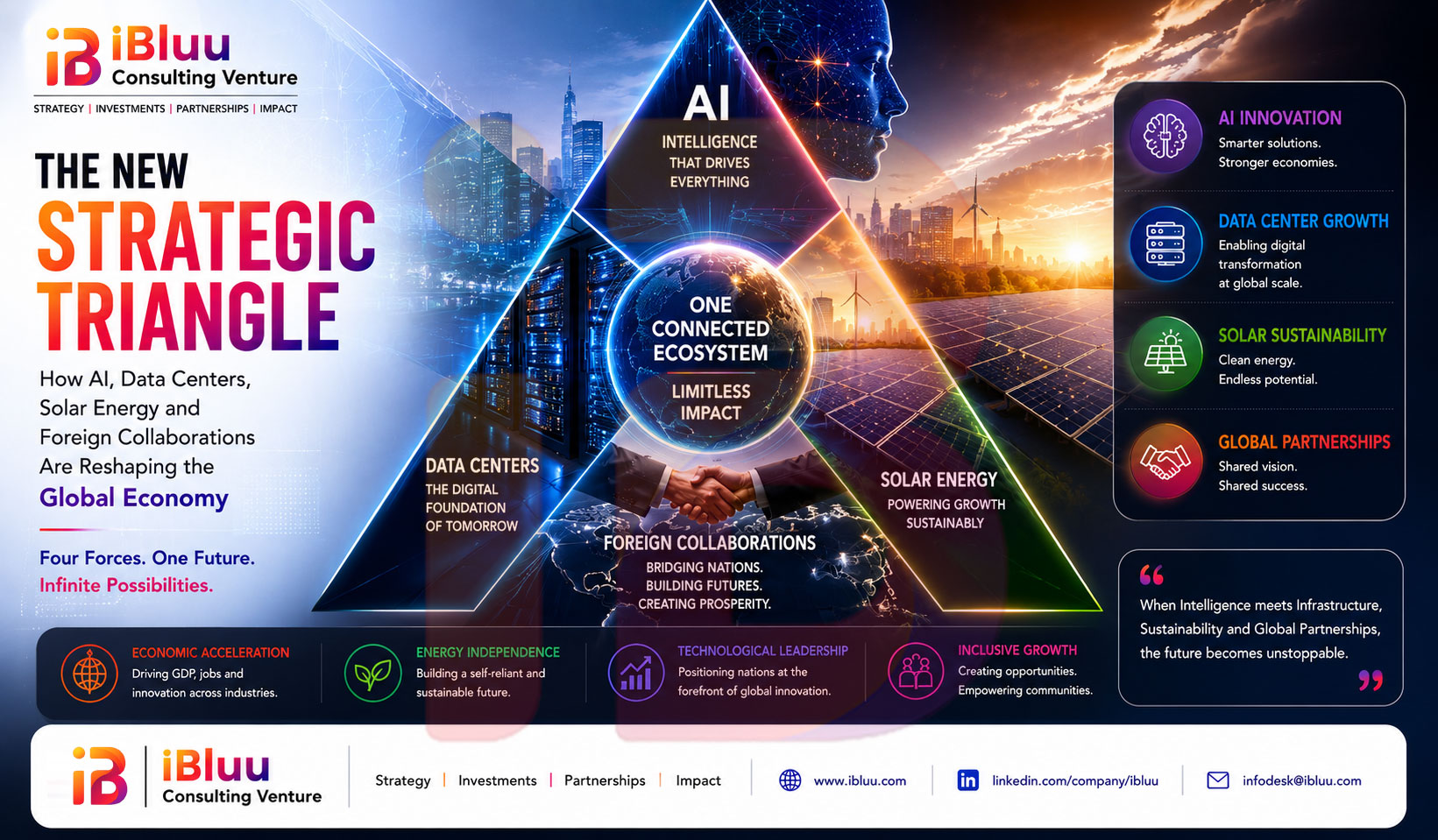
AI, Data Centers, Solar Energy, and Foreign Strategic Collaborations.
These four sectors are no longer separate industries.
They are becoming one integrated economic system.
AI Is Creating an Unprecedented Global Demand for Compute Infrastructure
Artificial intelligence has fundamentally altered the economics of digital infrastructure.
Training frontier AI models, operating inference engines, running autonomous systems, powering industrial digital twins, and enabling next-generation analytics require enormous computational resources.
Every AI model ultimately consumes three inputs:
- Compute
- Electricity
- Connectivity
Without any one of these, AI cannot scale.
This is why global hyperscalers are investing hundreds of billions of dollars into AI-ready infrastructure.
The race for artificial intelligence is increasingly becoming a race for compute capacity.
The race for compute capacity is becoming a race for electricity availability.
The AI Infrastructure Equation
| AI Input | Strategic Infrastructure Requirement |
|---|---|
| Compute | Data Centers |
| Electricity | Solar, Wind, Storage and Grid Infrastructure |
| Connectivity | Fiber Networks and Submarine Cables |
| Capital | Domestic and Foreign Investment |
| Technology | International Partnerships and Knowledge Transfer |
The future AI economy is therefore not a software ecosystem.
It is an infrastructure ecosystem.
Data Centers Are Becoming the Factories of Intelligence
Historically, factories converted raw materials into manufactured goods.
Modern data centers convert electricity into intelligence.
This makes them one of the most strategically important infrastructure assets of the AI century.
Global data center electricity demand is expected to increase dramatically by 2030 as AI workloads proliferate across industries.
High-density GPU clusters consume several times more power than traditional cloud infrastructure.
In some cases, next-generation AI campuses are expected to require gigawatts of dedicated power capacity.
The implication is clear:
The future winners in AI may not necessarily be those who write the best algorithms.
They may be those who secure the most reliable and cost-effective electricity.
Solar Energy Is Becoming a Strategic AI Asset
For decades, renewable energy was viewed primarily through an environmental lens.
The AI era is changing that perception.
Renewable energy is becoming an economic competitiveness issue.
A national security issue.
An AI strategy issue.
Solar energy in particular offers several advantages for data center operators:
- Long-term price visibility through PPAs.
- Reduced carbon intensity for ESG-sensitive investors.
- Energy diversification.
- Improved resilience against fossil fuel price volatility.
- Support for sustainability commitments of hyperscalers.
The relationship between solar parks and data centers is becoming increasingly symbiotic.
The data center consumes electricity.
The solar project guarantees electricity.
The PPA creates investment certainty for both.
Why Solar Developers Are Becoming Strategic Partners to Data Centers
| Data Center Requirement | Solar Sector Response |
|---|---|
| Stable Long-Term Power | Utility Scale Solar Projects |
| Green Energy Targets | Renewable PPAs |
| Cost Predictability | Fixed Tariff Structures |
| ESG Compliance | Low Carbon Generation |
| Energy Security | Hybrid Solar + Storage Solutions |
The future hyperscale campus may increasingly be paired with dedicated renewable energy ecosystems rather than relying entirely on conventional grid power.
Foreign Collaborations Are Becoming the Critical Force Multiplier
No nation will dominate the AI infrastructure race alone.
The scale of investment required is enormous.
The technology requirements are global.
The supply chains are international.
The expertise is distributed.
This creates an unprecedented opportunity for cross-border collaborations.
Examples include:
- International hyperscalers partnering with domestic developers.
- Foreign sovereign wealth funds investing in data infrastructure.
- Global technology firms collaborating on AI capacity deployment.
- Renewable developers entering long-term power partnerships.
- International engineering firms supporting large-scale infrastructure delivery.
The AI economy is therefore becoming one of the largest collaboration economies in modern history.
Why India Sits at the Center of This Convergence
Few countries possess all four ingredients simultaneously:
- Massive digital demand.
- Large-scale renewable energy potential.
- Competitive infrastructure economics.
- Strong geopolitical positioning.
India does.
India already operates one of the world’s largest digital ecosystems.
The country is simultaneously targeting hundreds of gigawatts of renewable energy capacity while attracting unprecedented foreign investment across infrastructure and technology sectors.
This creates a unique opportunity:
India can become not merely a consumer of AI infrastructure but one of its global production centers.
India’s Strategic Position in the AI Infrastructure Value Chain
| Segment | India’s Competitive Position |
|---|---|
| Digital Demand | Very Strong |
| Renewable Energy Potential | Very Strong |
| Engineering Talent | Very Strong |
| Infrastructure Costs | Strong |
| Geopolitical Positioning | Strong |
| International Partnerships | Growing Rapidly |
This combination is exceptionally rare globally.
The Emerging Investment Supercycle
The convergence of AI, energy, and infrastructure may create one of the largest investment cycles since telecommunications liberalization.
Capital deployment opportunities include:
- Hyperscale data centers.
- AI infrastructure campuses.
- Utility-scale solar projects.
- Battery energy storage systems.
- Grid modernization projects.
- Fiber and connectivity infrastructure.
- Industrial cooling technologies.
- Smart energy management systems.
The boundaries between infrastructure, energy, and technology are beginning to disappear.
Scenario Outlook Through 2035
Base Scenario
Steady AI adoption drives large-scale deployment of renewable-powered data centers supported by growing international partnerships.
Accelerated Scenario
AI demand significantly exceeds current projections, creating a global shortage of compute infrastructure and accelerating investments across solar and storage assets.
Constrained Scenario
Power bottlenecks, supply chain disruptions, and permitting delays slow deployment despite strong demand.
The difference between these scenarios will largely be determined by infrastructure readiness rather than technological innovation.
Risks That Investors Cannot Ignore
Energy Availability Risk
AI infrastructure growth could outpace electricity generation capacity.
Grid Stability Risk
Intermittent renewable generation requires large-scale storage solutions.
Water Consumption Risk
Advanced cooling systems must evolve rapidly.
Geopolitical Risk
Export controls, technology restrictions, and trade tensions may impact supply chains.
Capital Intensity Risk
AI-ready facilities require significantly higher capital expenditure per megawatt than traditional data centers.
The opportunity is enormous.
The execution challenge is equally significant.
Strategic Recommendations
For Governments
Treat AI infrastructure as strategic national infrastructure rather than conventional commercial assets.
For Investors
Prioritize integrated investment strategies combining digital infrastructure and renewable generation assets.
For Data Center Developers
Secure long-term renewable PPAs and invest early in energy resilience.
For Solar Developers
Position renewable projects as strategic AI enablers rather than commodity energy assets.
For International Partners
Build cross-border ecosystems that combine technology, capital, energy, and infrastructure expertise.
Conclusion: The Future Belongs to Integrated Infrastructure Economies
The next decade may fundamentally redefine how nations compete.
Countries will no longer compete only on labor costs or manufacturing capacity.
They will compete on compute availability.
They will compete on electricity abundance.
They will compete on infrastructure resilience.
Most importantly, they will compete on their ability to build international partnerships capable of scaling all three.
The AI revolution will not be won by algorithms alone.
It will be won by the nations and institutions capable of connecting intelligence, energy, infrastructure, and capital into a single strategic system.
The future belongs not to isolated industries.
The future belongs to ecosystems.
And the ecosystem linking AI, data centers, solar energy, and foreign collaborations may become one of the defining economic architectures of the twenty-first century.
Strategic Perspective
The analytical depth of this article has been shaped by the strategic lens of J Parasher, Founder and Managing Director of iBluu Consulting Venture (iBCV), a venture of iBluu Corporations, whose work focuses on national capability building, industrial competitiveness, infrastructure strategy, investment ecosystems, and long-horizon economic transformation.
His perspective increasingly views consulting not as a sectoral activity, but as a strategic operating system connecting capital, infrastructure, technology, policy, and international partnerships to create durable economic advantage.
Disclaimer: This article is intended for informational and thought-leadership purposes only and does not constitute investment, financial, legal, or professional advice. Market estimates and projections referenced are synthesized from publicly available information and industry intelligence available as of 2026 and remain subject to market developments and policy evolution.