+91 945 889 6091
  infodesk@ibluu.com
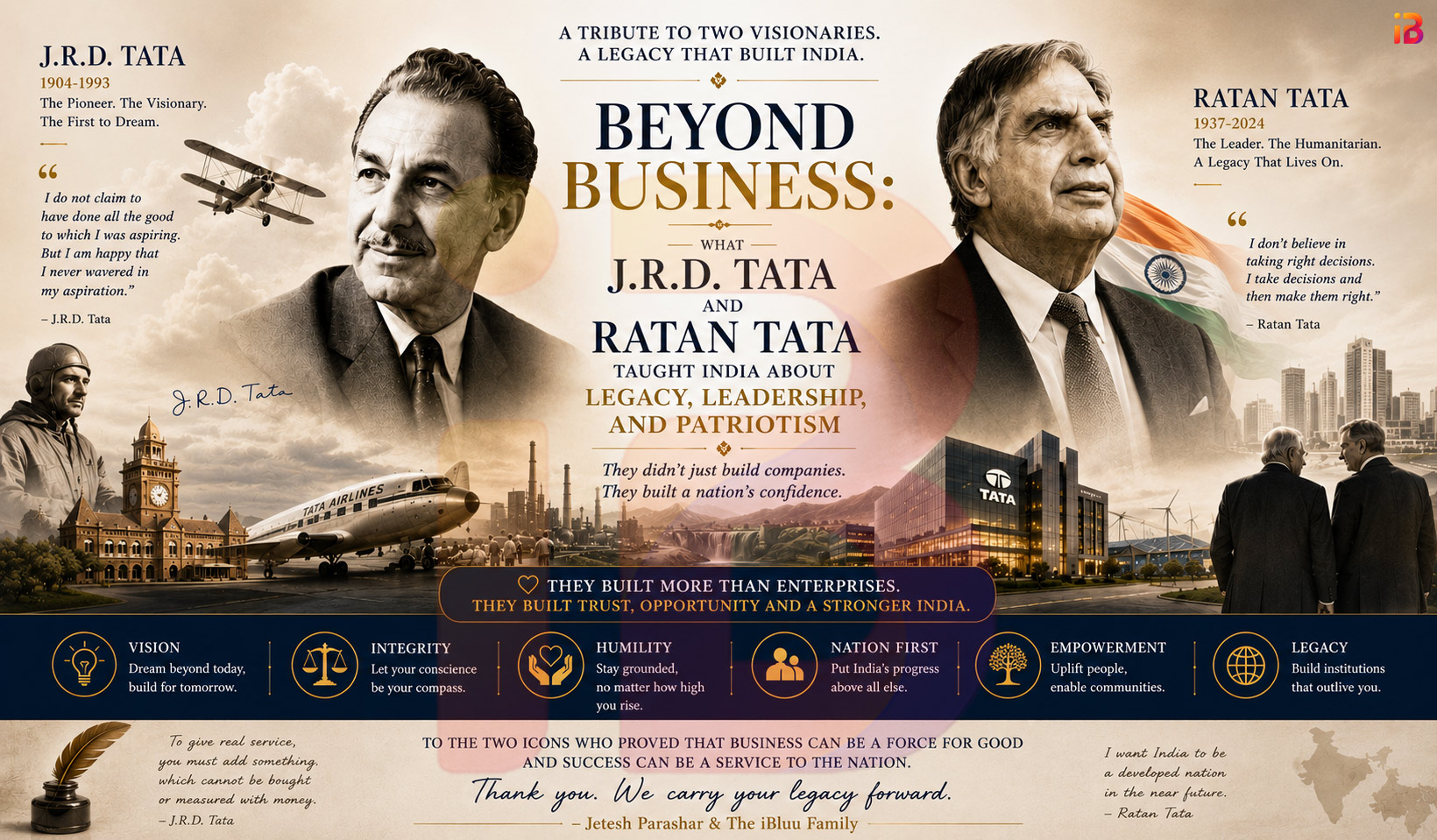
The Extraordinary Story of JRD Tata and Ratan Tata: The Legacy That Taught India About Leadership, Patriotism, Courage, and Purpose
Some people build companies. Some people build industries. A very rare few build a nation.
After watching Made in India: A Titan Story, I found myself thinking about a question that goes far beyond watches, automobiles, airlines, or corporate success.
What makes certain leaders impossible to replace?
Why do some business leaders become part of a nation’s collective memory while countless others, despite enormous wealth and success, gradually fade from public consciousness?
The answer, perhaps, lies in the lives of two extraordinary men:
J.R.D. Tata.
Ratan Tata.
Not because they built one of India’s largest business groups.
But because they consistently demonstrated that business can be a vehicle for nation-building.
The Difference Between Building Wealth and Building a Legacy
India has produced many successful businessmen.
Few have become symbols.
J.R.D. Tata and Ratan Tata became symbols because their ambitions extended beyond balance sheets.
They understood something that many leaders struggle to understand even today:
A company exists to generate profits. A legacy exists to generate progress.
That difference changes everything.
Profits can be measured quarterly.
Legacy is measured decades later.
When people remember J.R.D. Tata, they do not first remember revenues.
They remember vision.
When people remember Ratan Tata, they do not first remember market capitalization.
They remember character.
And character is what survives after business victories have been forgotten.
J.R.D. Tata: The Dreamer Who Helped India Learn to Fly
Long before aviation became commonplace, J.R.D. Tata (Jehangir Ratanji Dadabhoy Tata) believed India deserved to have its own wings.
In 1932, he personally piloted the first commercial flight of what would later evolve into Air India.
India was still under colonial rule.
Infrastructure was limited.
Resources were scarce.
Yet he saw possibilities where others saw obstacles.
That is the hallmark of transformative leadership.
Not predicting the future.
Creating it.
Over the following decades, J.R.D. Tata would help build institutions across aviation, engineering, manufacturing, hospitality, research, and technology.
His influence was not confined to boardrooms.
It helped shape modern India itself.
Ratan Tata: The Leader Who Chose Courage Over Comfort
If J.R.D. Tata represented vision, Ratan Tata represented courage.
Many leaders inherit businesses.
Few transform them.
When Ratan Tata took charge of the Tata Group in 1991, India’s economy was entering a new era.
The easier path would have been preservation.
He chose transformation.
And transformation always carries risk.
The Titan Story: A Lesson Far Bigger Than Watches
One of the most powerful lessons from Made in India: A Titan Story is that Titan was never merely about watches.
It was about confidence.
At a time when foreign brands dominated aspirations, Titan demonstrated that an Indian company could create world-class products and world-class brands.
The lesson for entrepreneurs is profound:
Success begins when a nation stops believing imported automatically means superior.
Titan was not simply selling timepieces.
It was helping redefine Indian self-belief.
The Nano Story: A Failure That Was Actually a Success
History often misunderstands visionaries.
The Tata Nano is frequently discussed as a business disappointment.
Yet its original purpose reveals something deeper about Ratan Tata’s character.
The idea emerged after he witnessed families precariously travelling on two-wheelers.
He asked a simple question:
Could safe mobility be made affordable for millions?
The Nano was not born from market research.
It was born from empathy.
Commercially, the project struggled.
But leadership is not always about successful outcomes.
Sometimes it is about asking the right questions.
And few business leaders have dared to dream at that scale for ordinary citizens.
The Ford Story: The Day Respect Replaced Humiliation
Few corporate stories have become as legendary as Tata Motors’ acquisition of Jaguar Land Rover.
The story began with a setback.
When Tata Motors explored selling its passenger vehicle business, reports suggest the Tata delegation experienced dismissive treatment during discussions with Ford.
Many leaders would have walked away bitter.
Ratan Tata walked away determined.
Years later, Tata Motors acquired Jaguar and Land Rover from Ford for approximately $2.3 billion in 2008.
The lesson was never about revenge.
It was about resilience.
Humiliation can either break ambition or fuel it.
For Ratan Tata, it became fuel.
Jaguar Land Rover: The Acquisition That Changed Global Perceptions
When Tata Motors acquired Jaguar Land Rover, critics were skeptical.
Could an Indian company manage iconic British automotive brands?
The answer became one of the most remarkable chapters in global business history.
JLR eventually became one of Tata Motors’ most significant value creators.
More importantly, the acquisition challenged outdated assumptions about Indian businesses.
It demonstrated that Indian companies could acquire, manage, and scale world-class global brands.
The psychological impact was as significant as the financial one.
Air India: A Full Circle Moment
Few moments were as symbolic as the Tata Group regaining ownership of Air India in 2022.
Nearly seven decades after the airline had been nationalized, it returned to the group that had originally created it.
For many Indians, it felt less like an acquisition and more like a homecoming.
A chapter that history had left unfinished was finally completed.
Not every business transaction carries emotional significance.
This one did.
The Question Many of Us Quietly Ask
Watching these stories raises a difficult question.
Do we still see enough leaders willing to think beyond quarterly earnings?
Do we still celebrate institution builders as much as valuation builders?
This is not criticism of anyone.
Every era produces different challenges.
Every generation writes its own chapter.
But the enduring appeal of J.R.D. Tata and Ratan Tata suggests that people are searching for something deeper than corporate success.
They are searching for purpose.
Because while wealth can inspire admiration, purpose inspires devotion.
And that is why certain leaders become timeless.
The Real Legacy Was Never About Business
Perhaps the greatest misunderstanding about J.R.D. Tata and Ratan Tata is that their story is primarily a business story.
It is not.
It is a story about responsibility.
A story about building institutions that outlive individuals.
A story about creating opportunities for people you may never meet.
A story about believing that corporate success and national progress can move together.
That philosophy transformed the Tata name from a business group into a national trust.
And that is a distinction very few organizations in the world achieve.
A Personal Reflection
As an entrepreneur and builder myself, the most powerful takeaway from these stories is not how large the Tata Group became.
It is why it became large.
There is a difference.
Many entrepreneurs dream of building successful companies.
The greater challenge is building something that improves lives, creates capability, generates trust, and contributes to the nation.
That is a much harder ambition.
But it is also a far more meaningful one.
The stories of J.R.D. Tata and Ratan Tata remind us that true success is not measured solely by wealth created.
It is measured by lives touched.
Not by valuation.
But by value.
Not by market share.
But by societal impact.
And not by what we accumulate.
But by what we leave behind.
The Final Lesson
A nation remembers great businessmen.
But it never forgets great nation builders.
J.R.D. Tata understood that.
Ratan Tata lived it.
And perhaps that is why, years from now, long after balance sheets, acquisitions, and market cycles have faded into history, their names will continue to inspire generations who never had the privilege of meeting them.
Because some leaders build businesses.
Some leaders build industries.
But a rare few build hope.
And hope is the most enduring legacy of all.
About the Perspective
The reflections presented in this article are influenced by the strategic and nation-building lens of J Parasher, Founder and Managing Director of iBluu Consulting Venture (iBCV), a venture of iBluu Corporations. His work consistently emphasizes long-term institution building, industrial transformation, ethical entrepreneurship, and the role of business as a catalyst for national progress. Like many entrepreneurs inspired by the journeys of J.R.D. Tata (Jehangir Ratanji Dadabhoy Tata) and Ratan Tata, he views legacy not as an outcome of success, but as the consequence of meaningful contribution.
Disclaimer: This article is a personal reflection inspired by publicly known historical events, leadership lessons, and the documentary series Made in India: A Titan Story. It is not intended to compare, critique, or evaluate any current individual, company, or management team. References to J.R.D. Tata, Ratan Tata, the Tata Group, Air India, Titan, Tata Nano, Ford, Jaguar Land Rover, and related events are based on publicly available information and are used solely for educational, inspirational, and commentary purposes.