+91 945 889 6091
  infodesk@ibluu.com
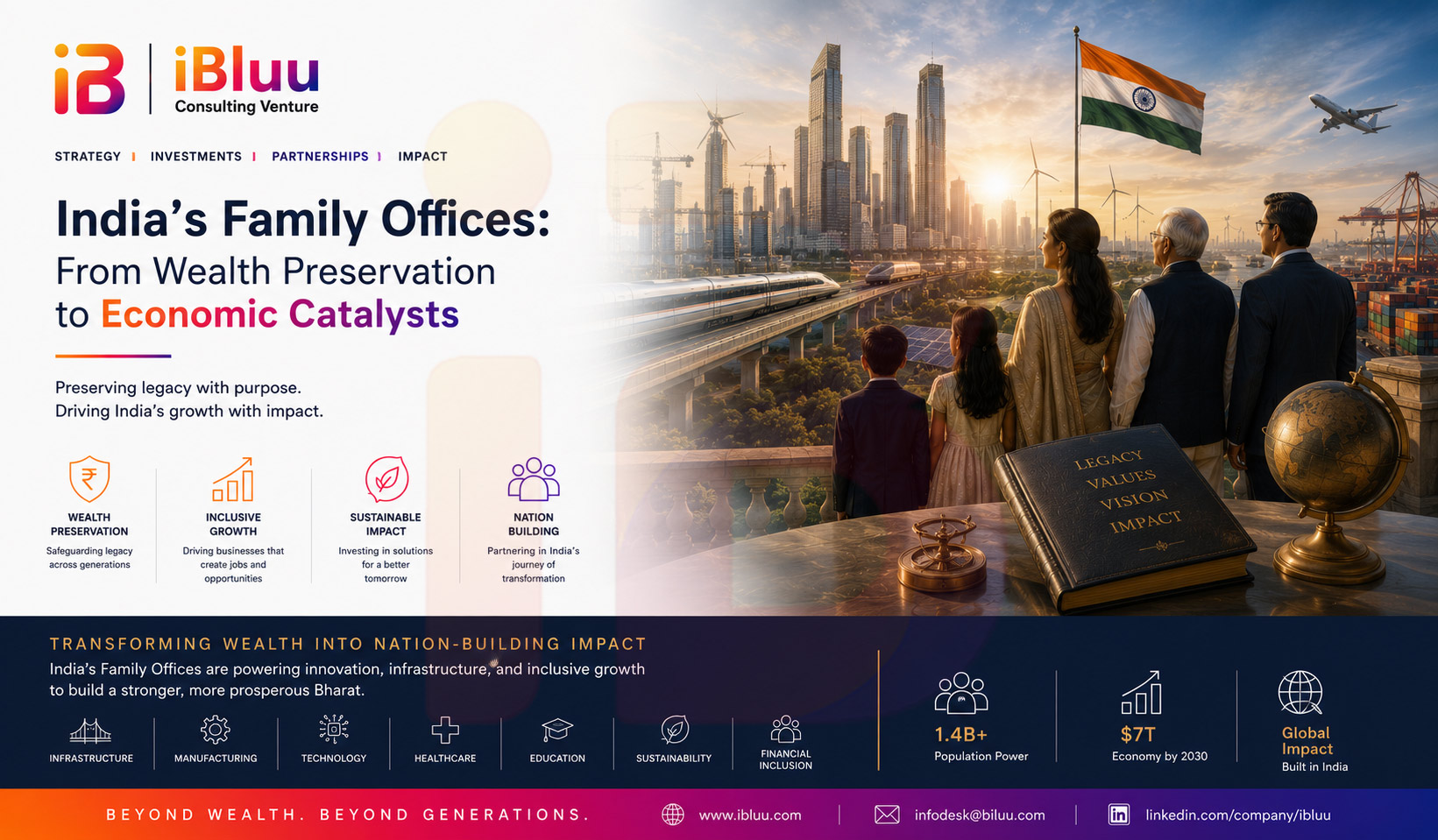
India’s Family Offices: From Wealth Preservation to Economic Catalysts — The Rise of UHNWIs and Affluent Families as Strategic Investors
A structural transformation is underway in India’s private wealth ecosystem.
For decades, India’s wealthiest families focused primarily on capital preservation through listed equities, fixed income instruments, gold, and real estate. Today, that model is rapidly evolving. Family offices are emerging as sophisticated investment institutions that increasingly resemble private investment firms, venture investors, and strategic capital allocators rather than traditional wealth-management structures.
This shift is occurring at a critical moment in India’s economic evolution. As the country advances toward becoming one of the world’s largest economies, family offices are deploying capital into startups, infrastructure, private equity, renewable energy, technology, healthcare, manufacturing, and global opportunities. In doing so, they are becoming an increasingly important source of patient capital supporting innovation, entrepreneurship, and long-term economic development.
The scale of this transformation is remarkable. India’s family office ecosystem has expanded from approximately 45 family offices in 2018 to nearly 300 by 2024, collectively managing an estimated US$30 billion in assets. Industry projections suggest assets under management could reach US$45 billion within the next three years, reflecting both wealth creation and growing institutional sophistication.
The implications extend far beyond wealth management. Family offices are increasingly influencing how capital is deployed across the Indian economy, creating new pathways for entrepreneurship, innovation, infrastructure development, and global investment connectivity.
The Great Wealth Transformation
India is experiencing one of the fastest periods of wealth creation in modern economic history.
Rapid entrepreneurship, expanding capital markets, technology-led value creation, private equity exits, IPO activity, and global business expansion have generated unprecedented liquidity for founders, promoters, and business families. At the same time, India continues to rank among the world’s fastest-growing major economies, creating substantial wealth across sectors including technology, manufacturing, pharmaceuticals, financial services, consumer businesses, and infrastructure.
The country’s ultra-high-net-worth population continues to expand rapidly. More than 13,000 households now possess wealth exceeding US$30 million, while estimates indicate that India’s UHNWI population could approach 19,000–20,000 individuals by 2028, placing the country among the world’s fastest-growing wealth markets.
This surge in wealth has fundamentally altered the requirements of affluent families.
Traditional advisory structures are increasingly insufficient for managing complex portfolios, succession planning, governance requirements, philanthropy, international diversification, and direct private investments. Consequently, families are establishing dedicated investment platforms designed to institutionalize decision-making while preserving long-term control over capital.
The result is the rapid emergence of India’s modern family office ecosystem.
Family Offices Are Becoming Institutional Investors
Historically, family offices served three primary functions:
- Wealth preservation
- Estate planning
- Succession management
Today, their mandate is considerably broader.
Modern family offices increasingly operate as strategic investment institutions with capabilities that include:
| Traditional Model | Emerging Model |
|---|---|
| Wealth Preservation | Wealth Creation |
| Domestic Investments | Global Allocation |
| Passive Investing | Direct Investing |
| Real Estate Focus | Multi-Asset Diversification |
| Family-Centric Decisions | Professional Governance |
| Generational Transfer | Strategic Capital Deployment |
This evolution reflects a broader trend observed globally, where family offices increasingly compete alongside venture capital funds, private equity firms, sovereign wealth funds, and institutional investors in sourcing and executing investment opportunities.
According to industry studies, Indian family offices are steadily increasing allocations toward alternative assets, private equity, venture capital, private credit, infrastructure assets, REITs, InvITs, and direct startup investments.
The shift signals a clear transition from preserving wealth to actively creating value.
The Rise of Direct Investing
Perhaps the most important development in India’s family office landscape is the growing preference for direct investment strategies.
Rather than investing exclusively through traditional funds, many family offices increasingly seek direct ownership positions in high-growth businesses.
Several factors explain this shift:
Greater Control
Direct investments allow families to influence strategic direction, governance, and value creation.
Long-Term Investment Horizon
Unlike traditional funds constrained by fixed investment cycles, family offices can remain invested for extended periods.
Access to Higher Alpha
Families increasingly seek opportunities capable of outperforming public markets.
Entrepreneur-to-Entrepreneur Capital
Founders often prefer strategic investors who understand operational realities rather than purely financial investors.
This dynamic has made family offices increasingly influential participants in India’s startup ecosystem.
Prominent family offices such as Premji Invest, Catamaran Ventures, Nadathur Holdings, and several promoter-led investment platforms have already established meaningful footprints across technology, consumer, healthcare, fintech, SaaS, and emerging industries.
Why Startups Are Increasingly Turning to Family Offices
Family offices offer a distinct advantage compared with many traditional investors.
Beyond capital, they frequently provide:
- Strategic mentorship
- Industry relationships
- Customer access
- Governance expertise
- Long-term capital stability
- Market credibility
Unlike many venture funds operating within finite investment cycles, family offices often possess the flexibility to support businesses through multiple growth stages.
As India’s startup ecosystem matures, this patient capital is becoming increasingly valuable.
Many industry observers believe family offices could contribute a meaningful share of domestic startup capital over the coming decade, helping reduce dependence on foreign funding while strengthening India’s entrepreneurial ecosystem.
Global Diversification Is Accelerating
Indian family offices are becoming increasingly international.
Traditionally concentrated in domestic assets, many now actively pursue opportunities across:
- United States
- Singapore
- UAE
- United Kingdom
- Europe
- Southeast Asia
Key motivations include:
Geographic Diversification
Reducing concentration risk.
Currency Exposure
Protecting portfolios against currency volatility.
Access to Innovation
Investing in global technology ecosystems.
Wealth Preservation
Holding assets across multiple jurisdictions.
GIFT City is also emerging as an increasingly important platform for cross-border structuring and international capital deployment, potentially positioning India as a competitive family-office destination over the long term.
The Next-Generation Effect
One of the most powerful forces shaping the future of family offices is generational transition.
Across India, next-generation leaders are assuming greater responsibility within family enterprises and investment platforms.
This generation typically exhibits:
- Higher global exposure
- Stronger technology adoption
- Greater ESG awareness
- Increased comfort with alternative assets
- Higher appetite for innovation-led investing
Unlike previous generations, many younger family members view family offices not simply as wealth management vehicles but as platforms for entrepreneurship, impact creation, and strategic investment.
Artificial intelligence, climate technologies, digital infrastructure, advanced manufacturing, biotechnology, energy transition, and deep technology increasingly feature within their investment priorities.
This generational shift may ultimately prove to be the most important long-term catalyst for the sector.
Key Challenges Facing Family Offices
Despite rapid growth, significant challenges remain.
Governance Complexity
Many family businesses still lack formal governance frameworks, investment committees, and family constitutions.
Succession Planning
Intergenerational wealth transfer remains one of the most sensitive challenges facing affluent families.
Talent Acquisition
Recruiting investment professionals capable of managing institutional-quality portfolios remains difficult.
Regulatory Complexity
Cross-border investment structures require increasingly sophisticated compliance and tax planning.
Portfolio Concentration
Many Indian families remain heavily exposed to promoter businesses, creating concentration risks.
Addressing these challenges will determine which family offices successfully evolve into enduring institutions.
Why Family Offices Matter to India’s Economic Future
The significance of family offices extends beyond private wealth.
As India seeks to strengthen domestic capital formation, family offices can serve as strategic intermediaries between wealth creation and productive investment.
Their capital increasingly supports:
- Startups
- Infrastructure
- Renewable energy
- Manufacturing
- Technology innovation
- Healthcare
- Education
- Global expansion initiatives
In many cases, family offices provide patient, long-term capital that complements traditional banking, venture capital, and private equity financing.
This role becomes especially important as India seeks to accelerate investment-led growth while reducing dependence on external capital flows.
The rise of family offices therefore represents not merely a wealth-management trend, but a broader institutional development within India’s financial architecture.
Strategic Outlook: The Next Decade
The trajectory appears clear.
The Indian family office ecosystem remains in its early stages compared with mature markets such as the United States, Singapore, Switzerland, and the Middle East. Yet the pace of expansion suggests substantial headroom for growth.
Over the next decade, several developments appear likely:
- Expansion toward 500–1,000 family offices
- Larger allocations to private markets
- Increased participation in infrastructure investing
- Greater use of GIFT City structures
- Rising cross-border investment activity
- Institutionalization of governance frameworks
- Greater adoption of AI-driven investment analytics
- Stronger ESG and impact-investing integration
- More collaboration between family offices and global investors
The winners will likely be those that combine entrepreneurial agility with institutional discipline.
Conclusion
India’s family offices are undergoing a profound transformation.
What began as a mechanism for preserving wealth is evolving into a powerful engine of capital formation, innovation funding, and long-term economic development.
As India’s wealth base expands and entrepreneurial success continues to create new pools of capital, family offices are increasingly positioning themselves as strategic investors rather than passive asset allocators.
Their influence is already visible across startups, private markets, infrastructure, technology, and global investment ecosystems. Over time, they may become one of the most important sources of patient domestic capital supporting India’s next phase of economic growth.
The question is no longer whether family offices will play a major role in India’s economic future.
The question is how large that role will become.
About the Author’s Strategic Perspective
The analytical depth of this article has been shaped by the strategic lens of J Parasher, Founder and Managing Director of iBluu Consulting Venture, is a strategic consulting and advisory firm operating under the iBluu Corporations ecosystem, whose work focuses on national capability building, global industrial benchmarking, capital formation, and long-horizon economic transformation. His perspective views family offices not merely as wealth-management structures, but as strategic economic institutions capable of influencing entrepreneurship, innovation, infrastructure development, and India’s long-term competitiveness.
Disclaimer: This article is intended solely for informational, educational, and thought-leadership purposes. It does not constitute investment, legal, tax, financial, or regulatory advice. Data referenced has been synthesized from publicly available industry reports, research publications, wealth studies, and market sources available as of June 2026. Readers should independently verify information and consult qualified professional advisors before making investment or business decisions.