+91 945 889 6091
  infodesk@ibluu.com
Assam 2035: Engineering India’s Northeast as a Global Hub for Medical Education and Healthcare Excellence in South East Asia
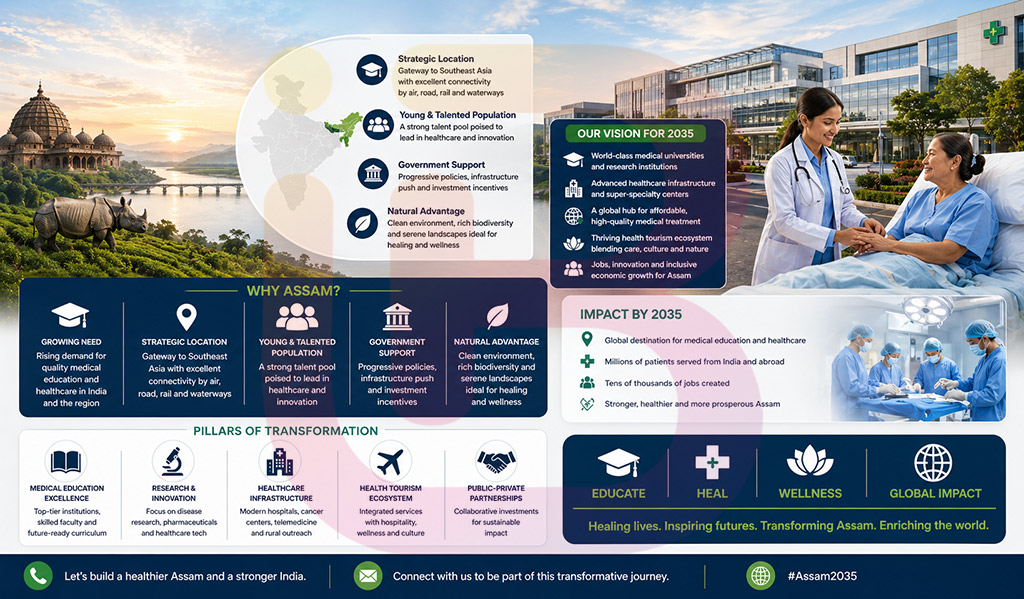
Assam is executing one of India’s most underappreciated yet structurally transformative healthcare plays—a coordinated expansion of medical education, clinical infrastructure, and cross-border patient inflows—with a clear ambition: to emerge as a premier hub for medical education and health tourism by 2035.
Backed by a planned ₹50,000 crore investment pipeline under the Assam Swasthya Utkarsha Abhijan, and a target of 60+ medical colleges across public and private sectors, the state is compressing what typically takes decades into a 10–12 year execution window.
For investors, hospital operators, education groups, and sovereign capital, Assam represents a first-mover opportunity in an underserved, high-growth regional healthcare market—with strong geopolitical adjacency to Southeast Asia, Bangladesh, Bhutan, and Northeast India’s 45+ million population base.
Strategic Context: From Regional Catch-Up to National Differentiation
Over the past decade, Assam has transitioned from a healthcare-deficit region to a primary referral hub for Northeast India, anchored by rapid expansion in government medical colleges, district hospitals, and tertiary care facilities.
However, the 2035 vision goes further:
This is not infrastructure expansion—it is ecosystem construction.
The strategy integrates:
- Medical education scale-up (supply of doctors and specialists)
- Super-speciality hospital clusters (cardiac, oncology, trauma, critical care)
- Health tourism corridors targeting cross-border patients
- Public health strengthening with digital and AI integration
Healthcare Infrastructure Blueprint: Scale with Structural Intent
Core Capacity Targets (2030–2035)
| Parameter | Current (Est.) | Target by 2035 | Strategic Impact |
|---|---|---|---|
| Medical Colleges | ~15–20 | 60+ | Workforce expansion + education exports |
| Healthcare Investment | ₹15,000–20,000 Cr (baseline) | ₹50,000 Cr pipeline | Infrastructure + PPP acceleration |
| Super-Speciality Hospitals | Limited clusters | Multi-city expansion | Reduce outbound medical travel |
| Regional Patient Inflow | Primarily domestic | International (SAARC + ASEAN) | Health tourism growth |
Key Insight:
The education–infrastructure coupling ensures Assam does not face the talent shortages that typically undermine healthcare expansion in emerging markets.
Medical Education as an Economic Multiplier
Unlike traditional healthcare strategies focused solely on hospitals, Assam is prioritizing medical education as the foundational growth engine.
- 60+ medical colleges will position Assam among India’s largest medical education clusters
- Expansion across government + private + PPP models
- Potential to attract international students from neighboring countries
Economic Spillovers:
- Faculty demand, research funding, and allied health professions
- Ancillary industries: diagnostics, pharma distribution, medical devices
- Long-term knowledge economy formation
This transforms healthcare from a service sector into a scalable economic engine.
Health Tourism Thesis: India’s Eastern Gateway
Assam’s geographic positioning is not incidental—it is strategic.
Catchment Advantage
- Bangladesh, Bhutan, Nepal, Myanmar
- Northeast India (historically underserved)
- Proximity to ASEAN markets via Act East Policy corridors
Cost–Value Proposition
- 60–80% lower treatment costs vs Western markets
- 30–50% lower than Tier-1 Indian metros
- Lower cost of stay and recovery periods
Emerging Focus Areas
- Cardiology & cardiac surgery
- Oncology (mid-cost treatment segments)
- Orthopedics and trauma
- Preventive healthcare + wellness
Financial Benchmarking & Investment Outlook
Healthcare Investment Economics (Indicative)
| Segment | Capex Intensity | IRR Potential (Base Case) | Notes |
|---|---|---|---|
| Medical Colleges | ₹500–800 Cr/unit | 14–18% | Long gestation, stable cash flows |
| Multi-Speciality Hospitals | ₹300–600 Cr | 16–22% | Strong regional demand |
| Diagnostics Networks | ₹50–150 Cr | 18–25% | High scalability |
| Health Tourism Facilities | Variable | 20–28% | Premium + cross-border demand |
Macro Multiplier:
Healthcare investments typically generate 2.5–4× economic multiplier via employment, consumption, and productivity gains.
Scenario Modeling: Assam Healthcare Economy by 2035
| Scenario | Outcome | Probability |
|---|---|---|
| Base Case | Assam emerges as Northeast’s dominant healthcare hub; moderate international inflows | 50–60% |
| Upside Case | Becomes Eastern India’s leading health tourism destination; strong ASEAN linkage | 25–35% |
| Downside Case | Execution delays, talent gaps, slower private participation | 15–20% |
Risk Landscape and Mitigation
Key Risks
- Talent retention and specialist availability
- Private sector participation pace
- Connectivity and logistics constraints
- Perception gap vs established metros
Mitigation Levers
- Medical education scale-up (built-in talent pipeline)
- PPP frameworks for hospital expansion
- Airport and connectivity upgrades
- Digital health and telemedicine integration
The Cross-Sector Playbook for Success
Global healthcare hubs (Thailand, Singapore, UAE) demonstrate that success requires multi-dimensional execution:
- Scale + Specialization (volume + niche excellence)
- Education + Clinical Integration
- International Patient Experience Standardization
- Policy Alignment + Visa Ease
- Private Capital Mobilization
Assam’s model is already aligning with at least three of these five pillars, positioning it ahead of most emerging healthcare clusters.
The Role of iBluu Consulting Venture Private Limited (iBCV)
As Assam’s healthcare ambitions transition from policy to execution, the role of strategic advisors becomes critical.
iBCV, a venture of iBluu Corporations, operates at the intersection of:
- Healthcare infrastructure strategy
- Investment structuring and capital alignment
- Government engagement and policy navigation
- Cross-border partnerships and consortium building
The analytical framing of this opportunity reflects the strategic lens of J Parasher, whose work emphasizes national capability building, capital efficiency, and long-horizon economic transformation.
In this context, Assam is not just a healthcare story—it is a strategic economic system in formation.
Actionable Recommendations for Stakeholders
For Investors & Funds
- Allocate early-stage capital to medical colleges and hospital clusters
- Prioritize Tier-2 city healthcare infrastructure plays
- Structure PPP-led entry models to de-risk execution
For Hospital Operators
- Enter via hub-and-spoke models
- Build cross-border patient acquisition channels
- Integrate digital and AI-driven diagnostics
For Policymakers
- Accelerate single-window clearances for healthcare investments
- Expand international patient visa frameworks
- Incentivize private participation in super-speciality care
Conclusion: A High-Conviction Bet on India’s Healthcare Future
Assam’s healthcare transformation is not incremental—it is structural, capital-intensive, and strategically timed.
It sits at the convergence of:
- Demographic demand
- Geopolitical positioning
- Policy commitment
- Capital readiness
By 2035, Assam will not just serve Northeast India—it will redefine how emerging regions build globally competitive healthcare ecosystems.
For those who move early, this is not merely an opportunity.
It is a front-row position in one of India’s most consequential healthcare transformations.
Disclaimer: This article is intended for informational and strategic insight purposes only. It does not constitute investment advice, financial recommendation, or a solicitation to invest. All projections, estimates, and scenarios are indicative in nature and subject to market dynamics, policy changes, and execution factors. Readers and investors are advised to conduct independent due diligence and seek professional advisory before making any investment or strategic decisions.