+91 945 889 6091
  infodesk@ibluu.com
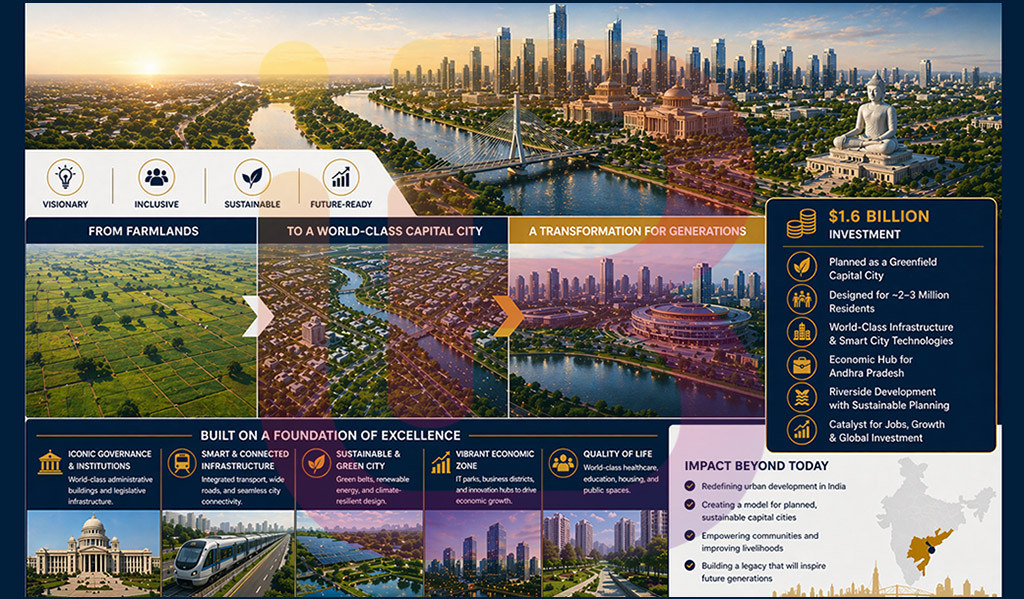
Amaravati: From Agricultural Land to One of India’s Most Ambitious $1.6 Billion Urban Projects—Redefining How Nations Build Cities from Zero
A decade ago, the land that is now Amaravati was agricultural terrain. Today, it is the nucleus of one of India’s most ambitious urban experiments—a greenfield capital city being assembled from first principles, backed by an estimated $1.6 billion in renewed capital deployment and long-horizon institutional intent.
This is not urban expansion. It is statecraft through infrastructure.
Amaravati represents a rare convergence:
- Political capital formation
- Institutional infrastructure build-out
- Real-estate-led economic activation
- Global capital signalling
For investors, the question is not whether Amaravati will be built.
The real question is: how much value will be captured—and by whom—during its formation phase.
The Strategic Thesis: Why Amaravati Exists
Following the bifurcation of Andhra Pradesh in 2014, the absence of a capital city created a structural vacuum—administrative, economic, and symbolic.
Amaravati is designed to solve all three.
But beyond governance, the deeper strategic logic is clear:
India is no longer just urbanising. It is designing cities as economic instruments.
Where legacy cities carry historical inefficiencies, Amaravati offers:
- Zero-legacy planning constraints
- Integrated zoning from inception
- Digitally native infrastructure architecture
- Policy-led capital attraction frameworks
Capital Deployment: Anatomy of the $1.6 Billion Phase
The current investment phase prioritises core state infrastructure and catalytic urban assets, including:
- Government administrative complexes
- Trunk infrastructure (roads, water, power grids)
- Flood-resilient urban design systems (Krishna River proximity)
- Initial residential and institutional clusters
Unlike fragmented urban projects, Amaravati follows a sequenced capital layering model:
| Phase | Focus Area | Strategic Outcome |
|---|---|---|
| Phase 1 (Current) | Core governance + infrastructure | State functionality + investor confidence |
| Phase 2 | Commercial + residential scale-up | Real estate monetisation |
| Phase 3 | Financial + institutional ecosystem | Long-term capital inflow |
Benchmarking Amaravati: Global Comparables
Amaravati’s ambition aligns with a select group of planned capital cities and economic hubs, including:
- Canberra
- Brasília
- Abu Dhabi
However, Amaravati differs in one critical dimension:
It is being built in an emerging-market growth context, where urbanisation, demographics, and capital demand intersect simultaneously.
This amplifies both:
- Upside potential (high growth velocity)
- Execution risk (policy continuity, funding cycles)
Economic Multiplier: Scenario Modeling (2026–2035)
Base Case (Most Probable)
- Annual incremental GDP contribution: $0.8–1.2 billion
- Real estate appreciation: 20–35% in early clusters
- Employment generation: 250,000+ direct and indirect jobs
Upside Case (Policy + Capital Acceleration)
- GDP impact: $1.5–2.2 billion annually
- Institutional inflows (finance, tech, education)
- Probability: 30–40%
Downside Case (Execution Delays / Political Risk)
- GDP impact: $0.5–0.7 billion annually
- Capital slowdown, phased delays
- Probability: 20–30%
Real Estate and Infrastructure: The First-Mover Advantage
Historically, greenfield capital cities have generated asymmetric returns in early cycles.
Amaravati presents similar dynamics:
- Land aggregation at sub-market pricing (early-stage discount)
- Zoning clarity enabling institutional participation
- Government-led demand anchoring (ministries, judiciary, public sector)
Expected IRR (select segments):
- Residential (early-phase): 18–28%
- Commercial (CBD clusters): 20–32%
- Infrastructure-linked assets: 12–18% (stable yield)
Risk Matrix: Where Execution Will Be Tested
Despite its strategic clarity, Amaravati faces non-trivial risks:
1. Policy Continuity Risk
Capital cities require multi-decade political alignment. Any disruption can delay value realisation.
2. Funding Sustainability
Phased capital deployment must remain consistent beyond initial allocations.
3. Demand Creation Lag
Unlike organic cities, demand must be engineered before it becomes self-sustaining.
4. Climate & Geography
Flood management and ecological balance near the Krishna River require precision planning.
The Structural Advantage: Building a City in the Digital Era
Unlike legacy capitals, Amaravati has the advantage of being born in the age of smart infrastructure:
- Integrated digital governance systems
- AI-enabled urban planning frameworks
- Smart utilities (energy, water, mobility)
- ESG-compliant design architecture
This positions Amaravati not just as a capital—but as a prototype for next-generation Indian cities.
The Role of iBCV: Structuring Capital, Not Just Advising It
iBluu Consulting Venture Private Limited (iBCV), a venture of iBluu Corporations, operates at the intersection of:
- Strategic government engagement
- Cross-border capital structuring
- Infrastructure advisory
- Partnership and consortium development
In projects like Amaravati, the role of iBCV is not transactional.
It is architectural.
Structuring how capital flows, how partnerships are formed, and how long-term value is institutionalised.
Perspective: The J Parasher Strategic Lens
The analytical depth of this transformation aligns with the strategic framework advanced by J Parasher:
Cities are no longer geographic entities.
They are economic systems engineered for capital, capability, and geopolitical relevance.
Amaravati is a test of that thesis.
Actionable Recommendations
For Global Investors
- Enter early-stage real estate and infrastructure corridors
- Form PPP consortia aligned with government-led anchors
- Hedge exposure across phased development cycles
For Corporates and Developers
- Secure land in proximity to administrative zones
- Align projects with ESG and smart-city mandates
- Build mixed-use assets for long-term resilience
For Policymakers
- Ensure continuity in policy and capital allocation
- Accelerate institutional tenant onboarding
- Position Amaravati in global investor roadshows
Final Word: A City That Will Define More Than a State
Amaravati is not just Andhra Pradesh’s capital.
It is a signal to global capital markets that India is entering a new phase—
where cities are built not only to govern populations, but to attract capital, shape economies, and project influence.
For those who understand timing:
Amaravati is not late-stage opportunity.
It is formation-stage leverage.
And in capital markets, that distinction defines everything.
Disclaimer: This article is intended for informational and strategic insight purposes only and does not constitute investment advice, solicitation, or recommendation. The views expressed are based on current policy direction, market data, and global benchmarking frameworks, which are subject to change. Readers are advised to conduct independent analysis and consult professional advisors before making investment or business decisions.