+91 945 889 6091
  infodesk@ibluu.com
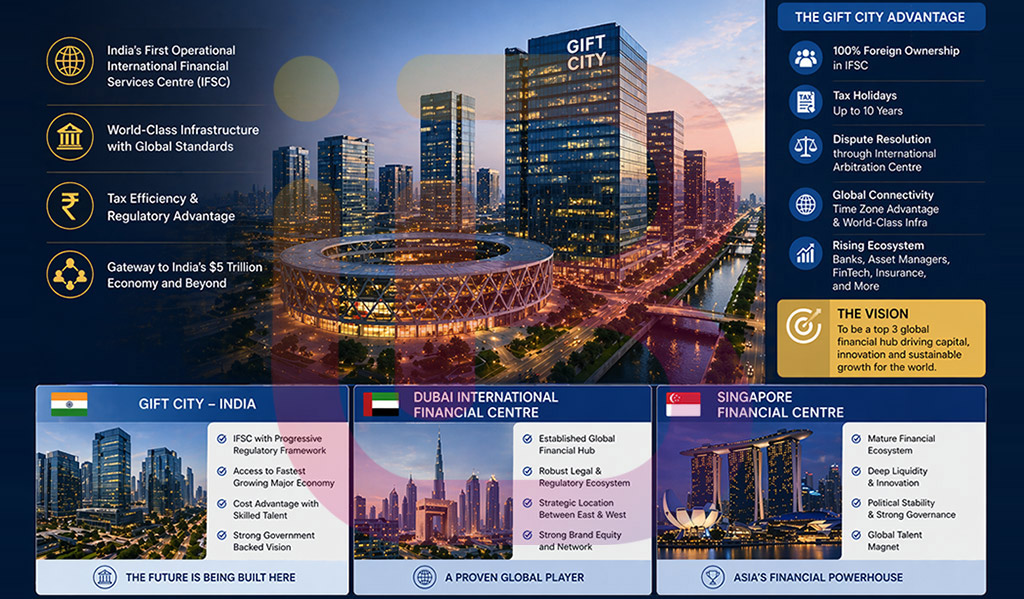
Ranked #1 Globally in Reputation, Scaling Beyond $100 Billion Monthly—India’s GIFT City Emerges as the World’s Most Trusted High-Growth Financial Centre
For decades, global financial flows linked to India were disproportionately routed through offshore hubs such as Dubai, Singapore, and London. The reason was structural—not cyclical: India lacked a globally competitive financial ecosystem with regulatory flexibility, tax neutrality, and operational efficiency.
GIFT City was conceived to solve that exact problem.
Built from scratch between Ahmedabad and Gandhinagar, GIFT City is not merely an infrastructure project—it is India’s strategic response to global financial displacement.
Investor takeaway: With IFSC exchange turnover consistently approaching or exceeding ~$90–100 billion monthly, banking assets crossing ~$100 billion, and over 1,150 registered entities, GIFT City has transitioned from concept to systemically relevant financial ecosystem.
Why GIFT City Exists: A Structural Gap, Not a Policy Experiment
Historically:
- Indian corporates accessed global capital via offshore jurisdictions
- Derivatives trading linked to Indian markets happened outside India
- Financial intermediation revenue accrued to foreign hubs
This created a permanent capital leakage loop.
GIFT City disrupts this by offering:
- A dollarized financial environment within India
- Regulatory architecture aligned with global standards via IFSCA
- Tax incentives comparable to leading international financial centers
This is not replication. This is strategic repositioning.
Scale Indicators: From Early Adoption to Market Relevance
By early 2026, GIFT City has crossed critical scale thresholds:
GIFT City Financial Ecosystem Snapshot
| Metric | Current Status (2025–26) |
|---|---|
| Monthly IFSC Exchange Turnover | ~$89–100+ billion |
| GIFT NIFTY Turnover (Peak Month) | ~$102.35 billion |
| Banking Assets | ~$100–106 billion |
| Capital Markets Activity | ~$80 billion ecosystem |
| Fund Commitments | ~$26+ billion |
| Registered Entities | 1,150+ |
| Employment | 20,000+ (target 100,000 by 2030) |
Interpretation:
- Crossing $100B monthly turnover is not symbolic—it signals liquidity depth and institutional participation
- Banking scale above $100B positions GIFT City as a serious offshore alternative
Institutional Architecture: Building a Global Financial Stack
GIFT City’s strength lies in its integrated ecosystem design, not just infrastructure.
Core Institutional Layers
- 37+ global and domestic banks
- 65+ insurance and reinsurance entities
- 35+ aircraft leasing firms (India’s emerging aviation financing hub)
- Fund management platforms attracting global capital
Global firms including HSBC, IBM, Oracle, and Google have established presence—validating institutional credibility and long-term viability.
Strategic Benchmarking: GIFT City vs Global Financial Hubs
| Parameter | GIFT City | Dubai (DIFC) | Singapore |
|---|---|---|---|
| Regulatory Model | Unified IFSC regulator (IFSCA) | DIFC framework | MAS |
| Cost Competitiveness | High | Medium | Low |
| Tax Incentives | Strong | Moderate | Moderate |
| Market Maturity | Emerging | Mature | Highly Mature |
| Growth Velocity | High | Stable | Stable |
Key Insight:
GIFT City is not yet competing on maturity—but it is outcompeting on growth velocity and structural cost advantage.
Geopolitical Context: The “Onshoring” of Financial Power
Global capital is undergoing strategic realignment:
- “China+1” strategies
- Supply chain diversification
- Regional financial autonomy
GIFT City sits at the intersection of:
- India’s economic expansion
- Regulatory modernization
- Capital market deepening
This positions it as a geopolitical financial lever, not just a domestic initiative.
Scenario Modeling: 2026–2035 Growth Trajectory
Base Case (Most Probable)
- Monthly turnover stabilizes at $120–150B
- Banking assets scale to $200B+
- Employment crosses 100,000
Upside Scenario (High Probability: 35–45%)
- Rapid derivatives migration from offshore centers
- Turnover exceeds $200B/month
- Emergence as Asia’s top 3 financial hubs
Downside Scenario (20–25% Probability)
- Regulatory friction or slower global adoption
- Turnover plateau at $80–100B
- Delayed institutional deepening
Risk Mitigation Strength:
- Strong policy backing
- Centralized regulatory authority (IFSCA)
- Increasing global institutional participation
Key Risks: Real but Manageable
- Liquidity concentration risk in early-stage markets
- Global competition from established hubs
- Regulatory calibration challenges during scaling
However, unlike legacy hubs, GIFT City benefits from:
- Greenfield flexibility
- Policy alignment at national level
- Lower structural cost base
Sectoral Opportunities: Where Capital Will Move First
High-Conviction Investment Areas
- Derivatives and capital markets infrastructure
- Aircraft leasing and aviation financing
- Global fund domiciliation
- Reinsurance and risk management platforms
Emerging Themes
- Fintech integration
- ESG-linked financial instruments
- Cross-border digital asset frameworks
iBCV Strategic Lens: From Advisory to Ecosystem Enablement
At the center of this transition is iBluu Consulting Venture Private Limited (iBCV), a venture of iBluu Corporations.
iBCV operates across:
- Investment advisory and capital structuring
- Strategic government engagement
- Cross-border financial partnerships
- M&A and institutional alignment
The analytical foundation of this perspective is shaped by J Parasher, whose strategic thesis reframes financial hubs not as infrastructure—but as economic control systems capable of capturing global value flows.
Actionable Recommendations
For Global Investors
- Allocate early-stage exposure to GIFT City platforms
- Partner with domestic institutions for regulatory navigation
- Target derivatives and fund management ecosystems
For Financial Institutions
- Establish IFSC presence to capture India-linked flows
- Leverage tax and regulatory advantages
- Build cross-border capital pipelines
For Policymakers & Operators
- Accelerate ecosystem depth (liquidity, product diversity)
- Strengthen global positioning campaigns
- Enable seamless integration with domestic markets
Conclusion: From Aspiration to Financial Power Center
GIFT City is not yet Dubai.
It is not yet Singapore.
But that is precisely the point.
It is something fundamentally different:
A purpose-built financial system designed to retain, attract, and scale global capital flows linked to India.
The real shift is already underway:
From offshore dependency → to domestic financial sovereignty.
And those who recognize this early will not just participate in GIFT City’s growth—
They will define its role in the global financial order.
Disclaimer: This article is intended for informational and strategic perspective purposes only and does not constitute financial, investment, or regulatory advice. All data points are based on publicly available estimates and industry benchmarks as of 2025–2026 and are subject to change. Readers are advised to conduct independent due diligence and consult professional advisors before making any investment or business decisions.