+91 945 889 6091
  infodesk@ibluu.com
Arogya Van: Where ESG, Ayurveda, and Infrastructure Converge to Create a New Economic Model
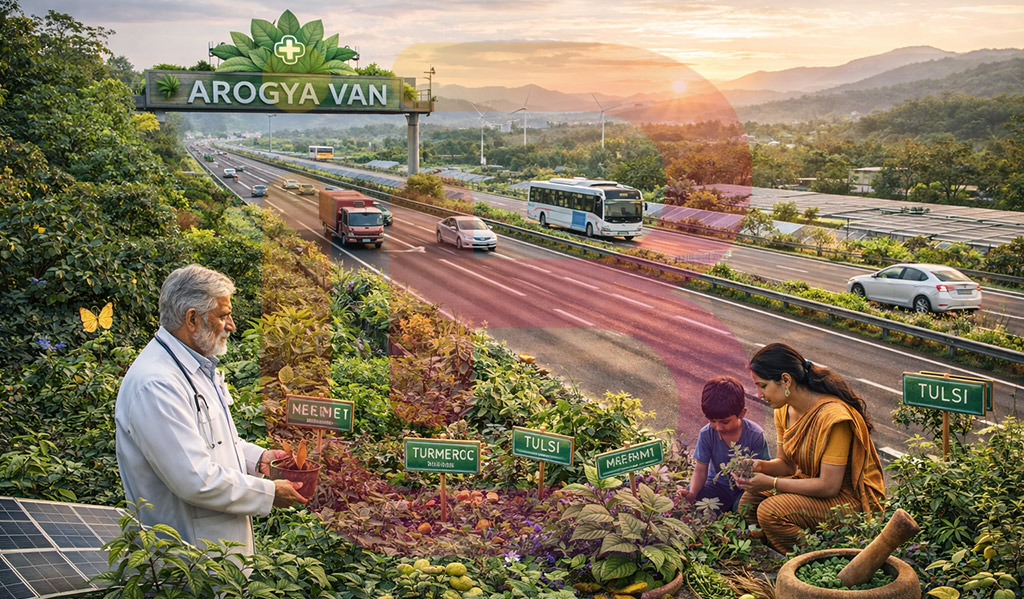
The launch of the “Arogya Van” programme by the National Highways Authority of India marks a structural shift in how infrastructure assets are conceptualized in India. What appears as a plantation initiative is, in reality, a multi-layered economic and ecological strategy—transforming underutilized highway land into a productive, monetizable, and sustainability-aligned asset class.
With over 67,000 medicinal trees planted across 62.8 hectares in 11 states, this initiative positions India’s highway network not merely as transport corridors—but as distributed bio-economic platforms.
From Idle Land to Strategic Bio-Bank: A Structural Reframing
Historically, highway right-of-way (ROW) land has been treated as passive or low-yield space. Arogya Van disrupts this paradigm.
The model is precise:
- Convert idle ROW land into medicinal plantations
- Align species selection with regional agro-climatic conditions
- Position plantations near toll plazas, interchanges, and high-visibility zones
- Create a living “Bio-Bank” supporting Ayurveda, biodiversity, and ESG outcomes
The plantation mix—featuring **Neem, Amla, Imli, Jamun, Lemon, Gular, and Maulsari—signals a deliberate shift toward commercially valuable and ecologically resilient species.
This is not greening.
This is land-use optimization with embedded economic logic.
The Ayurveda Link: Securing a High-Growth Supply Chain
India’s Ayurveda market is entering a high-growth phase, projected to expand from ~USD 11.8 billion (2024) to ~USD 35.7 billion by 2030 (CAGR ~20%).
Yet, the supply chain for medicinal plants remains:
- Fragmented
- Quality-inconsistent
- Partially import-dependent
Arogya Van directly addresses this gap by creating decentralized, highway-adjacent sourcing ecosystems.
Strategic Implications
- Reduces dependency on volatile global herb supply chains
- Enhances traceability and quality control
- Supports domestic manufacturing and exports
- Integrates infrastructure with bio-economy growth engines
This positions highways as feedstock corridors for Ayurveda and phytopharma industries.
ESG Asset Creation: Quantifying the Economic Value
Arogya Van’s true innovation lies in converting ecological value into financially measurable returns.
Per Hectare Value Creation (Mature Phase)
| Component | Estimated Annual Value |
|---|---|
| Medicinal Produce Revenue | ₹50,000 – ₹1,50,000 |
| Carbon Credit Potential | 10–15 tonnes CO₂/ha/year |
| Land Value Premium | Incremental |
| Total Value Creation | ₹2–4 lakh per hectare |
Scaled Opportunity
- Identified land: ~188 hectares (Phase expansion)
- Potential annual value (steady state): ₹4–7 crore+
- Additional upside via carbon markets and ESG-linked financing
Beyond direct revenue, the initiative strengthens NHAI’s ESG profile—potentially reducing cost of capital by 50–100 basis points through green financing access.
Scenario Modeling: Scale, Upside, and Downside
Projected Expansion Trajectory
- Base Case (Most Probable):
188 hectares by 2027 → 500+ hectares by 2030 - Upside Case (Policy + Private Participation):
1,000+ hectares by 2030 (40%+ CAGR post-pilot)
Probability: ~35–45% - Downside Case (Execution Gaps):
100–150 hectares by 2030
Probability: ~20–25%
Risk Matrix
| Risk Factor | Mitigation Lever |
|---|---|
| Tree survival rates | Agro-climatic selection, monsoon plantation |
| Market linkage | PPP with Ayurveda companies |
| Climate variability | Species diversification |
| Operational maintenance | Tech-enabled monitoring (drones, AI) |
Crucially, the initiative is low-capex, high-impact, limiting downside exposure relative to traditional infrastructure projects.
Beyond Ecology: Building Multi-Dimensional Infrastructure Value
Arogya Van operates across three simultaneous value layers:
- Ecological Layer
Biodiversity restoration, pollinator support, carbon sequestration - Economic Layer
Medicinal produce, carbon credits, land monetization - Strategic Layer
Ayurveda supply security, ESG compliance, infrastructure repositioning
This triple-bottom-line architecture transforms highways into regenerative economic systems.
Cross-Sector Execution Blueprint
Global benchmarks suggest that successful green infrastructure programs execute five critical moves. Arogya Van already embeds several:
- High-value, climate-aligned species selection
- Visibility-driven placement for awareness and demand creation
- Integration with commercial value chains (Ayurveda)
- ESG monetization through carbon and financing mechanisms
- Scalable monitoring via existing highway tech infrastructure
The model is not experimental—it is structurally scalable.
iBCV Perspective: From Advisory to Ecosystem Enablement
Within this evolving landscape, iBluu Consulting Venture Private Limited (iBCV), a venture of iBluu Corporations, plays a strategic role in enabling alignment across stakeholders.
Core Strategic Capabilities
- Business and infrastructure consulting
- Government and institutional engagement
- Investment advisory and ESG structuring
- M&A and partnership frameworks
- Technology integration for monitoring and optimization
iBCV’s approach reflects a broader transition in consulting—from advisory outputs to execution ecosystems.
Strategic Lens: A System-Level Economic Perspective
The analytical depth of this transformation aligns with the strategic thinking of J Parasher, whose framework positions infrastructure not as isolated assets—but as interconnected economic systems.
Under this lens:
- Highways become bio-economic corridors
- ESG becomes monetizable infrastructure logic
- Land becomes productive capital, not static inventory
This reframing elevates Arogya Van from initiative to national strategy prototype.
Actionable Recommendations
For Investors and ESG Funds
- Allocate to Ayurveda-linked supply chains and agroforestry models
- Explore PPP participation in plantation maintenance and harvesting
- Integrate carbon credit strategies into infrastructure portfolios
For Corporates (Ayurveda & Pharma)
- Secure long-term sourcing agreements from Arogya Van clusters
- Co-invest in processing and value-add infrastructure
- Leverage initiative for ESG reporting and brand positioning
For Policymakers
- Accelerate expansion to 500+ hectares by 2028
- Introduce private participation frameworks
- Launch Arogya Van 2.0 with commercial harvesting rights
Conclusion: A Quiet but Powerful Infrastructure Revolution
The Arogya Van programme is not a headline-grabbing mega project.
It is something more powerful.
It is a quiet redesign of infrastructure economics.
By converting linear highway assets into regenerative, revenue-generating bio-systems, India is demonstrating a new model—where sustainability, economy, and infrastructure are no longer separate conversations.
They are one integrated system.
And those who recognize this early will not just participate in it—
they will shape its scale, structure, and returns.
Disclaimer: This article is intended for informational and strategic insight purposes only and does not constitute investment advice, solicitation, or recommendation. The views expressed are based on current policy direction, market data, and global benchmarking frameworks, which are subject to change. Readers are advised to conduct independent analysis and consult professional advisors before making investment or business decisions.