+91 945 889 6091
  infodesk@ibluu.com
India vs Dubai Healthcare: A Strategic Clash Between Affordability, Accessibility, and Premium Patient Experience – Decoding the Forces Shaping Global Medical Value
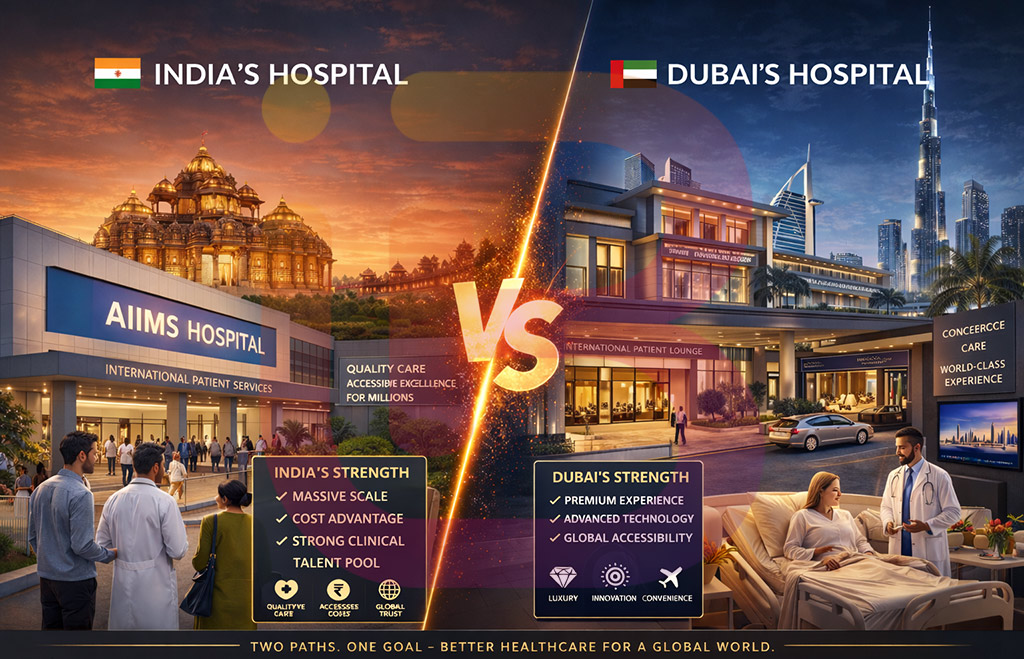
The global medical tourism landscape is increasingly defined by two powerful yet contrasting archetypes—India as the scale-driven, cost-optimized clinical powerhouse, and Dubai as the premium, experience-led healthcare destination.
India operates as a high-volume, cost-arbitrage clinical powerhouse, delivering 60–90% cost savings with global-quality outcomes. Dubai, by contrast, positions itself as a premium, experience-led medical ecosystem, optimized for affluent patients seeking seamless, luxury-integrated care.
India’s medical tourism market, valued at approximately USD 20.4 billion (2026) and projected to reach USD 65+ billion by 2036, is fueled by over 2 million international patients annually. Key inbound corridors include patients from Bangladesh, Nigeria, Kenya, Iraq, and Oman—reflecting India’s dominance across South Asia, Africa, and the Gulf.
In contrast, Dubai’s healthcare economy, though smaller (~USD 335–723 million), is expanding rapidly in high-margin segments such as wellness, elective procedures, and luxury recovery experiences.
Investor insight: The next decade will not be defined by competition—but by convergence. Hybrid models combining India’s clinical scale with Dubai’s hospitality precision are poised to dominate a projected $70–80 billion global medical tourism opportunity by 2035.
Global Patient Flow: India’s Expanding Medical Catchment Advantage
India’s rise is not theoretical—it is deeply validated by cross-border patient flows.
Over 2+ million international patients annually travel to India for treatment, with key source geographies including:
- Bangladesh: ~25–30% of inbound patients (cardiac, oncology, nephrology)
- Nigeria & Kenya (Africa corridor): Rapidly growing segment (~15–20%), driven by cost arbitrage and advanced tertiary care
- Iraq & Oman: ~10–12% (orthopedics, trauma, oncology)
- Afghanistan: ~8–10% (multi-specialty, critical care)
- Uzbekistan & Central Asia: Emerging high-growth corridor (~5–7%)
Strategic insight:
India’s healthcare system has effectively become a regional medical backbone for South Asia, Africa, and parts of the Middle East, leveraging:
- Visa accessibility
- Cultural adaptability
- Clinical depth at scale
Dubai, in contrast, primarily attracts:
- GCC high-net-worth patients
- Medical travelers prioritizing privacy, luxury, and proximity
Pricing Power: The Single Largest Differentiator
The most decisive differentiator is pricing.
India delivers structural cost leadership, driven by:
- A dominant generics pharmaceutical ecosystem (70–80% lower drug costs)
- High procedural volumes reducing per-unit costs
- Lower labor and operational expenses
Dubai operates on a premium pricing architecture, reflecting:
- Imported medical supplies and branded pharmaceuticals
- Higher physician compensation structures
- Luxury infrastructure integration
Procedure Cost Benchmarking (2026, USD Equivalent)
| Procedure | Dubai (Private) | India (Top Tier) | Cost Advantage (India) |
|---|---|---|---|
| Heart Bypass (CABG) | 32,000–49,000 | 5,000–7,600 | 75–85% |
| Knee Replacement | 22,000–30,000 | 4,000–6,000 | 72–82% |
| Cancer Treatment | 49,000–95,000 | 13,500–28,500 | 60–72% |
| Spine Surgery | 26,000–41,000 | 6,000–10,300 | 60–77% |
| IVF (per cycle) | 6,800–9,500 | 2,200–3,300 | 60–70% |
Why India wins:
- Dominance in generic pharmaceuticals (70–80% cheaper)
- High procedural volumes → lower per-unit cost
- Competitive physician and nursing cost structures
Dubai’s pricing reflects:
- Imported medical ecosystem
- Premium infrastructure and staffing
- Hospitality integration
Clinical Excellence and Specialized Care: Volume vs Precision Experience
India
- Global leadership in cardiology, oncology, orthopedics, transplants
- High procedural success rates (e.g., CABG survival >96%)
- Integration with AYUSH therapies for recovery
Dubai
- Highly personalized, protocol-driven care
- Strength in cosmetics, wellness, bariatrics, diagnostics
Key distinction:
- India = clinical depth + procedural scale
- Dubai = precision care + curated patient journeys
Nursing, Staffing and Patient Experience
Dubai leads in staffing ratios and service delivery:
- Ward ratios: ~1:3–1:4
- ICU: global best practices
- Multilingual, concierge-driven care
India offers:
- Competitive ratios (1:5–1:6 wards; 1:1–1:2 ICU)
- Strong clinical competence
- High patient throughput
However, where Dubai dominates is experience engineering:
- Hotel-like recovery suites
- Seamless concierge services
- Integrated hospitality ecosystems
India counters with:
- Personalized, family-centric care
- Dedicated international patient departments
- Affordable long-duration recovery options
Medicines, Equipment and Availability
India’s advantage is structural:
- Immediate access to generics
- Domestic manufacturing ecosystem
- Lowest global pricing
Dubai’s advantage is consistency:
- Zero stock-outs
- Latest imported medical technologies
- Premium pharmaceutical standards
Equipment parity:
Top-tier hospitals in both geographies operate state-of-the-art infrastructure (robotics, AI diagnostics, advanced imaging).
Visa, Cost of Living and Accessibility
Visa Ecosystem
- India: e-Medical Visa (24–48 hours, cost-efficient, minimal documentation)
- Dubai: Medical visa (structured, but documentation-heavy)
Cost of Stay (Per Day, 2026)
- India: $50–100
- Dubai: $200–400
Transportation
- India: 60–80% cheaper intra-city mobility
- Dubai: premium but highly efficient
Total Treatment Cost (Procedure + Stay):
- India delivers 70–85% overall savings
Aftercare and Recovery Economics
India holds a critical strategic advantage:
- Affordable extended recovery stays (2–4 weeks feasible)
- Integration with Ayurveda and wellness therapies
- Lower post-operative costs
Dubai offers:
- Premium recovery environments
- Shorter, high-cost recovery cycles
Implication:
India dominates long-term recovery economics, while Dubai dominates short-term premium recovery experiences.
Market Dynamics and Growth Trajectory (2026–2035)
- India:
- 2M+ patients annually
- Strong inflow from Africa, Middle East, South Asia
- Dubai:
- Targeting 1.2M patients under strategic healthcare vision
Scenario Modeling
- Base Case: USD 70–80B combined market by 2035
- Upside: USD 100B+ (hybrid ecosystem growth)
- Downside: USD 45–55B (geopolitical + cost risks)
Risk Landscape: Quantified and Manageable
India Risks
- Infrastructure variability
- Perception gaps in quality (mitigated by JCI/NABH accreditation)
- Urban capacity constraints
Dubai Risks
- High cost sensitivity in downturn cycles
- Dependence on premium patient segments
- Smaller domestic scale
Mitigation:
- India: private hospital expansion + digital health
- Dubai: cost optimization + mid-tier patient targeting
Strategic Inflection Point: The Rise of Hybrid Models
The future is not India vs Dubai.
It is India + Dubai.
Winning model:
- India → clinical execution, cost efficiency
- Dubai → patient experience, premium positioning
Emerging Opportunity
- Cross-border treatment pathways
- Fly-in surgical models
- Integrated recovery tourism
Actionable Recommendations
For Investors
- Allocate 60–70% capital to India (volume + ROI)
- Allocate 30–40% to Dubai (margin + premium positioning)
- Build India–Dubai joint ventures
For Healthcare Operators
- India: invest in hospitality and experience layers
- Dubai: introduce mid-cost treatment packages
Bold Strategic Move (2026–2030)
- Develop an “India–Dubai Medical Corridor”
- Target 5 million annual patients through integrated platforms
iBCV Strategic Lens
At the center of this transformation is iBluu Consulting Venture Private Limited (iBCV), a venture of iBluu Corporations.
iBCV operates at the intersection of:
- Investment advisory
- Healthcare infrastructure strategy
- Cross-border partnership structuring
The analytical depth of this perspective is shaped by J Parasher, whose strategic framework positions healthcare not merely as a service sector—but as a high-value economic export system with geopolitical leverage.
Conclusion: Scale vs Sophistication—A False Binary
India offers scale, affordability, and clinical firepower.
Dubai delivers luxury, precision, and seamless experience.
The real opportunity lies in rejecting the binary.
The future of global healthcare will belong to platforms that integrate India’s efficiency with Dubai’s elegance.
That is where the next decade’s healthcare alpha will be created.
Disclaimer: This article is intended for informational and strategic perspective purposes only and does not constitute medical, investment, or advisory recommendations. All data points are based on industry benchmarks and publicly available estimates as of 2026 and are subject to change. Readers and stakeholders are advised to conduct independent due diligence and consult with professional advisors before making any healthcare, investment, or business decisions.