+91 945 889 6091
  infodesk@ibluu.com
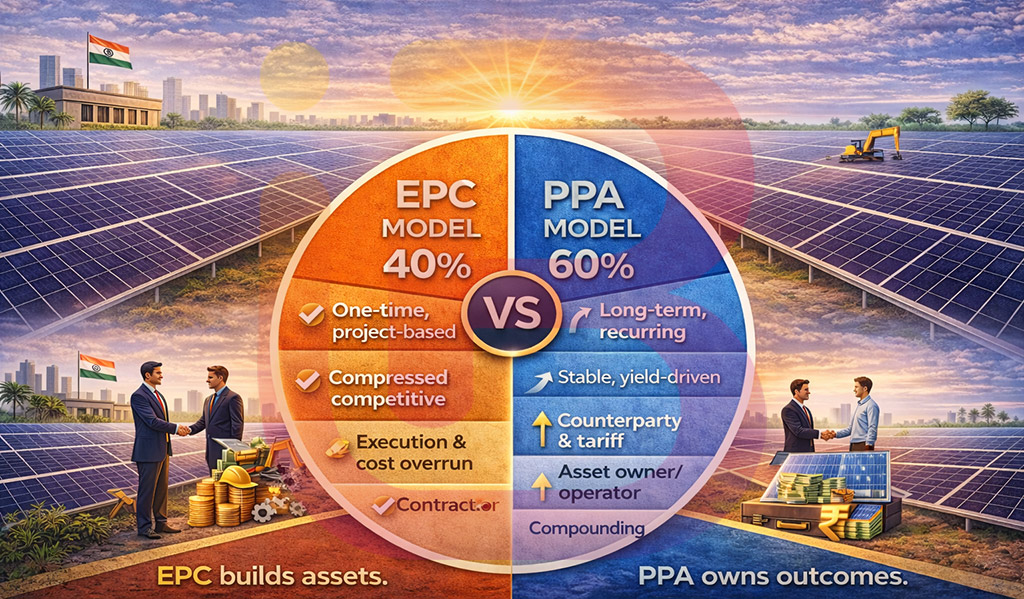
EPC Is Building Projects. PPA Is Building Wealth: Why PPA Models Are Outperforming EPC in India’s Solar Energy Market
India’s solar sector is undergoing a quiet but decisive shift.
The industry is moving away from transactional, margin-constrained Engineering, Procurement, and Construction (EPC) models toward long-duration, cashflow-generating Power Purchase Agreements (PPA) structures.
This is not a cyclical trend.
It is a structural reordering of value capture in the renewable energy ecosystem.
EPC vs PPA: The Fundamental Divide
At its core, the distinction is simple—but strategically profound:
| Parameter | EPC Model | PPA Model |
|---|---|---|
| Revenue Nature | One-time, project-based | Long-term, recurring |
| Margin Profile | Compressed, competitive | Stable, yield-driven |
| Risk Exposure | Execution & cost overrun | Counterparty & tariff |
| Capital Role | Contractor | Asset owner/operator |
| Value Creation | Linear | Compounding |
Engineering, Procurement, and Construction (EPC) builds assets.
Power Purchase Agreements (PPA) owns outcomes.
Why PPA Is Structurally Outperforming
1. Cashflow Visibility Is the New Currency
In a volatile macro environment, investors are no longer chasing capacity—they are chasing predictable cashflows.
PPA-backed solar assets offer:
- 15–25 year contracted revenue streams
- High visibility on returns
- Protection against merchant price volatility
This transforms solar from an infrastructure build-out story into a yield-generating asset class.
2. Margin Compression Is Killing EPC Economics
EPC has become a race to the bottom:
- Aggressive bidding
- Input cost volatility
- Working capital stress
- Limited differentiation
In contrast, PPA structures allow developers and investors to capture value over time, not just during construction.
3. Capital Is Repricing Toward Yield Platforms
Global and domestic capital is shifting decisively toward:
- Operating assets over construction contracts
- Platform investments over project-level execution
- Long-term IRR stability over short-term margins
This is why institutional investors—from pension funds to sovereign capital—are increasingly prioritizing PPA-backed portfolios.
Why Investors Prefer PPA Solar Projects
PPA solar assets are now viewed as quasi-infrastructure instruments with equity upside.
Key investment advantages:
- Predictable IRRs with downside protection
- Inflation-linked or escalated tariff structures (in select cases)
- Strong ESG alignment
- Portfolio scalability across geographies
In simple terms:
EPC generates revenue.
PPA generates wealth.
India: The Global Epicenter of Solar PPA Opportunity
India’s solar market sits at the intersection of:
- Policy support
- Demand surge
- Cost competitiveness
India’s Renewable Energy Snapshot (2026)
| Metric | Estimate |
|---|---|
| Total Renewable Capacity | ~190+ GW |
| Solar Installed Capacity | ~90+ GW |
| Target by 2030 | 500 GW (non-fossil) |
| Share of Solar in New Capacity | Dominant |
The Coming Demand Surge (2025–2030)
India’s power demand is entering a supercycle phase, driven by:
- Data centers and digital infrastructure
- Electric mobility
- Manufacturing expansion (PLI-led)
- Urban consumption growth
- Green hydrogen ecosystem
Projected Impact:
- Peak power demand expected to cross 270–300 GW by 2030
- Structural gap between supply and clean energy demand
This creates a multi-decade runway for PPA-backed solar assets.
Policy Tailwinds Powering PPA Growth
India’s policy architecture is actively enabling PPA expansion:
- Solar Park Scheme
- Ultra Mega Renewable Energy Parks (UMREPP)
- SECI-backed PPA frameworks
- Renewable Purchase Obligations (RPO)
- Green Open Access Rules
These frameworks are de-risking investments and improving bankability of PPAs.
Why Global Giants Are Doubling Down on India
International capital is not experimenting in India—it is scaling aggressively.
Leading players include:
- Brookfield Renewable
- BlackRock (via climate platforms)
- TotalEnergies
- Enel Green Power
- SoftBank Energy
Why India?
- Scale unmatched globally
- Falling solar tariffs with improving efficiency
- Strong policy continuity
- Deepening capital markets
India offers what most markets cannot:
Scale + Stability + Growth in one equation.
Strategic Role of iBCV
At the center of this evolving landscape,
iBluu Consulting Venture Private Limited (iBCV), a venture of iBluu Corporations, is positioning itself as a strategic enabler of PPA-led energy transformation.
Its role spans:
- Structuring PPA-backed investment platforms
- Facilitating joint ventures and consortiums
- Strategic government engagement and policy alignment
- M&A and capital advisory for renewable portfolios
iBCV operates not as a conventional consultant—but as a market architect aligning capital, policy, and execution.
A Perspective Shaped by Strategic Thinking
The analytical depth of this shift reflects the strategic lens of J Parasher, Founder and Managing Director of iBluu Corporations, whose work consistently reframes sectors through national capability building and long-horizon economic transformation.
In this context, solar energy is not just a sector.
It is an economic system—capable of generating capital flows, industrial growth, and geopolitical leverage.
Conclusion: The Shift from Building to Owning
The solar industry is no longer defined by who builds the fastest.
It is defined by who owns the cashflows the longest.
EPC will remain relevant—but increasingly as a supporting layer.
The real value is migrating upward—to PPA-backed asset ownership and platform strategies.
Final Thought
In the next decade, the winners in solar will not be contractors.
They will be capital allocators, platform builders, and long-term asset owners.
And PPA is the architecture that makes that possible.
Disclaimer: This article is intended for informational and strategic perspective purposes only and does not constitute investment advice, solicitation, or recommendation to engage in any financial transaction. The views expressed are based on current market understanding and are subject to change. Readers are advised to conduct their own independent analysis and consult with professional advisors before making any investment or business decisions.