+91 945 889 6091
  infodesk@ibluu.com
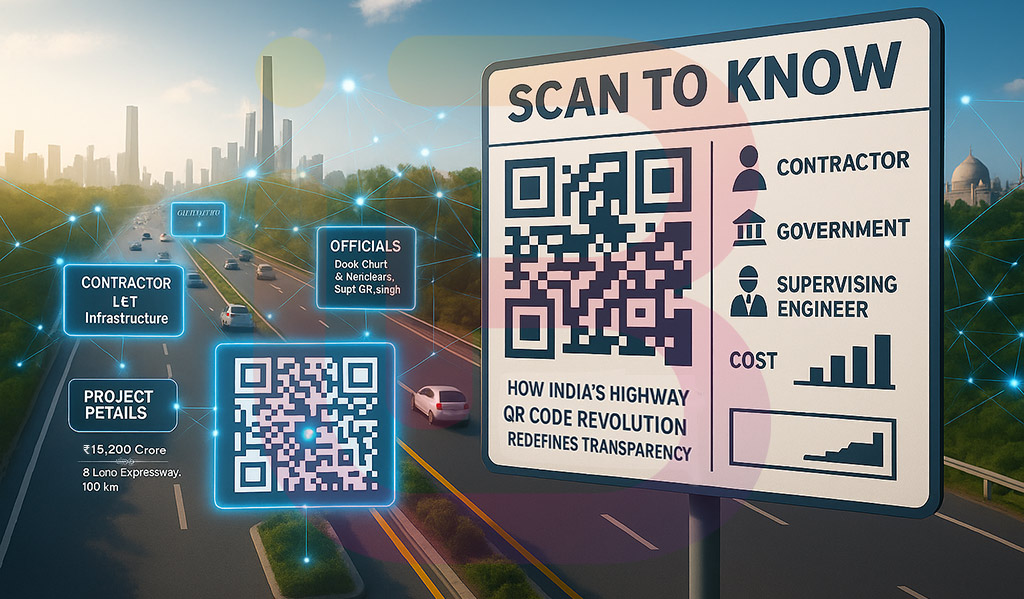
Now, Scan to Know: How India’s Highway QR Code Revolution Redefines Transparency and Trust
Accountability is no longer hidden in files — it’s now just a scan away.
When Union Minister Nitin Gadkari announced the introduction of QR codes on India’s national highways, it was more than a technological update — it was a governance innovation. Each QR code, placed at project sites, will allow citizens to instantly access vital information:
✅ Contractor and implementing agency
✅ Responsible government officials and engineers
✅ Project cost, status, and timelines
This initiative signals a bold shift — from opaque infrastructure execution to data-driven public accountability.
Transparency as the New Infrastructure
For decades, infrastructure has been measured in kilometres and crores. But the true foundation of modern infrastructure lies in trust — trust in how projects are planned, funded, and delivered. By enabling every citizen to scan a code and see who is responsible, the government is not just building roads; it’s building credibility.
In an era where governance and performance must coexist, this initiative introduces a new metric: transparency as a tangible public asset. It transforms the relationship between citizen and state — from distant observer to informed participant.
The Policy Signal Behind the Technology
For consultants, developers, and policymakers, the QR code initiative is more than administrative convenience — it’s a structural signal. It indicates the government’s increasing commitment to measurable governance, performance-based contracting, and open data ecosystems.
This has three critical implications:
- Enhanced accountability frameworks – contractors and engineers will be publicly visible for every milestone.
- Improved project governance – data integration across agencies can reduce delays and duplication.
- Boosted investor confidence – transparent systems reinforce India’s reputation for credible, compliant infrastructure delivery.
A New Paradigm for Consulting and Execution
For consulting and advisory firms, this represents an inflection point. As public infrastructure becomes more digitally visible, the demand for strategic advisory, compliance integration, and communication management will rise.
Consultants will play a key role in helping both government bodies and private developers adapt to data accountability, aligning execution with transparency.
This evolution is not about technology alone — it’s about governance maturity. And as India continues to accelerate its infrastructure vision, one truth becomes clear:
Transparency is no longer an afterthought — it is the infrastructure.
Read on LinkedIn: https://www.linkedin.com/pulse/transparency-new-infrastructure-how-indias-qr-code-initiative-transforming-dsc6c