+91 945 889 6091
  infodesk@ibluu.com
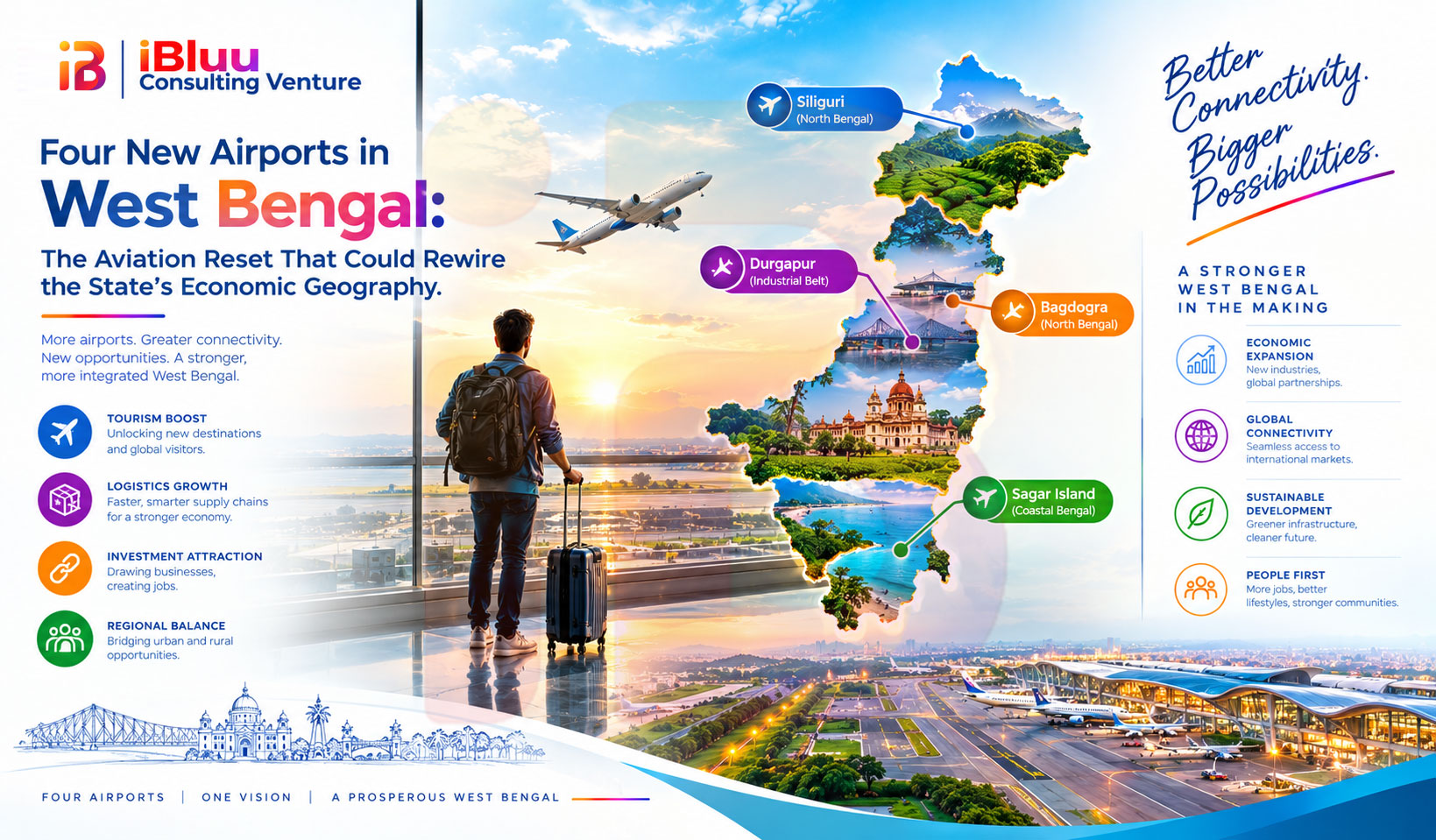
Four New Airports in West Bengal: From Airport Infrastructure to Economic Architecture — Building the State’s Emerging Multi-Hub Growth Model
From Regional Connectivity to Economic Infrastructure: How Chharra, Kalaikunda, Balurghat and Hasimara Could Create a Multi-Hub Network for Industry, Tourism, Trade, Logistics and Investment
Executive Summary: The Real Story Is Not Four Airports
West Bengal is entering a potentially important new phase in its aviation infrastructure.
An agreement signed in October 2026 between the state government and the Airports Authority of India (AAI), under the Centre’s regional-connectivity framework, has prioritised four airport projects at Chharra in Purulia, Kalaikunda in Paschim Medinipur, Balurghat in Dakshin Dinajpur and Hasimara in Alipurduar. The stated objective is to bring the four projects into operation within approximately two years.
But the strategic significance goes far beyond the construction of four aviation facilities.
The bigger opportunity is to move West Bengal from a highly concentrated aviation geography toward a distributed, multi-node economic network.
That distinction matters.
An airport is an infrastructure asset.
An airport network is an economic system.
The four projects could create new access points for industrial clusters, tourism destinations, high-value agriculture, tea, education, corporate travel, logistics and investment. Meanwhile, a proposed second greenfield airport near Kolkata—currently being explored around Kalyani—could eventually address the structural concentration of South Bengal’s air traffic and create a second major metropolitan aviation node. Around 2,000 acres across multiple mouzas have been identified for further examination, but the project remains at the development and land-process stage rather than being an approved operational airport.
The central question is therefore not:
“How many airports will West Bengal have?”
It is:
“What economic activity will these airports unlock—and can that activity become commercially self-sustaining?”
That is the real investment thesis.
1. The Aviation Baseline Is Changing
West Bengal’s existing aviation geography is dominated by Kolkata and Bagdogra, with Andal/Durgapur providing another civilian gateway and Cooch Behar retaining airport infrastructure but currently without scheduled airline service. AAI’s current information confirms that Cooch Behar has no scheduled airline operating at present.
This makes the new announcement more nuanced than the headline “four new airports” suggests.
The four projects are:
| Project | Geography | Strategic Configuration | Potential Economic Role |
|---|---|---|---|
| Chharra | Purulia | New airport development, phased | Tourism, industrial access, regional commerce |
| Kalaikunda | Paschim Medinipur | Civil enclave on existing airfield | Kharagpur industry, education, corporate travel, logistics |
| Balurghat | Dakshin Dinajpur | Revival/expansion | Regional commerce, agriculture, North–South connectivity |
| Hasimara | Alipurduar | Civil enclave on existing airfield | Dooars tourism, tea, regional commerce and logistics |
| Kalyani — proposed | Nadia | Potential greenfield airport | Second Kolkata hub, metropolitan decongestion, regional network |
The distinction between greenfield development, revival and civil-enclave conversion is critical for investors.
It changes capital intensity, implementation timelines, land requirements and operational complexity.
And it creates an opportunity to deploy capital more intelligently.
2. First Correction: ₹29,000 Crore Is Not a West Bengal-Only Airport Budget
The ₹29,000 crore figure is significant—but it needs to be interpreted correctly.
The Centre approved the Modified UDAN scheme with an overall outlay of approximately ₹29,000 crore over ten years. The national framework includes development of 100 aerodromes, operations and maintenance support, new helipads and continued viability-gap funding for regional airline operations.
Therefore, the ₹29,000 crore should not be presented as a ₹29,000 crore allocation exclusively for West Bengal.
The West Bengal projects are being prioritised within that broader national aviation programme.
This distinction is more than accounting hygiene.
It is fundamental to understanding project finance.
The state still needs to build an investable ecosystem around each airport—land, roads, utilities, terminal infrastructure, cargo facilities, aviation services, hotels, commercial real estate and airline demand.
Public expenditure can create the runway.
Private capital must increasingly create the ecosystem.
3. From Four Airports to a Multi-Hub Economic Network
The conventional way to evaluate airports is through passenger numbers.
The more sophisticated approach is to evaluate them through economic connectivity.
Consider the emerging geography:
Kolkata → Kalyani → Kalaikunda → Purulia → Balurghat → Hasimara/Bagdogra
This is not a literal airline route map.
It is an emerging economic-connectivity architecture.
Each node serves a different economic geography.
Kolkata
The metropolitan gateway for international business, corporate travel, finance, technology and global connectivity.
Kalyani
Potential second metropolitan aviation hub for northern Kolkata, Nadia and adjoining industrial and institutional zones.
Kalaikunda
Potential aviation gateway for the Kharagpur industrial and knowledge ecosystem.
Chharra
Potential gateway for Purulia’s industrial, mineral, cultural and tourism economy.
Balurghat
Potential aviation bridge for Dakshin Dinajpur and the wider North Bengal hinterland.
Hasimara
Potential gateway to the Dooars and a high-value tourism and tea economy.
This is the difference between airport development and economic geography engineering.
4. Kalaikunda: The Airport Could Become an Industrial Productivity Asset
Kalaikunda is particularly interesting because its value proposition extends beyond passengers.
The location sits within the wider Kharagpur industrial ecosystem.
Kharagpur already possesses industrial parks, engineering and manufacturing activity, major rail connectivity and proximity to Haldia and Kolkata-linked logistics networks. One existing industrial park in the area includes sectors such as iron and steel, telecom, engineering and food processing, while the wider industrial ecosystem includes major manufacturing investors.
Yet the existing airport-access equation has historically been a constraint.
Aviation connectivity changes the economics of time-sensitive corporate travel.
For multinational companies, senior management, engineering teams, technical specialists, investors and R&D personnel, saving several hours of surface travel can materially change the attractiveness of a location.
The strategic opportunity is therefore not simply:
Kharagpur + Airport = Better Connectivity
It is:
Airport + Industrial Land + IIT/Research Ecosystem + Rail + Road + Port Connectivity + Skilled Talent = Higher-Value Industrial Cluster
That is a much larger proposition.
If developed correctly, Kalaikunda can help reposition the Kharagpur region from a predominantly rail-road industrial location toward a multimodal industrial and knowledge corridor.
5. The Dual-Use Model: Capital Efficiency With Strategic Complexity
Kalaikunda and Hasimara are particularly significant because the proposed model involves civil enclaves on existing defence airfields. The existing runways at these locations are around 2,700 metres, providing an infrastructure base that could reduce the need to build entirely new runways.
From a capital-efficiency perspective, this is attractive.
The economic logic is straightforward:
Existing runway → lower greenfield civil works → faster deployment → lower initial capital burden → earlier commercialisation
But the model introduces a different risk profile.
Military and commercial aviation require:
- coordinated airspace management;
- controlled access and security protocols;
- segregated passenger and defence operations;
- coordinated aircraft movement procedures;
- robust emergency-response systems;
- defined operating windows;
- infrastructure-sharing protocols;
- clear responsibility matrices between defence, AAI, airlines and civil authorities.
The objective should not be merely to minimise CapEx.
It should be to maximise asset utilisation without compromising defence readiness or civil aviation reliability.
That requires institutional architecture as much as physical infrastructure.
6. Hasimara: Where Aviation Meets Tourism, Tea and the Dooars Economy
Hasimara could become one of the most strategically interesting regional nodes.
The Dooars possesses a distinctive combination of tourism assets, tea estates, forests, wildlife destinations and cross-border regional connectivity.
The aviation opportunity is therefore broader than passenger movement.
It is about compressing economic distance.
For tourism, the equation is:
Airport → Hotel → Wildlife/Tourism Circuit → Local Transport → Hospitality Spend → Employment
For high-value agriculture and tea:
Production → Processing → Quality Certification → Cold Chain → Airport → Domestic/International Market
That second equation deserves much greater attention.
West Bengal produced approximately 411 million kg of tea in 2025, around 30% of India’s total production. Dooars and Terai are major production regions within the state.
India’s tea exports also reached a record 280.40 million kg in 2025, generating approximately ₹8,488 crore in export earnings.
The strategic implication is not that all tea should suddenly move by air.
It should not.
Bulk, lower-value commodities generally remain better suited to rail and road.
The opportunity lies in high-value, time-sensitive, specialty and premium products where speed, quality preservation and market access can justify air logistics.
That could include specialty tea, premium agricultural products, perishables, flowers, seafood and selected processed foods.
The airport should therefore be designed not merely as a passenger terminal, but as a potential regional value-chain platform.
7. Tourism: Connectivity Can Change the Economics of the Destination
West Bengal’s tourism base is already substantial.
State budget data indicates that domestic tourist arrivals rose from approximately 8.8 crore in 2022 to 18.44 crore in 2024, while foreign tourist arrivals increased from around 10 lakh to 31 lakh over the same period.
But tourism value creation is not determined by visitor numbers alone.
The strategic variables are:
Length of Stay × Spend Per Visitor × Occupancy × Seasonality × Connectivity
A new airport can influence all five.
If air access reduces travel friction, destinations can attract:
- weekend travellers;
- premium domestic tourists;
- international tourists;
- corporate retreats;
- destination events;
- wildlife tourism;
- high-value experiential tourism.
But airport capacity alone will not produce this outcome.
The surrounding destination must be investable.
That means hotels, resorts, road connectivity, local mobility, digital booking systems, tourism circuits, safety infrastructure, destination management and professional hospitality capacity.
A runway does not create tourism.
A destination ecosystem does.
8. Chharra and Purulia: Aviation as a Regional Development Catalyst
Chharra represents a different model.
Rather than simply serving an existing large metropolitan market, the airport can potentially create a new economic access point for Purulia.
Its strategic catchment could combine:
- tourism;
- local commerce;
- industrial activity;
- mining-linked services;
- MSMEs;
- cultural tourism;
- institutional travel;
- regional government and corporate connectivity.
The challenge is demand density.
Purulia cannot be evaluated using the same passenger assumptions as Kolkata.
Its business case must therefore be built around a portfolio of demand, rather than a single traffic source.
That means combining:
Tourism + Business Travel + Government Travel + SME Mobility + Cargo + Seasonal Demand
The airport’s viability will depend on whether these demand streams can be deliberately aggregated.
9. Balurghat: Connectivity for a Region, Not Just a City
Balurghat could become an important bridge between North and South Bengal.
Its economic value is likely to be strongest when aviation is integrated with:
- district-level industrialisation;
- agricultural supply chains;
- road improvements;
- rail connectivity;
- warehousing;
- cold-chain infrastructure;
- healthcare access;
- education;
- government services.
This is where aviation policy intersects with regional-development policy.
An airport without surface connectivity creates an isolated node.
An airport connected to industrial parks, highways, railway stations, logistics centres and commercial clusters becomes an economic multiplier.
10. Kalyani: The Larger Metropolitan Question
Perhaps the most consequential long-term aviation proposal is not one of the four projects.
It is the proposed Kalyani greenfield airport.
The state has begun identifying land across approximately 2,000 acres in the Kalyani area, with the project intended to reduce pressure on Kolkata’s existing airport. However, the detailed project report, construction schedule and land processes remain to be finalised.
The strategic rationale is compelling.
Kolkata airport handled more than 21 million passengers in FY2025–26, placing it among India’s busiest aviation gateways.
The question is therefore not simply whether Kolkata needs additional capacity.
It is whether eastern India’s metropolitan aviation system should continue operating primarily through one dominant metropolitan gateway.
Kalyani could eventually enable a different model:
Kolkata Airport → International/Primary Hub
Kalyani → Secondary Metropolitan/Regional Hub
Bagdogra → North Bengal Gateway
Andal → Western Industrial Gateway
Regional Airports → Distributed Feeder Network
That architecture could transform the hub-and-spoke economics of eastern India.
But Kalyani should not be treated as a standalone airport project.
It should be conceived as part of a regional aviation masterplan integrating Kolkata, Bagdogra, Andal, Kalyani and the emerging regional airports.
11. The Civil Aviation Policy Is Now an Economic Necessity
The call for West Bengal to create a dedicated civil aviation policy is strategically important.
A new airport does not automatically attract airlines.
Airlines evaluate:
Passenger demand + fares + aircraft utilisation + airport charges + route economics + competitive intensity + turnaround time + connectivity + incentives
A state aviation policy should therefore provide a transparent framework for:
- route-development incentives;
- airport and aeronautical-charge support;
- ATF-related fiscal competitiveness where constitutionally and commercially feasible;
- viability-gap support;
- passenger-development incentives;
- cargo and cold-chain investment;
- MRO development;
- aviation-skilling programmes;
- airport-linked industrial development;
- private airport participation;
- multimodal connectivity;
- tourism-airline partnerships.
The objective should be to move from airport construction policy to aviation ecosystem policy.
12. The Biggest Risk: Building Airports Before Building Demand
This is where the investment story needs intellectual honesty.
India has repeatedly demonstrated that regional aviation infrastructure can face a difficult commercial problem:
Infrastructure can be created faster than sustainable demand.
The risk is the emergence of underutilised or intermittently served airports.
The solution is not to abandon regional aviation.
It is to build demand before capacity becomes stranded.
Each airport should have a route-development strategy built around a quantified catchment analysis.
A serious investment model should stress-test at least three scenarios:
| Scenario | Demand Environment | Strategic Response |
|---|---|---|
| Downside | Weak passenger conversion; limited airline commitment | Focus on essential connectivity, government support and phased CapEx |
| Base Case | Stable regional passenger demand + tourism growth | Expand routes gradually and develop commercial ecosystem |
| Upside | Strong tourism, industry, cargo and corporate demand | Accelerate route density, logistics, hospitality and commercial development |
The key metric should not be “airport completed.”
It should be:
“Airport commercially activated.”
13. Land Is the First Critical Path
The two-year ambition is aggressive.
The most important early-stage variables will be:
Land → Clearances → Design → Procurement → Construction → Certification → Airline Commitment → Commercial Launch
Any break in this chain can move the operational date.
This makes land availability and administrative coordination particularly important for Chharra, Balurghat and any future greenfield development.
Kalyani presents an even larger land-and-planning challenge because the project is expected to involve a substantial greenfield footprint and surrounding urban development.
For investors, the lesson is straightforward:
Do not underwrite the headline date. Underwrite the critical path.
14. The Investment Opportunity Is Larger Than the Airport
The airport itself is only the first layer.
The second-order opportunity could include:
Around Regional Airports
- hotels;
- business centres;
- restaurants;
- retail;
- parking;
- mobility services;
- aviation services.
Around Industrial Gateways
- warehouses;
- light manufacturing;
- industrial parks;
- cold storage;
- fulfilment centres;
- logistics parks;
- corporate offices.
Around Tourism Gateways
- resorts;
- eco-tourism;
- destination management;
- premium transport;
- experiential hospitality.
Around Aviation Infrastructure
- ground handling;
- MRO;
- pilot training;
- aviation academies;
- cargo handling;
- drone logistics;
- aviation technology.
This is the airport-adjacency economy.
Globally, the largest value creation around airports often comes not from passenger fees alone, but from the commercial ecosystem that forms around connectivity.
15. Cargo Could Be the Underestimated Opportunity
Passenger traffic receives the headlines.
Cargo can create the economic depth.
West Bengal sits at the intersection of eastern India, North-East India, Bangladesh-facing trade geography and major industrial corridors.
The opportunity is to develop differentiated regional cargo strategies rather than replicate metropolitan cargo infrastructure at every airport.
For example:
Hasimara → tea, perishables, premium agricultural products
Kalaikunda → industrial components, engineering products, high-value manufacturing inputs
Balurghat → agricultural and regional products
Chharra → selected high-value regional products and industrial supply chains
The strategic principle should be:
Do not move everything by air. Move what becomes significantly more valuable when time becomes shorter.
That is the economics of premium air logistics.
16. Defence-Civilian Dual Use: The Strategic Dimension
There is also a broader national-security dimension.
India increasingly needs aviation infrastructure that can support both civilian economic activity and strategic mobility.
The Kalaikunda and Hasimara civil-enclave model demonstrates how existing strategic assets can potentially support broader economic connectivity without duplicating every piece of infrastructure.
But this model must be governed carefully.
The priority should be:
Defence readiness first.
Civil efficiency second.
Shared infrastructure where operationally compatible.
That requires clearly defined protocols rather than ad-hoc coordination.
If executed well, the model can become a template for capital-efficient regional aviation development in other parts of India.
17. What Investors Should Measure
The most sophisticated investors will look beyond airport construction.
They should monitor:
| Investment Indicator | Why It Matters |
|---|---|
| Route Commitment | Indicates genuine airline demand |
| Passenger Catchment | Measures addressable market |
| Load Factor Trajectory | Tests commercial sustainability |
| Aircraft Frequency | Measures network depth |
| Cargo Throughput | Indicates industrial integration |
| Hotel Occupancy | Measures tourism conversion |
| Industrial Land Absorption | Tests economic spillover |
| Warehouse Demand | Measures logistics activation |
| Travel-Time Reduction | Quantifies productivity gains |
| Private CapEx Around Airport | Measures investor confidence |
| Airport-to-Industrial-Cluster Connectivity | Tests economic integration |
| Operating Subsidy Dependency | Measures long-term viability |
The ultimate KPI is not passenger volume.
It is economic value created per unit of aviation infrastructure.
18. Three Possible Futures for West Bengal’s Aviation Economy
Scenario 1 — Infrastructure Expansion
Four airports become operational, but airline schedules remain limited.
Connectivity improves.
Economic transformation remains modest.
Outcome: Better mobility, limited multiplier.
Scenario 2 — Regional Aviation Network
Airlines establish sustainable regional routes.
Tourism grows.
Industrial clusters begin using the airports.
Cargo infrastructure develops.
Outcome: Regional economic diversification accelerates.
Scenario 3 — Integrated Aviation Economy
The airports become embedded into a wider system of:
Industrial Corridors + Tourism Circuits + Cargo Networks + Rail + Highways + Logistics Parks + Airports + Digital Infrastructure + Investment Zones
Kalyani becomes a second metropolitan aviation node.
Kalaikunda supports an industrial cluster.
Hasimara becomes a tourism-and-tea gateway.
Balurghat becomes a regional commerce node.
Chharra anchors Purulia’s connectivity.
Outcome: West Bengal moves from airport expansion to genuine multi-hub economic architecture.
This is the scenario with the greatest strategic upside.
19. What the State Should Do Now
For State Policymakers
1. Publish a dedicated Civil Aviation Policy.
Give airlines, developers and investors a predictable framework.
2. Build airport-to-cluster connectivity before terminal capacity.
A 30-minute surface connection can be more economically valuable than a larger terminal.
3. Create airport-specific economic development plans.
Do not give Chharra, Kalaikunda, Balurghat and Hasimara identical strategies.
4. Build cargo ecosystems selectively.
Prioritise commodities where speed creates measurable economic value.
5. Integrate aviation with tourism policy.
Air connectivity should be linked directly with destination development.
6. Develop a West Bengal Aviation Masterplan.
The four projects, Kolkata, Bagdogra, Andal, Cooch Behar and the proposed Kalyani airport should be evaluated as one network.
20. What Investors and Developers Should Do
Institutional capital should look beyond the airport boundary.
The early opportunities are likely to emerge around:
Airport-linked logistics
Hospitality
Warehousing
Cold chains
Industrial parks
Commercial real estate
Mobility
Tourism infrastructure
Aviation services
MRO and training
But investment should be phased against demonstrated demand.
The most attractive assets will not necessarily be the ones closest to the terminal.
They will be the assets positioned at the intersection of aviation, industry and consumer demand.
21. What Airlines Should Do
Airlines should not view these airports simply as government-supported regional routes.
They should identify where the network can create first-mover advantage.
The strategic opportunity is to establish route leadership before competitors arrive.
But the route strategy should be based on:
Catchment economics + tourism seasonality + corporate demand + connecting traffic + cargo potential + aircraft utilisation
The objective is not to launch the maximum number of routes.
It is to build the most economically resilient network.
22. iBluu Perspective: The Runway Is Not the Strategy
The most important question surrounding West Bengal’s four-airport expansion is not whether the state can build four more aviation facilities.
It is whether the state can turn aviation into a platform for economic transformation.
The strongest model is not:
Airport → Passenger
It is:
Airport → Connectivity → Investment → Industry → Tourism → Logistics → Employment → Exports → Regional Competitiveness
That is the multiplier.
And this is why the four projects should be viewed as part of a much larger economic architecture.
Chharra can connect Purulia.
Kalaikunda can connect industry.
Balurghat can connect regional markets.
Hasimara can connect the Dooars.
Kalyani could eventually connect a second metropolitan growth axis.
Together, they have the potential to create something much more valuable than four airports:
a distributed economic network.
The analytical depth of this article has been shaped by the strategic lens of J Parasher, Founder and Managing Director of iBluu Consulting Venture (iBCV), a venture of iBluu Corporations, whose work consistently focuses on national capability building, global industrial benchmarking and long-horizon economic transformation. His perspective reframes consulting not as a sectoral play, but as a strategic economic system with export potential, innovation leverage and geopolitical relevance.
23. The Final Test: Connectivity Must Become Competitiveness
West Bengal does not need airports merely because other states have more airports.
It needs aviation infrastructure that changes the economics of doing business.
The next decade should therefore be measured not only by:
runways built,
terminals commissioned,
or
flights launched.
It should be measured by:
investment unlocked,
industrial capacity created,
tourism value captured,
cargo moved,
travel time eliminated,
jobs generated,
exports expanded,
and ultimately,
regional economic productivity increased.
The runway is only the beginning.
The real asset is the economic network built around it.
West Bengal now has an opportunity to move from a concentrated aviation model to a distributed one—from connectivity as infrastructure to connectivity as economic strategy.
Four airports can improve mobility.
A connected aviation ecosystem can reshape economic geography.
And that is the larger opportunity now taking shape across West Bengal.
Disclaimer: This article is intended for strategic, informational and analytical purposes only. Project configurations, timelines, land availability, airline operations, investment commitments, policy frameworks and proposed infrastructure may evolve subject to statutory approvals, feasibility assessments, land and environmental processes, defence clearances, financing, procurement, airline economics and other regulatory or market conditions. Any forward-looking observations, scenario analysis or investment implications represent strategic perspectives rather than forecasts, investment advice or guarantees of commercial outcomes.