+91 945 889 6091
  infodesk@ibluu.com
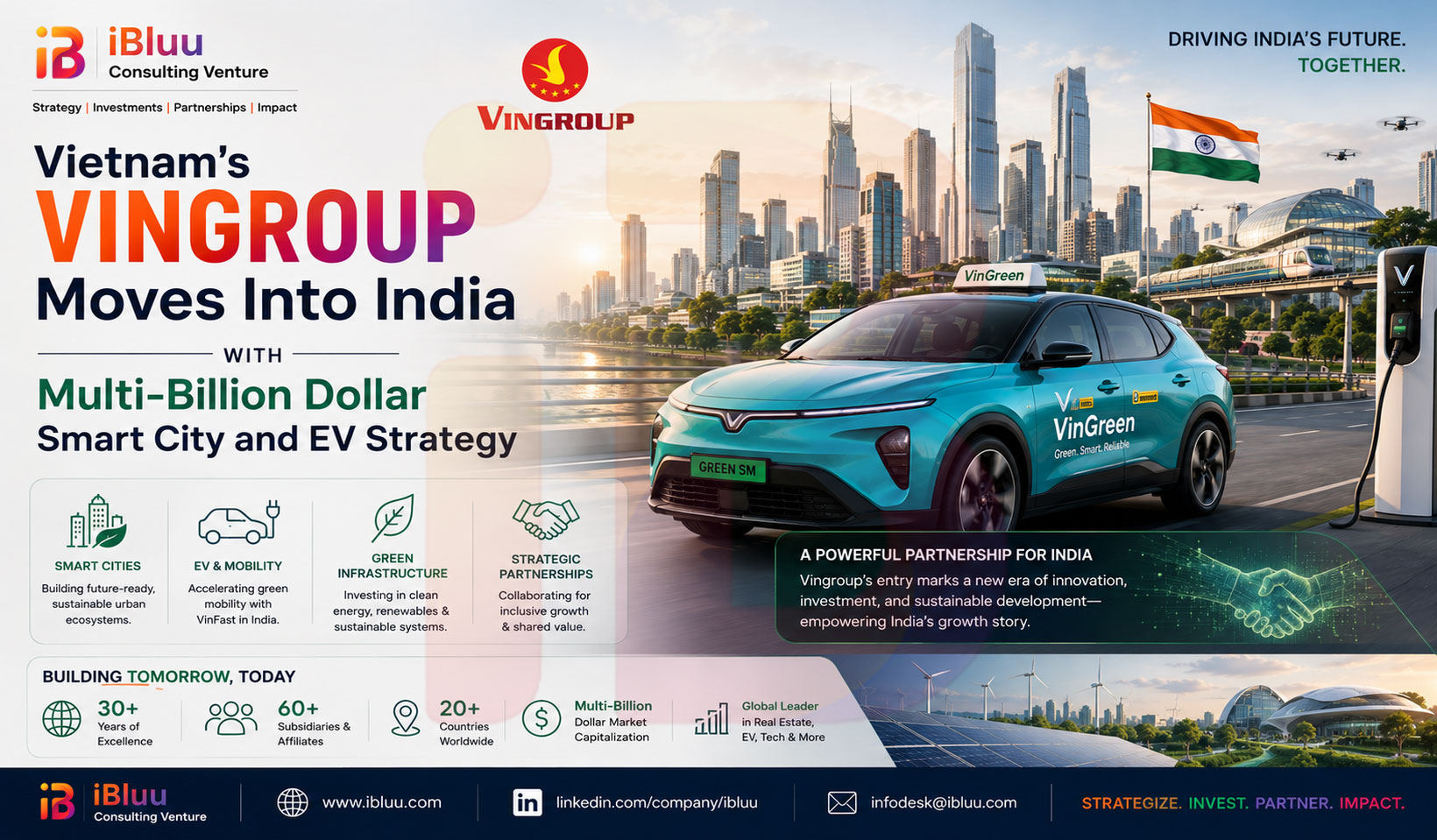
From Vietnam to India: Inside Vingroup’s Multi-Billion-Dollar Blueprint to Build an EV, Smart City and Green Infrastructure Expansion Strategy
India Is Becoming More Than a Market. It Is Becoming Vingroup’s Next Strategic Operating Platform.
India’s investment story is increasingly being defined not simply by the scale of foreign capital entering the country, but by the architecture of what global companies are attempting to build once they arrive.
Against that backdrop, Vietnam’s Vingroup is emerging as an important case study.
The conglomerate is no longer approaching India solely through electric vehicles. Its strategy is expanding toward a broader ecosystem spanning electric mobility, integrated urban development, renewable energy, charging infrastructure, tourism, healthcare and education.
The signal is significant.
Vingroup’s India strategy increasingly resembles an attempt to replicate an integrated ecosystem model—where mobility, energy, real estate, social infrastructure and consumer services reinforce one another rather than operate as disconnected businesses.
That makes its India expansion strategically more consequential than any individual investment announcement.
The question is no longer simply how many vehicles will VinFast manufacture in India?
The more important question is:
Can Vingroup use India as a multi-sector growth platform connecting mobility, cities, energy and infrastructure at unprecedented scale?
The answer will depend on execution. But the strategic intent is becoming increasingly difficult to ignore.
Executive Perspective: From EV Entry to Ecosystem Construction
Vingroup is Vietnam’s largest private multi-sector corporation, with businesses spanning industrials and technology, real estate and services, infrastructure, green energy, culture and social enterprises.
Its Indian expansion has developed through several layers.
First came VinFast, establishing an electric-vehicle manufacturing presence in Tamil Nadu.
Then came broader state-level investment discussions.
In December 2025, Vingroup signed an MoU with Telangana for a proposed US$3 billion, phased multi-sector ecosystem across approximately 2,500 hectares. The framework includes smart urban development, electric mobility, healthcare, education, tourism, renewable energy and charging infrastructure.
In April 2026, Vingroup signed another MoU with Maharashtra for approximately US$6.5 billion of potential investment, including integrated urban townships, electric mobility, renewable energy and social/public infrastructure.
And in Tamil Nadu, the group’s EV platform is moving beyond its initial automobile manufacturing footprint. VinFast announced a further US$500 million Phase II investment at Thoothukudi, including dedicated production lines for electric buses and e-scooters, alongside manufacturing, assembly and testing capabilities.
The emerging architecture is therefore clear:
EV manufacturing → mobility services → charging → renewable energy → smart urban development → healthcare → education → tourism.
This is not a conventional market-entry strategy.
It is an ecosystem strategy.
1. Maharashtra: The Most Ambitious Urban-Mobility Play
The Maharashtra MoU represents perhaps the most consequential component of Vingroup’s current Indian expansion.
The official announcement describes approximately US$6.5 billion of investment opportunities across Maharashtra and the Mumbai Metropolitan Region.
The urban-development component alone is estimated at approximately US$5 billion, centred on integrated townships spanning approximately 1,000 hectares.
The proposed developments are intended to combine residential and commercial components with education, healthcare and integrated amenities.
This matters because the project is not being conceived merely as a housing development.
It is being positioned as a new urban growth centre connected to the broader Mumbai 3.0 development narrative.
The mobility layer
Vingroup, through GSM India, is also proposing approximately 60,000 electric vehicles for an electric taxi and mobility-as-a-service platform across Mumbai and Maharashtra.
The estimated investment for this mobility initiative is approximately US$1.5 billion.
That creates a potentially powerful flywheel:
Urban population → mobility demand → EV fleet → charging infrastructure → renewable electricity → energy demand → urban development.
This is strategically important because mobility becomes both a transportation business and an infrastructure-demand generator.
2. Telangana: A US$3 Billion Ecosystem Blueprint
The Telangana proposal provides perhaps the clearest illustration of Vingroup’s broader strategic model.
The December 2025 MoU envisages a phased US$3 billion investment ecosystem covering approximately 2,500 hectares.
Its proposed components include:
- A Vinhomes Smart City development
- Electric mobility and electric taxi services
- Renewable energy
- EV charging infrastructure
- Healthcare
- Education
- Tourism and entertainment
- Strategic connectivity infrastructure
The proposed Vinhomes Smart City would occupy approximately 1,080 hectares and is designed for roughly 200,000 residents.
The project could generate approximately 10,000 jobs, according to Vingroup’s proposal.
The social-infrastructure layer includes plans for Vinschool education facilities, Vinmec healthcare infrastructure and V-Green charging infrastructure.
The tourism component is equally ambitious: Vingroup proposes a roughly 350-hectare integrated theme-park, zoo and safari development through VinWonders.
And beneath the ecosystem sits energy infrastructure.
Vingroup’s VinEnergo proposes a 500 MW solar farm covering approximately 500 hectares to supply green electricity to urban areas, industrial zones and the electrified mobility ecosystem.
This is the critical strategic insight:
The proposed smart city is not simply a real-estate project. It is designed as an energy-consuming, mobility-intensive and digitally connected economic ecosystem.
3. Tamil Nadu: Where the Strategy Has Already Acquired Industrial Form
Tamil Nadu is different.
Maharashtra and Telangana represent major proposed ecosystem expansions. Tamil Nadu already has an operating industrial foundation.
VinFast’s Thoothukudi facility represents the manufacturing backbone of Vingroup’s Indian EV strategy.
The company initially committed approximately US$2 billion to the Tamil Nadu manufacturing programme. Its first phase included a facility with an initial annual production capacity of approximately 50,000 EVs, with expansion potential toward 150,000 vehicles annually.
In December 2025, VinFast announced a further US$500 million Phase II investment, with approximately 500 acres of additional land proposed for expansion.
The expansion is designed to support electric buses and e-scooters in addition to electric cars, covering manufacturing, assembly, testing and related activities.
That creates another strategic layer.
Vingroup is effectively building an Indian EV platform capable of addressing multiple mobility segments:
Passenger cars → electric two-wheelers → electric buses → fleet mobility → charging infrastructure.
Tamil Nadu therefore serves as the industrial anchor for the broader Indian ecosystem.
4. The Real Strategy: Build an Integrated Green-Economy Flywheel
The most important aspect of Vingroup’s India expansion is not any single investment.
It is the interconnection between businesses.
Consider the architecture.
Electric Mobility
VinFast provides the vehicle platform.
Fleet Mobility
GSM can create large-scale demand for those vehicles through electric taxi and mobility-as-a-service operations.
Charging
V-Green can develop the charging infrastructure required to support fleet and private EV adoption.
Renewable Energy
VinEnergo can develop renewable generation to support the broader electricity ecosystem.
Urban Development
Vinhomes can create large integrated urban developments where mobility, energy and social infrastructure can be designed together.
Healthcare
Vinmec adds institutional healthcare infrastructure.
Education
Vinschool creates education infrastructure inside the ecosystem.
Tourism
VinWonders adds entertainment and tourism infrastructure.
The strategic proposition becomes considerably larger than EV manufacturing.
It becomes:
Build the city. Power the city. Move the city. Educate the city. Heal the city. Entertain the city.
That is a fundamentally different industrial model.
5. Why India Is Strategically Important to Vingroup
India offers Vingroup something that few markets can replicate simultaneously:
scale + manufacturing capability + urbanisation + energy transition + consumer growth + policy support + export potential.
India is among the world’s largest automobile markets and is rapidly developing its electric mobility ecosystem.
At the same time, the country is investing heavily in renewable generation, transmission, charging infrastructure, industrial corridors, logistics and urban infrastructure.
This creates an unusually large addressable market for a conglomerate whose businesses span precisely these sectors.
The opportunity is therefore not limited to Indian consumers.
India can potentially function as:
A manufacturing base.
A consumption market.
A technology and supply-chain platform.
A regional export hub.
A renewable-energy platform.
A mobility laboratory.
That strategic optionality is likely one of the most powerful attractions.
6. The Energy-Mobility Nexus Could Become a Competitive Differentiator
One of the most interesting components of Vingroup’s strategy is the relationship between EVs and renewable energy.
Electric mobility is ultimately an electricity-demand business.
If EV penetration accelerates, charging demand rises.
If charging demand rises, grid requirements increase.
If renewable energy supplies that electricity, the carbon intensity of mobility can decline.
Vingroup’s proposed Telangana model explicitly connects its 500 MW solar proposal with urban areas, industrial zones and the electrified mobility ecosystem.
This creates a potential vertically integrated model:
Renewable generation → electricity → charging → EV fleet → mobility services → urban demand.
The economics will ultimately determine whether this integration creates genuine value, but strategically it offers Vingroup the possibility of controlling more of the value chain than a conventional automobile manufacturer.
7. The Investment Numbers Are Large—but They Must Be Read Correctly
A critical distinction is necessary for investors and policymakers.
These announcements are primarily MoUs, frameworks and proposed investments—not equivalent to fully deployed capital.
The Maharashtra official announcement describes approximately US$6.5 billion in investment exploration.
The Telangana MoU describes a proposed US$3 billion phased ecosystem.
Tamil Nadu’s US$500 million Phase II investment is linked to a specific manufacturing expansion framework.
Therefore, headline investment values should not automatically be interpreted as immediate committed capital expenditure.
For investors, the relevant progression is:
MoU → land allocation → approvals → project SPV → financial close → construction → commissioning → commercial operations.
Each stage converts strategic intent into financial reality.
That distinction is essential.
8. What Could Make the Strategy Work?
Vingroup possesses several potential structural advantages.
1. Ecosystem integration
The company can potentially create demand across multiple businesses rather than relying on a single product category.
2. Manufacturing localisation
India can become an increasingly localised production base rather than simply an import market.
3. Large domestic demand
The country’s scale provides room for multiple EV and mobility segments to grow simultaneously.
4. Renewable-energy alignment
Large-scale renewable investment can support both corporate decarbonisation and the electricity requirements of mobility infrastructure.
5. Urbanisation
India’s rapidly expanding cities create a large long-term market for integrated townships and urban infrastructure.
6. Cross-sector capital deployment
A conglomerate structure potentially allows capital to move between sectors according to changing market opportunities.
9. But the Strategy Faces Material Risks
Strategic ambition does not eliminate execution risk.
Indeed, the larger the ecosystem, the more complex the execution.
Capital Intensity
Smart cities, manufacturing plants, solar farms, hospitals, schools, tourism assets and charging networks require substantial upfront capital.
Regulatory Complexity
Each business operates under a different regulatory framework.
Automotive manufacturing, electricity generation, land development, healthcare, education and tourism all require different approvals.
Land and Infrastructure
Large integrated developments depend on land aggregation, connectivity, utilities and timely government infrastructure.
EV Competition
India’s EV market is increasingly competitive, with established domestic manufacturers and global players competing across passenger vehicles, commercial mobility and two-wheelers.
Consumer Adoption
Large-scale EV fleet economics depend on utilisation, financing costs, battery economics, charging availability and residual values.
Project Execution
The difference between an MoU and a successful megaproject is execution discipline.
The strategic question is therefore not whether the vision is large.
It is whether the organisation can execute multiple capital-intensive businesses simultaneously across several Indian states.
10. The Competitive Implication for Indian Industry
Vingroup’s entry should not be interpreted simply as another foreign automobile manufacturer entering India.
It potentially introduces a different competitive proposition:
ecosystem competition.
Indian companies increasingly compete not only on products, but on integrated platforms.
An EV manufacturer may compete on vehicles.
A real-estate developer may compete on townships.
An energy company may compete on solar.
A mobility company may compete on fleets.
But Vingroup’s model attempts to connect all four.
That creates a strategic question for Indian businesses:
Will the next generation of competition occur between companies—or between ecosystems?
If the latter becomes true, companies with strong partnerships across energy, mobility, infrastructure, technology and urban development could gain structural advantages.
11. What Indian Companies Can Learn
Vingroup’s Indian strategy offers several lessons for Indian businesses.
Build ecosystems, not isolated businesses.
A successful platform can create multiple reinforcing revenue streams.
Integrate infrastructure with demand.
Energy infrastructure becomes more valuable when linked directly to predictable consumption.
Think beyond domestic scale.
India’s scale is enormous, but companies that develop globally competitive capabilities can use India as a launchpad for international expansion.
Create institutional partnerships early.
Large infrastructure projects require alignment between developers, governments, investors, lenders, technology companies and local partners.
Treat sustainability as infrastructure economics.
Renewable energy and EVs should not be viewed merely through an ESG lens. They are increasingly becoming fundamental components of industrial competitiveness.
12. The Geopolitical Dimension: India–Vietnam Economic Convergence
There is also a broader geopolitical dimension.
India and Vietnam are strengthening economic and strategic relationships within an Indo-Pacific environment increasingly shaped by supply-chain diversification, manufacturing resilience and clean-energy transition.
Vingroup’s expansion creates a private-sector channel through which economic ties can deepen.
The significance extends beyond one corporation.
If Vingroup successfully establishes manufacturing, mobility, energy and urban infrastructure ecosystems in India, it could become an example of Vietnamese capital and industrial capability integrating with India’s growth architecture.
That model could encourage additional Vietnamese companies to consider India not merely as an export destination but as an investment and production base.
13. From Company Expansion to Economic Architecture
The deeper significance of Vingroup’s India strategy lies here:
It is attempting to move from selling into India to building inside India.
That distinction matters.
A company selling vehicles captures consumer demand.
A company manufacturing vehicles captures industrial value.
A company operating mobility fleets captures service value.
A company building charging networks captures infrastructure value.
A company developing renewable energy captures power-system value.
A company developing cities captures long-duration real-estate and urban value.
When those businesses are integrated, the economic opportunity becomes considerably larger.
This is why Vingroup’s strategy deserves to be watched beyond the automobile sector.
14. What Investors and Strategic Partners Should Watch Next
The headline MoUs are only the beginning.
The next indicators will determine whether the strategy becomes transformational.
Investors and strategic partners should monitor:
Land allocation: Has identified land moved from proposal to legally executable development?
Approvals: Are statutory and sector-specific approvals progressing?
Capital deployment: Is announced capital translating into actual project expenditure?
Manufacturing localisation: How quickly does the Indian supply chain deepen?
EV volumes: Can VinFast achieve sustainable production and sales scale?
Fleet utilisation: Can GSM achieve commercially viable utilisation rates?
Charging density: Does V-Green create sufficient network coverage?
Renewable integration: Can proposed renewable assets support economically viable energy demand?
Urban absorption: Can large township developments achieve sustainable occupancy and commercial demand?
Financing: Can the projects secure competitive long-term capital?
These indicators will tell the market far more than headline MoU values.
15. Strategic Outlook
Vingroup’s Indian expansion is still a developing story.
But its direction is becoming increasingly clear.
The company is moving from a single-sector EV entry toward a potentially integrated platform spanning:
Mobility.
Manufacturing.
Renewable Energy.
Charging Infrastructure.
Smart Cities.
Healthcare.
Education.
Tourism.
Maharashtra brings the scale of the Mumbai metropolitan opportunity.
Telangana brings the integrated smart-city and renewable-energy blueprint.
Tamil Nadu brings the industrial and manufacturing foundation.
Together, they suggest a broader strategic ambition.
India is not being approached simply as another sales market.
It is being positioned as a long-term operating ecosystem.
The Strategic Bottom Line
The most important question surrounding Vingroup’s India strategy is not whether the company can announce multi-billion-dollar projects.
It is whether it can convert capital, technology, manufacturing, infrastructure and ecosystem integration into commercially sustainable Indian platforms.
That distinction will define the outcome.
If successful, Vingroup could become more than a foreign EV manufacturer in India. It could evolve into a multi-sector infrastructure and consumer ecosystem connecting electric mobility, renewable energy and next-generation urban development.
And that would carry significance far beyond Vingroup.
It would demonstrate how a global conglomerate can enter one of the world’s fastest-growing economies not by competing in a single industry, but by building an interconnected economic system around the structural needs of the market.
The larger strategic lesson is unmistakable:
The next generation of global investment will not be defined merely by where capital goes. It will be defined by how intelligently capital connects industries, infrastructure, technology and human demand.
India is becoming one of the world’s most important arenas for that convergence.
Vingroup appears determined to participate in it at scale.
Strategic Lens: J Parasher, Founder & Managing Director, iBluu Corporations
The analytical perspective of this article has been shaped by the strategic lens of J Parasher, Founder and Managing Director of iBluu Consulting Venture (iBCV), a venture of iBluu Corporations, whose work focuses on national capability building, global industrial benchmarking and long-horizon economic transformation.
His perspective views major investment programmes not as isolated sectoral transactions, but as components of a broader economic architecture—where capital, policy, infrastructure, technology, energy, mobility and urbanisation converge to create scalable economic ecosystems.
For businesses and investors, that lens changes the central question from “What is the investment?” to:
“What economic system is being built—and where can strategic capital, technology and partnerships create the greatest long-term value?”
That is ultimately the more consequential question for India’s next phase of global investment.
Sources & verification
Key factual claims in this analysis have been cross-checked against Vingroup’s official announcements, Maharashtra’s MMRDA, VinFast India and Reuters reporting. The Maharashtra figure is presented primarily as approximately US$6.5 billion, consistent with the official Vingroup announcement; larger figures reported elsewhere are not treated as confirmed committed capital.
About iBluu Corporations: iBluu Corporations — a multidisciplinary consulting and advisory platform focused on business strategy, infrastructure development, strategic government engagement, renewable energy, real estate, healthcare and technology.
Disclaimer: This article is intended for strategic, informational and thought-leadership purposes only. Investment values cited for proposed projects, particularly MoUs and investment frameworks, should not be interpreted as guaranteed capital deployment. Project scope, timelines, approvals, financing, land availability, regulatory conditions and commercial structures may change. Investors and businesses should conduct independent legal, financial, technical, tax, regulatory and commercial due diligence before making investment or participation decisions.