+91 945 889 6091
  infodesk@ibluu.com
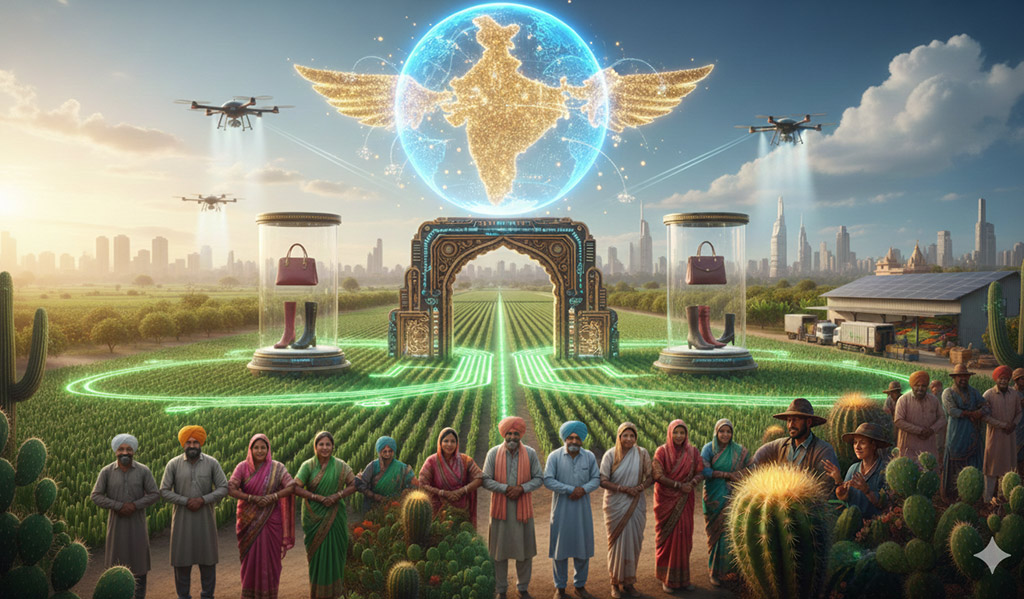
Cactus Vegan Leather and the Architecture of a Multi-Billion-Dollar Industry Across Fashion, Sustainability, and Global Trade
In a world where fashion has long relied on animal leather and petroleum-based synthetics, one Indian startup made a radically different choice.
Not cows.
Not chemicals.
Cactus.
What began as an unconventional idea is now emerging as one of the most credible material innovations of the decade—a plant-based alternative to leather that aligns sustainability, scalability, and commercial performance in ways traditional materials no longer can.
This is not a niche sustainability story.
It is a strategic industrial shift.
Cactus 🌵 Vegan Leather: A Material Designed for the Next Economy
Cactus leather—derived primarily from the Nopal cactus—represents a new class of bio-materials engineered for a world under environmental, regulatory, and ethical pressure.
Unlike animal leather, it does not depend on livestock, deforestation, or water-intensive tanning.
Unlike plastic-based “vegan” leathers, it does not lock industries into fossil-fuel dependency or microplastic pollution.
Instead, cactus leather delivers a rare trifecta:
🔹 Low water consumption (up to 90% less than animal leather)
🔹 Rapid regrowth cycles without replanting
🔹 Cruelty-free, non-toxic production
🔹 Durability and texture compatible with luxury standards
🔹 Scalable agricultural economics
This is why global fashion houses, automotive brands, and lifestyle companies are no longer asking if bio-leathers will scale—but how fast.
Why the Environmental Case Is Also a Business Case
Sustainability is no longer a moral add-on.
It is a competitive requirement.
Cactus leather directly addresses the most acute pain points facing global manufacturers:
Environmental Advantages
- Minimal land and water footprint
- Reduced greenhouse gas emissions
- No toxic chromium tanning
- Regenerative farming potential in arid regions
Strategic Business Advantages
- Compliance-ready for tightening ESG and carbon regulations
- Supply-chain diversification away from volatile livestock markets
- Strong brand resonance with Gen Z and millennial consumers
- Premium positioning without ethical compromise
For business houses, cactus leather is not just an alternative material—it is a risk-mitigation asset and a brand accelerator.
The Economics: From Sustainable Idea to Scalable Revenue Engine
The global vegan leather market is already valued in the multi-billion-dollar range and is projected to grow at double-digit CAGR over the next decade.
Within this market, plant-based leathers—especially cactus—are gaining disproportionate attention due to their balance of performance and sustainability.
Revenue Potential (Indicative Outlook)
- High-margin B2B supply contracts with fashion, footwear, automotive, and furniture brands
- Export-driven revenue from Europe, North America, and East Asia
- Long-term annuity models through farming + processing + material licensing
India, with its agricultural base, cost efficiency, and manufacturing depth, is uniquely positioned to become a global production hub for cactus-based vegan leather.
The opportunity is not incremental.
It is industry-defining.
Global Demand: Why the World Is Looking to India
International markets are actively searching for credible, scalable, and ethically produced vegan leather.
Europe is tightening sustainability regulations.
The U.S. is witnessing consumer-led pressure on fashion brands.
Luxury houses are re-engineering supply chains for ESG transparency.
India offers something rare:
- Climate suitability for cactus cultivation
- Skilled agri and manufacturing labor
- Cost competitiveness
- Export infrastructure
- Government alignment on sustainability and innovation
The result: India’s vegan leather is no longer “emerging”—it is being actively sought.
The Future of Vegan Leather: India and the World
The trajectory is clear.
Over the next decade:
- Animal leather will face increasing regulatory and reputational pressure
- Plastic-based alternatives will struggle under environmental scrutiny
- Bio-materials like cactus leather will move from innovation labs to mainstream supply chains
India has the opportunity to:
✔ Lead global production
✔ Control intellectual property
✔ Anchor exports
✔ Build farmer-linked industrial ecosystems
✔ Shape international sustainability standards
The question is not whether vegan leather will scale.
The question is who will control the ecosystem.
Where iBluu Consulting Venture Private Limited Creates Strategic Leverage
This transformation does not happen through innovation alone.
It requires alignment—between entrepreneurs, farmers, global buyers, and government institutions.
That is where iBluu Consulting Venture Private Limited, a venture of iBluu Corporations, plays a catalytic role.
Our Strategic Mandate
We connect visionary companies with government authorities and global markets to build a fully integrated vegan leather ecosystem.
Our role spans:
🔹 Business and Strategic Consulting
🔹 Strategic Government Engagement and Policy Advisory
🔹 Facilitating access to cactus seeds and cultivation frameworks
🔹 Real Estate and land advisory for cactus farming and harvesting
🔹 Structuring export pathways and international partnerships
🔹 Connecting Indian producers with global fashion and industrial buyers
We don’t just advise on sustainability.
We build commercially viable sustainability systems.
A Material Shift with Global Consequences
Cactus vegan leather is more than an alternative.
It is a signal.
A signal that the future of fashion, materials, and manufacturing will be shaped by those who rethink inputs, redesign supply chains, and realign with the planet.
India has a moment.
Cactus leather is one of its sharpest opportunities.
Those who move early will not just participate in the market—
they will define it.