+91 945 889 6091
  infodesk@ibluu.com
Why Israel, Russia, and Europe Now See India as the Backbone of Global Manufacturing
The Quiet Re-Architecture of Global Supply Chains
For more than three decades, global manufacturing followed a predictable logic: optimize for cost, centralize production, and stretch supply chains across borders.
That model is now obsolete.
What is emerging in its place is not a temporary rebalancing—but a structural redesign of how, where, and with whom the world produces. In this redesign, one reality has become unmistakably clear:
India is no longer an alternative. It is becoming the default.
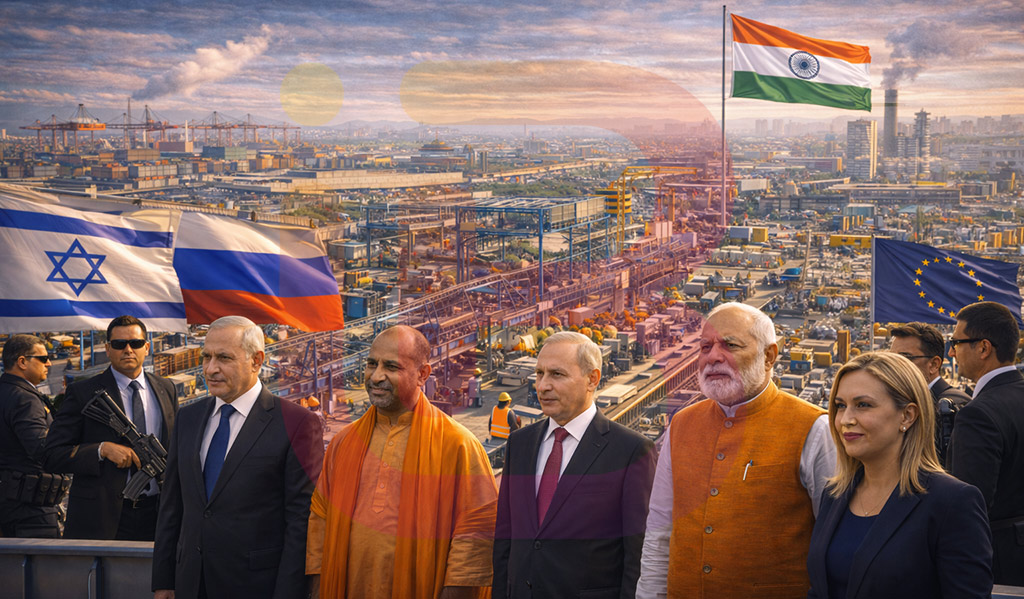
From Israel’s advanced manufacturing ecosystem, to Russia’s strategic industrial recalibration, to Europe’s search for resilient production partners, a growing number of nations are converging on India—not out of necessity alone, but by strategic choice.
This shift is neither ideological nor sentimental.
It is cold, rational, and economically inevitable.
1. The End of the Single-Point-of-Failure World
Global shocks—geopolitical conflict, sanctions, trade wars, pandemics, energy disruptions—have exposed a hard truth:
Efficiency without resilience is fragility.
Israel, Russia, and European economies are rethinking production through a new lens:
- Supply continuity
- Political neutrality
- Scalable redundancy
- Long-term partner reliability
India sits at the rare intersection of all four.
Unlike tightly aligned blocs, India maintains strategic autonomy—engaging with the US, Europe, Russia, the Middle East, and Asia without being structurally dependent on any single axis. For global manufacturers, this neutrality is not diplomatic—it is operational insurance.
2. Cost Is No Longer the Differentiator. Scale Is.
The world does not need cheaper factories.
It needs factories that can grow without breaking.
India offers something few nations can replicate:
- A workforce that scales from thousands to millions
- Industrial ecosystems that expand horizontally, not just vertically
- Domestic demand large enough to anchor global production economics
For Israel, this means rapid scale-up of advanced components and dual-use technologies.
For Russia, it means industrial continuity amid sanctions and realignment.
For Europe, it means de-risking production without deindustrializing.
India is not winning because it is inexpensive.
India is winning because it can absorb scale without destabilizing cost, quality, or timelines.
3. Manufacturing Has Become a Geopolitical Strategy
Production today is no longer an operational decision—it is a sovereign strategy.
European nations are quietly moving manufacturing partnerships to India to:
- Reduce overexposure to politically volatile regions
- Secure long-term supply for energy, infrastructure, mobility, and defense-linked sectors
- Balance climate goals with industrial competitiveness
Israel views India not just as a manufacturing base, but as a co-development partner—combining Israeli innovation with Indian execution at scale.
Russia, navigating a fundamentally altered trade environment, sees India as a strategic industrial bridge—capable of sustaining volume production while remaining globally connected.
In each case, India is not filling a gap.
It is becoming the backbone.
4. Policy Alignment Is Converting Intent into Execution
What differentiates India today from India of the past is not ambition—it is alignment.
- Central and state governments are coordinated, not competing
- Industrial corridors are integrated with logistics, ports, and power
- Incentive frameworks are increasingly predictable and long-term
- Regulation is shifting from control to facilitation
This matters because global manufacturers no longer ask:
“Is production possible?”
They ask:
“Can production be scaled, protected, and sustained for 20 years?”
India can now answer yes—credibly.
5. India Is Evolving from Factory Floor to Production Platform
The most misunderstood aspect of India’s rise is this:
India is not positioning itself as the world’s factory.
It is positioning itself as the world’s production platform.
A platform does not just manufacture—it integrates:
- Engineering
- Supply chains
- Compliance
- Capital structuring
- Government interface
- Cross-border partnerships
This is precisely where execution complexity breaks most global expansion strategies—and where specialized advisory becomes mission-critical.
The Role of iBluu InfraVenture & iBluu Consulting Venture
A Venture of iBluu Corporations
As global players move from intent to implementation, the real challenge is not market entry—it is alignment.
Alignment between:
- Global headquarters and Indian execution
- Policy vision and on-ground approvals
- Capital expectations and operational realities
- Foreign partners and domestic stakeholders
iBluu InfraVenture Private Limited and iBluu Consulting Venture Private Limited operate precisely at this intersection.
Our work spans:
- Strategic and Business Consulting for global manufacturing entry and expansion
- Strategic Government Engagement & Relations Advisory, converting policy into progress
- Real Estate Investment Advisory, aligning land, zoning, and infrastructure with scale plans
- Mergers & Acquisitions, enabling market access through structured partnerships
- Alliance & Tender Partnerships, creating consortium-driven execution models
We do not advise from the outside.
We architect from the inside—where capital, government, and execution converge.
Conclusion: This Is Not a Shift. It Is a Re-Rating.
The global system is not temporarily leaning toward India.
It is re-rating India’s role in the world economy.
From peripheral producer to central platform.
From cost arbitrage to strategic anchor.
From emerging market to indispensable manufacturing partner.
Israel, Russia, and Europe are not betting on India’s future.
They are responding to India’s present.
And those who understand this early will not just participate in the next phase of global production—they will help shape it.
Read Full Article on LinkedIn: https://www.linkedin.com/pulse/why-global-powers-israel-russia-europe-turning-india-worlds-production-46ljc