+91 945 889 6091
  infodesk@ibluu.com
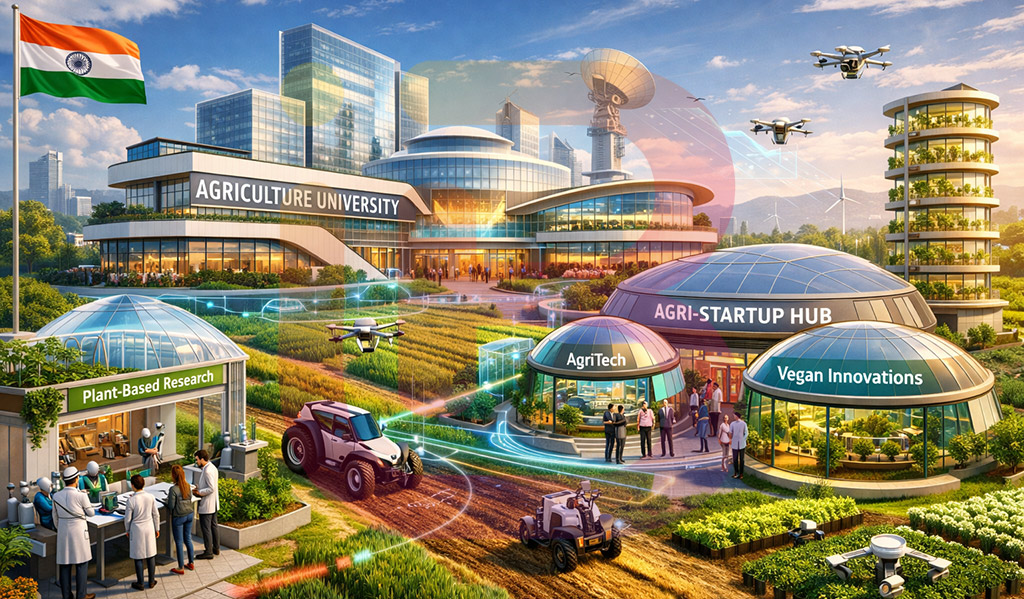
Why India’s Proposed Agriculture Universities in Assam Will Become the Launchpads for Agri-Startups, Vegan Agriculture, and AgriTech Innovation
An Upcoming Agriculture University in Patharkandi, Assam
Why This Is More Than an Academic Institution—It Is a Strategic Economic Signal
India’s agricultural story is often told in fragments—food security here, farmer distress there, exports in one chapter, startups in another. But moments arise when infrastructure, policy, demography, and technology align.
The proposed Agriculture University in Patharkandi, Assam is one such moment.
This is not merely about adding another campus to India’s education map.
It is about redefining agriculture as a knowledge economy, not a subsistence sector.
Indian Agriculture Since Independence: From Survival to Strategic Strength
At the time of Independence, India faced chronic food shortages and dependency on imports. Agriculture was survival-oriented, fragmented, and technologically constrained.
The Green Revolution changed that trajectory.
- Introduction of high-yield varieties
- Expansion of irrigation
- Fertilizer and mechanization adoption
- Institutional support through research and extension
The outcome was historic:
India transformed from a food-deficit nation into one of the world’s leading agricultural producers.
Today:
- India is among the largest producers of rice, wheat, milk, fruits, vegetables, pulses, and spices
- It is a major exporter of rice, spices, cotton, sugar, tea, and horticultural products
- Agriculture supports over 40% of the population, directly or indirectly
Yet, despite this scale, agriculture still contributes disproportionately less to income, signaling a need for value creation, not volume expansion.
Agricultural Universities in India: Strong Foundation, Growing Need
India currently has over 70 agricultural universities, including:
- State Agricultural Universities (SAUs)
- Central Agricultural Universities
- Deemed universities under ICAR
These institutions have played a critical role in:
- Crop science and breeding
- Soil health and irrigation
- Livestock and fisheries
- Extension services and farmer training
However, geographic concentration and legacy curricula limit their ability to address:
- Region-specific agro-climatic challenges
- Emerging technologies
- New consumption patterns
- Climate and sustainability pressures
This is where new-generation agricultural universities become essential.
Why Assam—and Why Patharkandi—Matters Strategically
Assam and the North-East are not agricultural peripheries; they are underutilized agri-frontiers.
Key advantages:
- Rich biodiversity and fertile river basins
- Unique crops, horticulture, tea, bamboo, medicinal plants
- Strategic proximity to South-East Asian markets
- High potential for organic and low-chemical farming
Patharkandi’s location enables:
- Regional research tailored to Eastern and North-Eastern agro systems
- Cross-border agricultural knowledge exchange
- Development of agro-based MSMEs and startups
An agriculture university here becomes a regional innovation anchor, not just an academic center.
Why India Needs More Such Universities—Now
1. Agriculture Is No Longer Just Farming
Modern agriculture integrates:
- Data science
- Artificial Intelligence
- Robotics and automation
- Climate modeling
- Supply-chain analytics
Universities must evolve from teaching how to grow to teaching how to build agri-systems.
2. Climate Change Has Made Agriculture a National Security Issue
Food security, water stress, soil degradation, and crop volatility demand:
- Research-driven adaptation
- Region-specific solutions
- Technology-backed resilience
More universities mean distributed intelligence, not centralized dependency.
3. India Needs Agri-Entrepreneurs, Not Just Agri-Graduates
Traditional extension models are insufficient.
What India needs:
- Agri-startup founders
- Supply-chain innovators
- Food-tech entrepreneurs
- Sustainable material scientists
Universities must become startup incubators, not just degree issuers.
The Rise of Agri-Startups and the New Generation Mindset
India’s agri-startup ecosystem is expanding rapidly:
- Precision farming platforms
- Farm-to-fork logistics
- Organic certification and traceability
- Alternative proteins and functional foods
Gen Z and younger millennials are not rejecting agriculture—they are reimagining it.
Their interests lie in:
- Organic and regenerative farming
- Vegan and plant-based foods
- Climate-positive agriculture
- Ethical supply chains
- Technology-first solutions
An agriculture university that integrates AI + agriculture + entrepreneurship becomes a magnet for this generation.
Vegan Foods, Organic Agriculture, and the Next Consumption Shift
Consumer behavior is changing globally:
- Demand for organic, chemical-free food is rising
- Vegan and plant-based diets are moving from niche to mainstream
- Sustainability and ethics influence purchasing decisions
India, with its agricultural diversity, is uniquely positioned to lead this shift—if backed by research and innovation.
Universities can drive:
- Plant-based protein research
- Sustainable crop alternatives
- Nutritional science linked to indigenous crops
- Export-grade organic value chains
Beyond Food: Vegan Leather and Agriculture-Based Materials
One of the most transformative intersections lies beyond food.
Vegan leather and plant-based materials, derived from:
- Pineapple leaves
- Banana fiber
- Mushroom mycelium
- Agricultural waste
These innovations:
- Reduce environmental impact
- Create new revenue streams for farmers
- Power sustainable fashion and manufacturing
An agriculture university that integrates material science, biotech, and agri-waste valorization moves agriculture into the industrial value chain, not just consumption.
Policy and Economic Implications
For policymakers, such institutions deliver:
- Regional economic development
- Skilled employment generation
- Startup ecosystems in non-metro regions
- Reduced rural-urban migration
- Export-oriented agri-industries
For the Indian economy:
- Higher value per hectare
- Diversified export baskets
- Stronger rural income resilience
This is economic architecture, not educational expansion.
The Role of iBluu Corporations
Through iBluu Ventures Private Limited, iBluu InfraVenture Private Limited, and iBluu Consulting Venture Private Limited, iBluu Corporations operates at the intersection of:
- Business & Strategic Consulting
- Strategic Government Engagement & Relations Advisory
- IT Consulting
- Investment Advisory & Consulting
- Mergers & Acquisitions
- Strategic Partnerships & Alliances
Our role in such initiatives lies in:
- Designing institution-led economic ecosystems
- Aligning education with industry and policy
- Structuring public–private collaboration models
- Enabling agri-startup and innovation frameworks
- Positioning regions as investment-ready agri hubs
We view agriculture universities not as standalone institutions, but as platforms for national value creation.
Conclusion: Agriculture Universities as Engines of India’s Next Growth Cycle
The upcoming agriculture university in Patharkandi, Assam represents a strategic inflection point.
Not just for Assam.
Not just for agriculture.
But for India’s economic future.
The next Green Revolution will not be about yield alone.
It will be about intelligence, sustainability, technology, and entrepreneurship.
And it will be built—field by field, lab by lab, startup by startup—through institutions that understand agriculture as a future industry, not a legacy sector.
That is why initiatives like this matter.