+91 945 889 6091
  infodesk@ibluu.com
The Strategic Architecture of India’s $592 Billion Logistics Engine: Quietly Reshaping Manufacturing, Trade, and the Digital Economy
India’s logistics sector is undergoing one of the most consequential structural transformations in the country’s modern economic history. What was once viewed as a fragmented cost center is rapidly evolving into a high-technology, multi-modal backbone powering India’s growth ambitions.
Valued at approximately $330 billion in FY2025, India’s logistics industry is projected to expand to $592.36 billion by 2031, growing at roughly 10% CAGR, according to industry estimates. The sector already contributes around 6.4% of India’s GDP, supports over 50 million jobs, and acts as a multiplier for manufacturing, trade, and digital commerce.
But the deeper shift is structural.
Logistics in India is no longer just about moving cargo between warehouses and ports. It is increasingly about moving the economy itself—optimizing supply chains, enabling exports, supporting manufacturing clusters, and accelerating the growth of India’s digital marketplace.
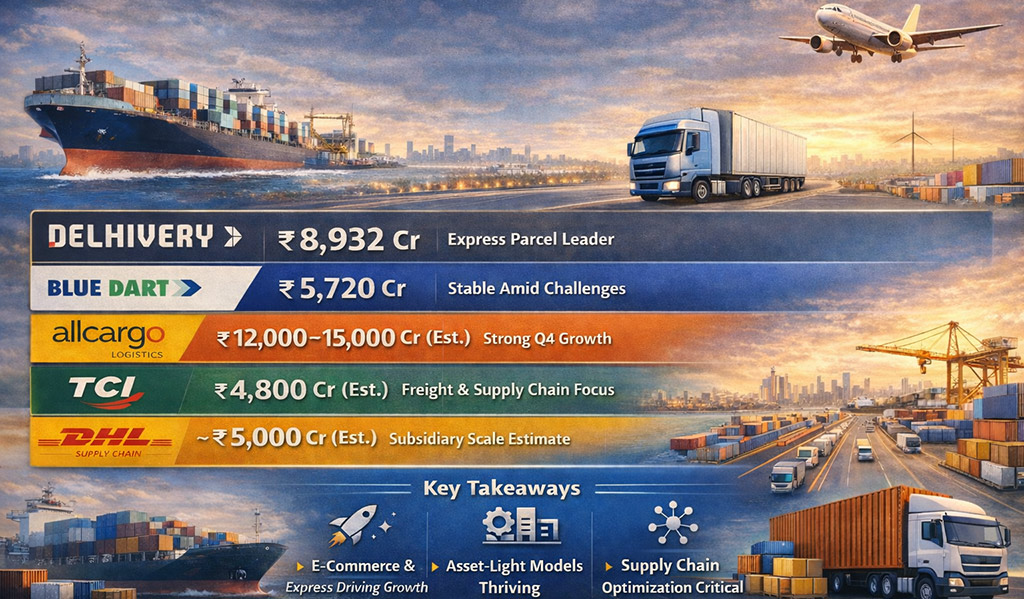
Companies such as Delhivery, Blue Dart Express, Allcargo Logistics, Transport Corporation of India (TCI), and DHL Supply Chain India are emerging as central architects of this transformation. Through technology integration, asset-light logistics models, multimodal freight capabilities, and global supply chain networks, these firms are redefining the competitive structure of India’s logistics ecosystem.
The strategic question is no longer whether logistics matters to India’s economy.
The real question is how fast India can transform logistics from a constraint into a strategic advantage.
The Structural Transformation of India’s Logistics Backbone
Historically, India’s logistics sector has been characterized by fragmentation, infrastructure gaps, and high operating costs.
Logistics costs in India have traditionally hovered around 14% of GDP, significantly higher than global benchmarks of 8–10% in advanced economies. These inefficiencies have long acted as a hidden tax on Indian manufacturing and exports.
However, the landscape is rapidly shifting.
A series of structural reforms and macroeconomic shifts are driving the modernization of the sector:
- National Logistics Policy (NLP) targeting logistics costs reduction to 8% of GDP
- PM Gati Shakti initiative integrating infrastructure planning
- Dedicated Freight Corridors (DFC) transforming rail freight movement
- Bharatmala highway expansion
- Digitalization of supply chains and logistics networks
At the same time, three major economic forces are accelerating logistics demand:
- Explosive e-commerce growth
India’s e-commerce market has crossed ₹4.1 lakh crore in FY2025, growing at roughly 25% CAGR. Every online transaction depends on logistics execution—from warehousing to last-mile delivery.
- Manufacturing expansion through PLI schemes
Government production-linked incentives across electronics, semiconductors, automotive, and renewable energy are driving large-scale manufacturing investments exceeding ₹1.9 lakh crore.
- Global supply chain reconfiguration
The China+1 strategy adopted by global manufacturers is redirecting supply chain investments toward India and Southeast Asia.
In this environment, logistics is becoming a strategic enabler of industrial competitiveness rather than merely an operational function.
The Companies Redefining India’s Logistics Future
A handful of major logistics companies are leading the transformation of India’s supply chain infrastructure.
Their competitive strategies differ—some dominate express logistics while others specialize in multimodal freight—but together they represent the evolving architecture of India’s logistics economy.
Key Logistics Leaders in India (FY2025)
| Company | FY2025 Revenue | Core Strength | Strategic Edge |
|---|---|---|---|
| Delhivery | ~$1.2B | Express parcel logistics | Technology-driven logistics platform |
| Blue Dart Express | ~$0.8B | Express courier & air logistics | Strong urban last-mile delivery |
| Allcargo Logistics | ~$2.1B | Multimodal freight | Global logistics network |
| Transport Corporation of India (TCI) | ~$1.1B | Integrated supply chain | Asset-light logistics model |
| DHL Supply Chain India | ~$2.5B | End-to-end supply chain | Global logistics scale |
Delhivery: Technology-Driven Express Logistics
Delhivery has emerged as one of India’s most prominent logistics technology companies. The firm handles over 1 billion parcels annually, leveraging AI-driven routing algorithms, automated sorting centers, and predictive analytics to optimize delivery networks.
Its logistics platform integrates freight, parcel delivery, warehousing, and supply chain services, positioning the company as a technology-enabled logistics ecosystem rather than a traditional courier operator.
Blue Dart Express: Dominance in Express Delivery
Backed by the global logistics network of DHL, Blue Dart remains one of India’s most trusted express logistics providers.
The company manages over 500 million shipments annually, with strong penetration in metropolitan and tier-2 markets. Its competitive edge lies in time-critical deliveries and air cargo integration, making it a preferred partner for high-value shipments.
Allcargo Logistics: Multimodal Freight Leadership
Allcargo Logistics has built its strength around multimodal transport and international freight forwarding, handling approximately 1 million TEUs annually through global shipping networks.
With operations across 100+ countries, the company connects Indian exporters with international markets through integrated freight and container logistics.
Transport Corporation of India (TCI): The Integrated Supply Chain Specialist
TCI operates one of India’s most diversified logistics networks, covering road freight, rail logistics, coastal shipping, and supply chain services.
Its asset-light logistics strategy, where a significant share of fleet operations is outsourced, allows it to scale operations efficiently while maintaining capital discipline.
DHL Supply Chain India: Global Scale and Integrated Logistics
DHL operates one of the largest integrated supply chain networks in India, with warehousing capacity exceeding 500 million square feet globally and a rapidly expanding footprint in India.
Its operations focus on automotive logistics, healthcare supply chains, and technology manufacturing, sectors that demand high precision and reliability.
Key Trends Reshaping the Logistics Industry in FY2025
Several powerful trends are redefining how logistics operates in India.
1. E-Commerce and Express Logistics Surge
The rise of digital commerce has transformed parcel delivery into one of the fastest-growing logistics segments.
Express parcel logistics in India is growing at 25% CAGR, with companies like Delhivery and Blue Dart collectively handling a large share of the market.
The shift toward same-day and next-day delivery expectations is forcing logistics providers to invest heavily in automation, regional warehouses, and predictive demand analytics.
2. Asset-Light and Integrated Logistics Models
Traditional asset-heavy logistics models are gradually being replaced by platform-driven logistics ecosystems.
Companies are increasingly relying on:
- Third-party transport fleets
- Digital freight marketplaces
- Integrated supply chain management platforms
This approach reduces capital expenditure while improving network scalability.
3. Supply Chain Optimization Through Technology
Technology is becoming the defining competitive advantage in logistics.
Key innovations include:
- AI-based route optimization
- Blockchain-enabled supply chain transparency
- Automated warehousing and robotics
- Real-time shipment tracking
Industry estimates suggest over 40% of logistics firms in India are now integrating AI or advanced analytics into their operations.
Economic Impact: Logistics as a Growth Multiplier
Logistics is increasingly becoming a strategic pillar of India’s economic development.
The sector acts as a multiplier for manufacturing, trade, and services, with global studies suggesting that every $1 invested in logistics infrastructure can generate up to $2.5–3 in economic output.
Key macroeconomic contributions include:
- $330B logistics market size (FY2025)
- Projected $592.36B market by 2031
- 50+ million jobs supported
- Critical enabler of India’s $1 trillion export ambition
As India accelerates toward a $5 trillion economy, logistics efficiency will become a decisive factor in global competitiveness.
Countries that dominate logistics networks often dominate trade flows.
Challenges That Still Need Resolution
Despite strong momentum, India’s logistics sector still faces several structural challenges.
Infrastructure Gaps
Logistics costs remain elevated due to inefficiencies in road freight networks, warehousing distribution, and multimodal integration.
Talent and Skill Shortages
The sector will require over 1 million skilled logistics professionals by 2030 to support growth.
Sustainability Pressures
Logistics contributes significantly to transportation emissions, forcing companies to explore electric delivery fleets, green warehouses, and carbon-neutral supply chains.
Geopolitical Supply Chain Risks
Global disruptions such as Red Sea shipping crises or geopolitical trade conflicts can quickly impact freight costs and supply chain reliability.
Addressing these risks will require stronger supply chain resilience strategies.
The Road Ahead: Logistics as India’s Strategic Advantage
Looking ahead, the transformation of India’s logistics ecosystem will depend on three critical imperatives:
First, accelerated infrastructure integration through the National Logistics Policy and PM Gati Shakti framework.
Second, large-scale adoption of AI-driven logistics platforms and digital supply chain systems.
Third, deeper global integration as India becomes a key node in emerging trade corridors such as the India–Middle East–Europe Economic Corridor (IMEC).
If these transitions unfold successfully, logistics could evolve from a structural bottleneck into one of India’s most powerful economic accelerators.
The iBluu Strategic Lens
From the perspective of iBluu Consulting Venture Private Limited (IBCV)—the consulting arm of iBluu Corporations—logistics should not be viewed purely as an operational sector.
It should be viewed as economic infrastructure with geopolitical implications.
Strategic logistics ecosystems determine:
- industrial competitiveness
- export velocity
- supply chain resilience
- investment attractiveness
The analytical depth of this perspective reflects the strategic framework developed by J Parasher, Founder and Managing Director of iBluu Corporations, whose work consistently focuses on national capability building, global industrial benchmarking, and long-horizon economic transformation.
His approach reframes logistics not simply as transportation infrastructure, but as a strategic economic system capable of shaping trade power, industrial development, and global investment flows.
Conclusion
India’s logistics sector is entering a defining decade.
The convergence of infrastructure investment, digital innovation, global supply chain shifts, and rising domestic consumption is reshaping the role logistics plays in the economy.
In this new paradigm, logistics companies are no longer just transport operators.
They are architects of economic connectivity.
And in the race toward a $5 trillion economy, the networks that move goods may ultimately determine how fast India moves forward.