+91 945 889 6091
  infodesk@ibluu.com
The Rise Of India’s Luxury Real Estate Power: Why Branded Residences Have Become The Preferred Asset Of India’s High-Net-Worth Elite
For decades, India’s real estate narrative revolved around affordability, volume, and urban sprawl.
That narrative has decisively broken.
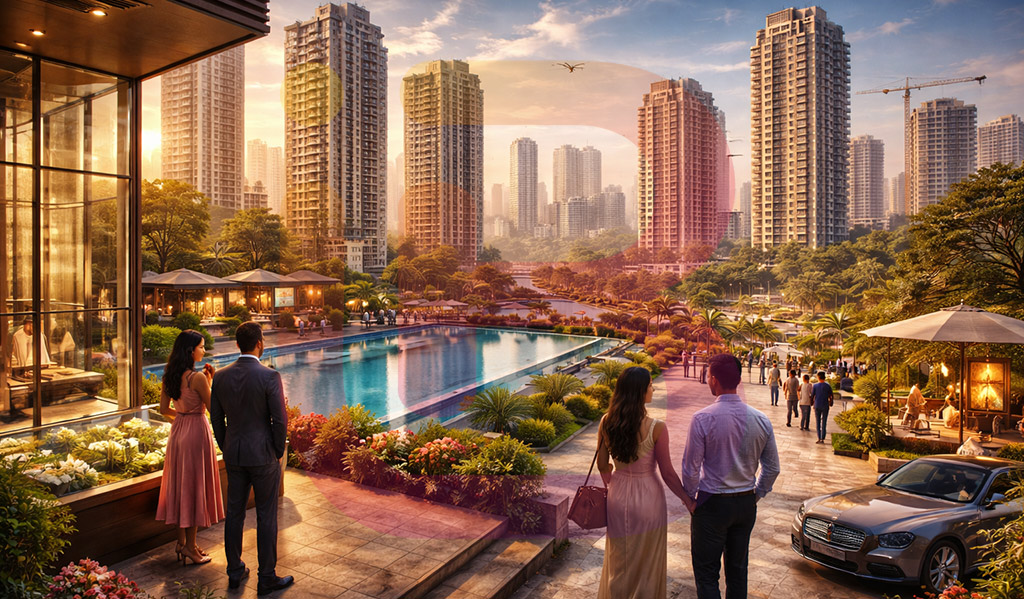
India is now witnessing one of the fastest accelerations in luxury housing demand globally—across villas, branded residences, ultra-luxury apartments, and private farm estates. This is not speculative froth. It is a deep, multi-year structural reallocation of wealth into premium real assets.
Luxury housing is no longer a lifestyle indulgence.
It has become a strategic asset class.
The Velocity of Demand: What the Numbers Signal
Over the last 3–4 years, India’s luxury and ultra-luxury residential segment has consistently outpaced mid-income housing in both absorption and price appreciation.
Key directional indicators across major metros show:
- Luxury home sales growth significantly faster than overall residential growth
- Price appreciation in premium micro-markets materially higher than city averages
- Reduced inventory overhang in luxury segments compared to mass housing
- Strong pre-launch absorption for branded and gated luxury projects
High-value ticket sizes—often ₹5 crore to ₹50 crore+—are no longer niche. They are becoming normalized among India’s upper-income and globally mobile population.
Where Demand Is Concentrating: India’s Luxury Corridors
Luxury demand is not evenly distributed. It is surgically concentrated in cities that combine wealth creation, global connectivity, and aspirational living.
Primary Demand Hubs
- Mumbai MMR – South Mumbai, Bandra, Worli, Lower Parel, Alibaug
- Delhi NCR – Lutyens’ Delhi, Golf Course Road, Dwarka Expressway, South Delhi, Noida luxury zones
- Bengaluru – Whitefield, North Bengaluru, gated villa communities
- Hyderabad – Financial District, Kokapet, West Hyderabad
Emerging & Lifestyle Luxury Markets
- Pune – Hillside villas, second-home luxury
- Chennai – ECR luxury residences
- Goa, Dehradun, Alibaug, Coorg, Lonavala – farmhouses, second homes, estate living
The fastest growth is occurring not just in apartments—but in low-density luxury formats: private villas, managed estates, and farmhouses with institutional-grade design and security.
The Formats Driving the Boom
1. Ultra-Luxury Apartments
- Large floor plates, low density
- Branded residences and concierge living
- Strong preference among CXOs, founders, global Indians
2. Gated Villas & Row Houses
- Privacy, space, community security
- Particularly strong in Bengaluru, Hyderabad, Pune
3. Personal Farmhouses & Estate Homes
- Demand surged post-pandemic
- Blending lifestyle, wellness, sustainability, and capital preservation
- Often positioned as “productive luxury” rather than idle assets
Why the Last 3–4 Years Changed Everything
This boom did not happen accidentally. It is the outcome of multiple forces converging simultaneously:
Wealth Creation at the Top
India has seen rapid growth in:
- Startup founders
- Private equity exits
- Capital market participants
- Global Indian professionals
This cohort prefers real assets with control, prestige, and long-term value.
Post-Pandemic Lifestyle Reset
The pandemic permanently altered how India’s wealthy think about:
- Space
- Privacy
- Wellness
- Work-from-home permanence
Luxury homes became productive infrastructure for life and work, not consumption.
Financial Maturity
HNIs are now more sophisticated:
- Real estate is seen as portfolio diversification
- Preference for clean titles, institutional developers, structured deals
- Increased appetite for advisory-led acquisitions
Policy & Infrastructure Tailwinds
- Infrastructure corridors reshaping micro-markets
- Improved regulatory clarity
- Greater institutional participation
The Strategic Upside for India
The luxury housing surge is not just a real estate story. It has macro-economic advantages:
- Higher capital inflows into domestic assets
- Stronger linkages with construction, design, services, and employment
- Improved urban quality benchmarks
- Increased global confidence in India’s wealth absorption capacity
Luxury housing also acts as a signal to global investors: India is not just a growth market—it is a wealth market.
How Global Institutions View India’s Luxury Real Estate Trajectory
Global financial institutions increasingly recognize India as:
- A long-term, consumption-led economy
- A wealth-creation hub rather than just a manufacturing base
- A stable destination for real asset investment
The growing appetite for luxury housing—both domestically and internationally by Indian buyers—signals confidence in India’s economic continuity, governance maturity, and capital markets depth.
Indian HNIs are now active buyers not just in India, but also in:
- Dubai
- London
- Europe
- Select global luxury destinations
This two-way flow further integrates India into global real estate capital circuits.
Where iBluu Fits Into This Transformation
This shift demands strategic advisory—not brokerage.
Through:
- iBluu Ventures Private Limited
- iBluu InfraVenture Private Limited
- iBluu Consulting Venture Private Limited
iBluu operates across:
- Luxury real estate strategy and investment advisory
- Government and regulatory engagement
- Capital structuring and M&A
- Developer partnerships and alliances
- Institutional and HNI portfolio advisory
iBluu’s role is to design intelligence around capital, assets, and outcomes—helping clients navigate luxury real estate not as emotion, but as strategy.
Conclusion: Luxury Housing Is India’s Confidence Index
The rise of luxury homes in India is not about indulgence.
It is about confidence—in income, in governance, in future stability.
When a nation’s wealthy invest heavily in long-term domestic assets, it sends a powerful message:
They believe the future will be built here.
India’s luxury housing boom is not a trend to watch.
It is a signal to understand—and a market to design for.
And those who approach it with strategy—not speculation—will define its next decade.