+91 945 889 6091
  infodesk@ibluu.com
Tamil Nadu’s Strategic Blueprint: Rewriting India’s Economic Geography from the South with Massive FDI, Innovation Hubs, and Sustainable Industrial Dominance
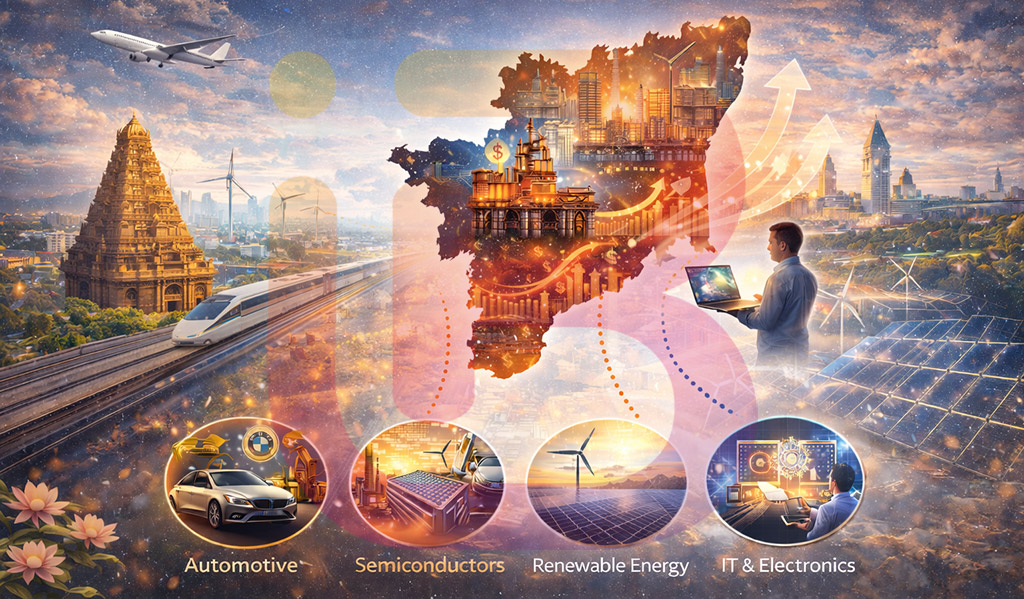
Over the past two decades, Tamil Nadu has undergone one of the most profound industrial transformations in India. Once primarily known as a regional manufacturing hub, the state has evolved into one of Asia’s most diversified industrial ecosystems, spanning automotive manufacturing, electronics, aerospace, renewable energy, and global technology services.
With a Gross State Domestic Product (GSDP) of approximately ₹31.55 lakh crore (~$310 billion) in FY2024-25, Tamil Nadu already ranks among India’s largest economic engines. More importantly, the state has articulated a clear ambition: to become a $1 trillion economy by 2030–32, placing it among the most powerful sub-national economies globally.
Investment momentum is accelerating toward that goal.
Since May 2021, Tamil Nadu has secured ₹9.74 lakh crore in investment commitments, projected to generate 18.7 lakh jobs across advanced manufacturing, electronics, electric mobility, aerospace, and technology services.
Foreign direct investment has also remained resilient. While national inflows softened in 2024, Tamil Nadu attracted $3.68 billion in FDI, reflecting continued global confidence in the state’s industrial ecosystem.
Under a sustained growth trajectory — roughly 9% real growth combined with moderate inflation — Tamil Nadu’s economy could surpass $1.5 trillion by 2035, driven by high-value sectors such as EV manufacturing, semiconductors, Global Capability Centers (GCCs), aerospace systems, and green hydrogen infrastructure.
In strategic terms, Tamil Nadu is no longer competing purely on cost advantages. It is competing on ecosystem depth, supply-chain integration, talent availability, and policy agility.
Strategic Thesis: India’s Southern Gateway for Global Supply Chains
Tamil Nadu’s strategic advantage lies in its ability to combine industrial depth, global connectivity, and policy execution.
The state hosts four major ports, a strong engineering talent base, and one of India’s largest automotive clusters, often referred to as the “Detroit of Asia.”
This industrial depth is increasingly attractive to multinational corporations pursuing China+1 supply chain diversification strategies.
Geopolitical developments are reinforcing this trend.
Strategic cooperation frameworks such as the US–India Initiative on Critical and Emerging Technology (iCET), momentum toward an EU–India Free Trade Agreement, and the restructuring of global manufacturing supply chains are encouraging corporations to diversify production away from China and Taiwan.
Within India, Tamil Nadu competes with states such as Gujarat, Maharashtra, and Karnataka. Yet it retains a distinctive edge in several sectors:
• Automotive and electric vehicle manufacturing
• Aerospace and defence systems
• Electronics and semiconductor supply chains
• Global technology services and GCC operations
This combination has positioned Tamil Nadu as India’s southern gateway for global manufacturing and technology supply chains.
Investment Landscape and Macro Metrics
Tamil Nadu’s investment thesis is built on high-value industrial clusters rather than low-cost incentives.
The state has secured ₹9.74 lakh crore in investment commitments since 2021, according to Guidance Tamil Nadu, the government’s investment promotion agency.
These commitments span multiple sectors:
| Sector | Estimated Investment |
|---|---|
| Electronics & EV manufacturing | ₹2.8 lakh crore |
| Aerospace & Defence | ₹1.2 lakh crore |
| IT & Global Capability Centres | ₹80,000+ crore |
| Green Hydrogen & Renewables | ₹50,000+ crore |
Major corporate investors include Foxconn, Ola Electric, Tata Advanced Systems, VinFast, Samsung, and multiple global electronics manufacturers.
Foreign direct investment remains robust.
Tamil Nadu attracted $3.68 billion in FDI during 2024-25, even as national FDI inflows experienced a decline.
From a macroeconomic standpoint, the growth trajectory remains strong.
| Metric | Value |
|---|---|
| GSDP (2024-25) | ₹31.55 lakh crore (~$310B) |
| 2030 Target | $1 trillion |
| 2035 Outlook | $1.5–1.7 trillion |
Achieving the trillion-dollar milestone requires approximately 15–16% nominal annual growth, a target considered achievable given the scale of industrial investments currently underway.
The economic multiplier effect is significant. Investment-to-output ratios suggest that every rupee invested in industrial infrastructure could generate 2.8 to 3.2 times economic output over a 5–7 year cycle.
Sectoral Depth and Regional Industrial Hubs
A defining feature of Tamil Nadu’s investment strategy is decentralized industrial development.
Nearly 80% of new investment commitments are being directed toward Tier-2 and Tier-3 cities, reducing pressure on Chennai while expanding regional economic growth.
| Hub City | Key Sectors | Strategic Rationale |
|---|---|---|
| Chennai | EVs, SaaS, FinTech, Port Logistics | Established tech ecosystem and global port connectivity |
| Coimbatore | GCCs, Aerospace, R&D | Engineering talent and emerging GCC hub |
| Hosur | Electronics, EV clusters | Strategic logistics location near Bengaluru |
| Trichy & Madurai | Aerospace & Defence | Strong MSME engineering ecosystem |
| Tuticorin | Green hydrogen, renewable energy | Deep-water port for energy exports |
The Chennai–Kanyakumari Industrial Corridor, supported by a $484 million Asian Development Bank loan, is designed to integrate these regional clusters into a single supply chain network.
Government Policy Accelerators
Policy agility remains a critical component of Tamil Nadu’s investment success.
The state government operates Guidance Tamil Nadu, a single-window investment clearance agency capable of approving major projects within 30 days.
Several sector-specific policies are accelerating industrial investment:
Space Industrial Policy 2025 aims to attract ₹10,000 crore in investments and create 10,000 high-skill jobs in space technology manufacturing.
R&D Policy 2022 incentivizes multinational corporations to establish high-value innovation centres rather than traditional outsourcing units.
Footwear and Leather Policy 2022 targets ₹20,000 crore in new investments, with a focus on increasing female workforce participation.
Tamil Nadu has also established the Industrial Ecosystem Fund, designed to de-risk infrastructure investment and support industrial clusters.
These initiatives are aligned with national programs including Production-Linked Incentives (PLI), PM Gati Shakti infrastructure planning, and the National Logistics Policy.
ESG and Sustainability Thesis
Tamil Nadu is also emerging as India’s leader in renewable energy deployment.
The state currently hosts over 11,100 MW of renewable energy capacity, the highest in India.
Energy transition is becoming a major investment theme.
Tuticorin is being developed as a green hydrogen export hub, with more than ₹50,000 crore in potential investment proposals.
Sustainability is also integrated into infrastructure financing.
The Tamil Nadu Infrastructure Fund Management Corporation (TNIFMC) mandates Environmental, Social, and Governance frameworks across its investment portfolios.
Industrial corridors such as the Chennai–Kanyakumari corridor are designed to integrate climate-resilient infrastructure, renewable energy integration, and sustainable logistics systems.
Stakeholder Benefits and Economic Impact
Tamil Nadu’s economic expansion delivers significant benefits across multiple stakeholders.
For the state government, diversified industrial investment strengthens the tax base and is projected to reduce the fiscal deficit to 2.9% by FY2027.
For investors, Tamil Nadu offers one of India’s most attractive consumer markets. Per-capita income has reached ₹3.62 lakh, roughly 1.77 times the national average.
For the central government, Tamil Nadu represents a critical economic pillar, contributing 9.2% of India’s GDP despite occupying only 4% of the country’s land area.
Local communities also benefit significantly. The state’s investment commitments since 2021 are expected to generate 18.7 lakh new jobs, many in high-value manufacturing and technology sectors.
Risk Quantification and Structural Challenges
Despite strong growth prospects, Tamil Nadu faces several structural risks.
Rapid expansion of technology hubs in Chennai and Coimbatore is creating a talent competition environment, potentially driving wage inflation.
Climate risks also require attention. Coastal cities such as Chennai remain vulnerable to flooding and rising sea levels, necessitating investments in climate-resilient infrastructure.
Global trade uncertainty represents another variable. Tamil Nadu exports goods worth more than $52 billion annually, making it sensitive to protectionist trade policies.
However, mitigation strategies are already being implemented, including climate-resilient infrastructure mandates, industrial water-management systems, and global skill partnerships with international universities.
Scenario Modelling: 2030–2035 Economic Outlook
Three potential scenarios illustrate Tamil Nadu’s future economic trajectory.
| Scenario | 2030 Economy | 2035 Economy |
|---|---|---|
| Base Case | $1 trillion | $1.5 trillion |
| High Growth | $1.2 trillion | $1.7 trillion |
| Downside Case | $850 billion | $1.2 trillion |
The most likely trajectory remains the base case, supported by strong industrial investment and continued export growth.
Strategic Recommendations for Investors
Three investment themes stand out for the next decade:
Global Capability Centers in Tier-2 cities, particularly Coimbatore and Madurai.
Green hydrogen and renewable energy infrastructure, anchored in Tuticorin.
Electric vehicle component ecosystems, supporting global automotive supply chains.
Investors able to integrate into Tamil Nadu’s industrial clusters are likely to benefit from strong economic multipliers and long-term export growth.
Strategic Advisory and the Role of IBCV
Complex economic transformations of this scale require deep coordination between governments, investors, and industrial ecosystems.
iBluu Consulting Venture Private Limited (IBCV) — a venture of iBluu Corporations — operates at this intersection.
Through services spanning business and strategic consulting, government engagement advisory, IT consulting, investment structuring, mergers and acquisitions advisory, and international partnership development, IBCV supports investors and institutions navigating India’s evolving industrial landscape.
The analytical lens informing this report reflects the strategic perspective of J Parasher, Founder and Managing Director of iBluu Corporations. His work consistently focuses on national capability building, global industrial benchmarking, and long-horizon economic transformation.
From this perspective, consulting is not merely a service industry — it is a strategic economic system capable of shaping national competitiveness, global investment flows, and the future architecture of industrial ecosystems.
Conclusion: The Trillion-Dollar Moment
Tamil Nadu’s transformation is not incremental.
It is structural.
The state is evolving from a regional manufacturing hub into one of the world’s most sophisticated sub-national industrial ecosystems.
If the current investment trajectory continues, Tamil Nadu will not only achieve its $1 trillion economic milestone within the next decade — it will emerge as one of Asia’s most strategically important industrial regions.
For investors, corporations, and policymakers, the message is clear:
The question is no longer whether Tamil Nadu will grow.
The real question is who will participate in building the trillion-dollar ecosystem that is now taking shape.