+91 945 889 6091
  infodesk@ibluu.com
Made in India Defence Power Play: From Import Dependence to Industrial Dominance — The Architecture of Economic and Geopolitical Power
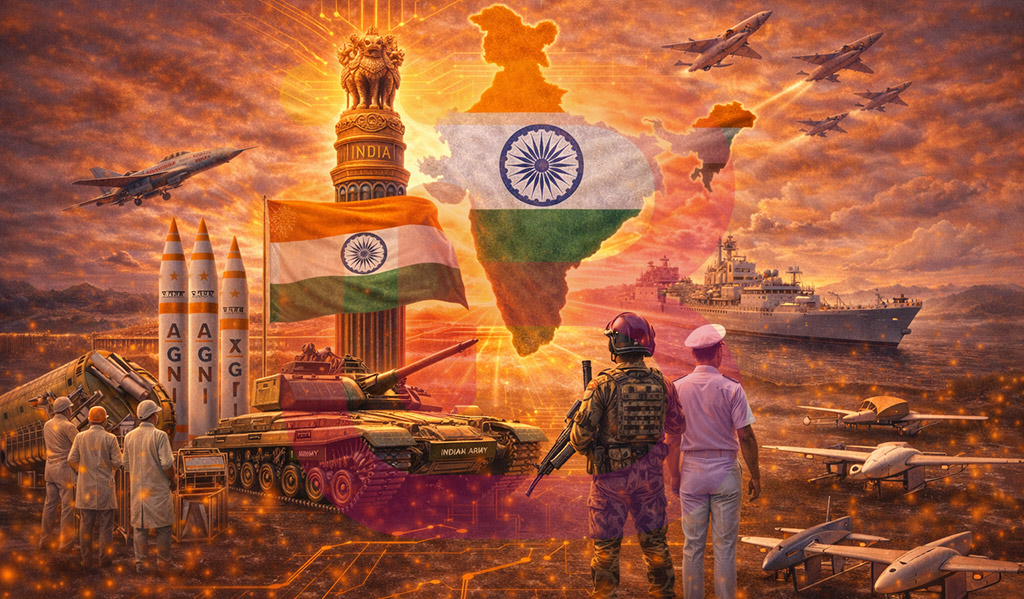
India’s defence sector is undergoing one of the most profound industrial transformations of the 21st century. What was once a system structurally dependent on foreign suppliers is now emerging as a sovereign defence-industrial ecosystem—capable of designing, manufacturing, exporting, and upgrading critical military platforms across air, land, sea, space, cyber, and emerging warfare domains.
This is not merely a manufacturing shift.
It is a reconfiguration of India’s strategic power architecture.
From a nation importing nearly 70% of its defence requirements a decade ago, India is now approaching a regime where over two-thirds of its defence platforms are indigenously designed or assembled, with exports scaling into a structural growth engine rather than a symbolic milestone.
India is no longer buying security.
India is producing strategic capability.
The Structural Shift: From Buyer Nation to Defence Platform State
Historically, India’s military modernisation was externally anchored—Russia for heavy platforms, France for aviation, Israel for electronics, the US for surveillance and systems integration. This created tactical strength, but strategic vulnerability.
The inflection point arrived with:
- Atmanirbhar Bharat in defence manufacturing
- Defence Procurement Procedure (DPP/DAP) reforms
- Positive Indigenisation Lists
- Liberalised FDI regime
- iDEX and startup defence innovation ecosystem
- Dedicated Defence Industrial Corridors
Together, these reforms engineered a systemic transition:
from procurement-driven defence to platform-driven defence.
India is now building:
- Indigenous intellectual property
- Domestic design bureaus
- Localised defence supply chains
- Export-ready military systems
- Sovereign upgrade and lifecycle control
This marks the birth of India as a Defence Platform Economy.
The Defence Stack: What India Is Actually Building
India today manufactures or co-develops almost every category of modern military capability.
1. Air Power and Aerospace
- Tejas Mk-1A / Mk-2 / AMCA – Indigenous fighter aircraft ecosystem
- Prachand LCH / ALH Dhruv / LUH – Attack & utility helicopters
- C295 Transport Aircraft – Airbus–Tata assembly in India
- GE–HAL Jet Engine Programme – Next-generation propulsion
Strategic meaning: India is moving from aircraft buyer to aerospace systems integrator.
2. Missile Systems and Strategic Weapons
- BrahMos Supersonic Cruise Missile (JV)
- Akash / Akash-NG Air Defence Systems
- Pinaka Multi-Barrel Rocket System
- Agni / Prithvi / Nirbhay / Astra
Exported to Southeast Asia, Middle East, Armenia, Philippines.
Strategic meaning: India now controls deterrence-grade IP.
3. Armoured Vehicles and Land Systems
- Arjun Mk-1A Main Battle Tank
- K9 Vajra Self-Propelled Artillery
- TATA, L&T, Bharat Forge platforms
Strategic meaning: India is becoming a ground warfare manufacturing hub.
4. Naval Platforms
- INS Vikrant Aircraft Carrier
- Indigenous destroyers, frigates, corvettes
- Submarine programmes (P75, P75I)
Strategic meaning: India now possesses blue-water shipbuilding sovereignty.
5. Drones, Cyber and Electronic Warfare
- Indigenous UAV swarms
- Anti-drone systems
- AESA radars
- Battlefield AI
- ISR platforms
- Cyber warfare infrastructure
Strategic meaning: India is positioning itself in algorithmic warfare.
6. Emerging Strategic Domains
- Rare earth processing (defence magnets)
- Semiconductor fabs for military chips
- Quantum communication
- Space-based surveillance
- Green aviation fuels
Strategic meaning: Defence is now converging with deep-tech industrial policy.
The Investment Engine Behind the Transformation
India’s defence transformation is capital-intensive by design.
Government
- One of the world’s largest defence budgets
- Capital expenditure increasingly reserved for domestic procurement
- Dedicated R&D institutions
- Strategic corridors and clusters
- Export promotion framework
Private Sector
- Tata, L&T, Adani, Bharat Forge, Vedanta, Mahindra, Reliance
- Defence manufacturing no longer PSU-only
- Private sector share rising rapidly
Foreign Collaboration
- Engine technology
- Sensors and electronics
- Semiconductors
- Naval systems
- Aerospace manufacturing
This hybrid model ensures:
- Tech transfer
- IP localisation
- Manufacturing scale
- Export readiness
India is no longer chasing defence capability.
It is financing defence sovereignty.
The Export Breakthrough: India as a Defence Supplier
India today exports:
- Missiles
- Artillery
- Radar systems
- UAVs
- Naval platforms
- Ammunition
- Electronic warfare systems
To:
- Southeast Asia
- Middle East
- Africa
- Eastern Europe
- Latin America
This is not arms trading.
This is geostrategic positioning through defence diplomacy.
Every export contract:
- Deepens geopolitical influence
- Creates long-term service lock-in
- Expands strategic partnerships
- Builds global defence credibility
India is now competing not on price.
It is competing on trust, reliability, and geopolitical alignment.
Where This Places India Globally
India is now:
- Among the top global defence spenders
- On track to become a top-tier exporter
- One of the few nations with full-stack defence capability
- A serious alternative to US–Russia–China dominance
India is becoming:
- A strategic supplier to middle powers
- A defence partner for emerging economies
- A platform for multipolar military industrialisation
This is defence as foreign policy infrastructure.
The Economic Impact: Defence as a Growth Engine
Defence manufacturing is now:
- A core contributor to industrial GDP
- A high-multiplier sector
- A deep employment generator
- A catalyst for R&D and innovation
- A magnet for advanced manufacturing FDI
Defence is no longer a cost center.
It is now a strategic growth industry.
It upgrades:
- Metallurgy
- Electronics
- Aerospace
- AI
- Cyber
- Semiconductors
- Advanced materials
Defence today is not about war.
It is about industrial modernisation at national scale.
The Geopolitical Meaning
India’s defence self-reliance changes three global equations:
1. Strategic Autonomy
India reduces vulnerability to:
- Sanctions
- Supply chain disruptions
- Technology denial regimes
2. Multipolar Balance
India becomes:
- A counterweight supplier
- A stabilising power
- A non-aligned defence producer
3. Technology Sovereignty
India controls:
- Design
- Manufacturing
- Upgrade cycles
- Export terms
- Strategic IP
This is not military power.
This is geoeconomic power with kinetic credibility.
The Real Strategic Insight
India is not building weapons.
India is building sovereign industrial capability under the logic of national security.
This is the same model:
- The US used during the Cold War
- China used post-2000
- Europe used post-NATO integration
Defence is not the destination.
Defence is the industrial launchpad.
For:
- Aerospace leadership
- Semiconductor ecosystems
- Advanced manufacturing
- AI platforms
- Deep-tech export economies
India’s defence strategy is, in reality,
a national industrial strategy disguised as military policy.
Perspective from J Parasher, Founder and Managing Director, iBluu Corporations
The strategic framing of this article is shaped by the analytical philosophy of J Parasher, Founder and Managing Director of iBluu Corporations.
His core thesis is simple but radical:
“Consulting is not an industry. It is a national economic system. Defence is not a sector. It is a sovereign industrial platform.”
This perspective positions defence manufacturing not as a policy initiative, but as:
- A long-horizon economic transformation engine
- A global export capability
- A geopolitical influence multiplier
- A technological sovereignty framework
In this view, Made in India Defence is not about weapons.
It is about India designing its future power structure.
Final Strategic Conclusion
India’s defence transformation is not incremental.
It is civilisational in scale.
The nation is transitioning:
From importer → to integrator
From buyer → to builder
From consumer → to platform
From dependency → to sovereignty
India is no longer asking:
“Who will protect us?”
India is now answering:
“We will build the systems that shape global security itself.”
This is not a defence story.
This is India’s industrial rebirth in strategic form.