+91 945 889 6091
  infodesk@ibluu.com
Inside India’s Most Powerful Economic State: Maharashtra’s Bold Strategy to Build the Most Powerful Sub-National Economic Ecosystem in the Global South
Strategic Framing: The Trillion-Dollar Ecosystem Shift
A structural transformation is unfolding within India’s economic architecture, and at its center stands Maharashtra.
For decades the state functioned primarily as India’s largest recipient of regional capital flows — benefiting from Mumbai’s financial gravity, strong industrial legacy, and logistics advantages. Today, however, Maharashtra is executing a deliberate and far more sophisticated strategy: transitioning from isolated investment inflows to integrated industrial ecosystems.
In FY2024-25 alone, Maharashtra secured approximately ₹1.65 lakh crore ($19–20 billion) in Foreign Direct Investment, representing roughly 28–32% of India’s total FDI inflows, while also attracting ₹14.5 lakh crore in domestic investment commitments through global investment forums and state industrial summits.
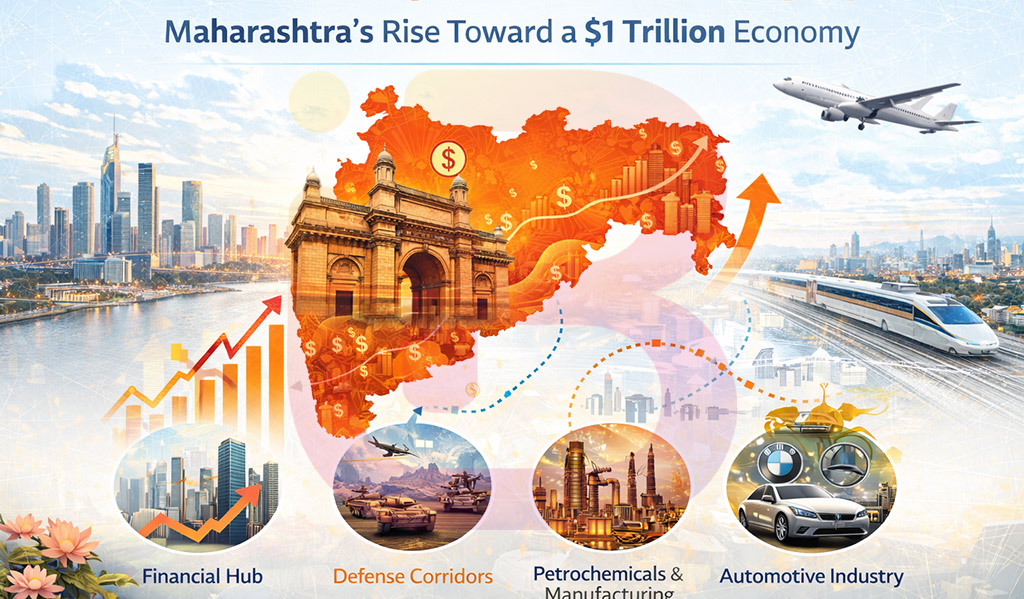
This capital is not merely funding projects — it is architecting a large-scale economic ecosystem designed to transform Maharashtra into a $1 trillion economy by 2030.
More importantly, the state is positioning itself as India’s primary gateway for global supply-chain reconfiguration under the China+1 strategy, emerging as a strategic platform for Western, Japanese, and Middle Eastern capital seeking stable production bases in Asia.
Executive Investment Snapshot
| Indicator | Current Status |
|---|---|
| FY25 FDI Inflow | ₹1.65 lakh crore (~$19.6B) |
| Share of India’s FDI | ~31% |
| Domestic Investment Intentions | ₹14.5+ lakh crore |
| Estimated GSDP FY25 | ₹49.39 trillion (~$580–615B) |
| Target GSDP 2030 | $1 trillion |
| Vision 2047 Projection | $1.8–2 trillion |
| Job Creation Potential | ~5 million jobs by 2030 |
With an estimated GDP multiplier effect of 2.5–3x for every dollar of investment, the scale of Maharashtra’s economic transformation could have cascading effects on India’s industrial competitiveness and export capacity.
From Fragmented Capital to Integrated Industrial Ecosystems
Before 2020, Maharashtra’s investment model largely followed a fragmented pattern of project-based FDI inflows.
The post-pandemic global economic reset has accelerated a strategic pivot toward cluster-based industrial ecosystems, where manufacturing, logistics, digital infrastructure, and services operate within integrated value chains.
This shift is driven by policies such as the Maharashtra Industrial Investment and Services Policy (MIISP 2025) and large-scale infrastructure corridors linked to the Delhi–Mumbai Industrial Corridor (DMIC).
Compared with peer states:
• Gujarat focuses heavily on manufacturing and energy infrastructure
• Karnataka concentrates on technology and innovation ecosystems
Maharashtra’s strategy is broader: integrating finance, technology, logistics, manufacturing, and services within a single economic framework.
In many respects, the model resembles Guangdong Province in China, where industrial clustering and infrastructure coordination transformed the region into a global manufacturing powerhouse.
Investment Landscape and Strategic Global Partners
Maharashtra’s investment ecosystem now attracts capital from multiple geopolitical corridors.
Major International Investment Sources (FY2024-25)
| Country | Key Investors | Investment Focus |
|---|---|---|
| United States | Microsoft, Google, Tesla (discussions) | Data centers, EV ecosystem |
| Japan | Suzuki, Mitsubishi | Automotive manufacturing |
| South Korea | Samsung | Electronics manufacturing |
| UAE | Brookfield, DP World | Renewables, logistics |
Estimated investment flows include:
• $4–5 billion from US companies, particularly in data center infrastructure and technology platforms
• $3 billion+ from Japan and South Korea, primarily in automotive and electronics manufacturing
• $2 billion+ from UAE investors, focused on logistics, infrastructure, and renewable energy
Domestic conglomerates also play a pivotal role.
Major industrial investments include:
• Adani Group – renewable energy infrastructure and port logistics
• Tata Group – aerospace manufacturing and semiconductor initiatives
• Reliance Industries – data centers and green hydrogen development
Together, these investments are designed to create end-to-end value chains with more than 40% local value addition.
From an investor perspective, projects linked to the state’s industrial ecosystem policies have demonstrated estimated internal rates of return between 15% and 22%, according to recent financial benchmarking.
City-Level Economic Specialisation
One of Maharashtra’s defining economic strategies is regional economic specialization, enabling different districts to anchor specific industrial sectors.
Key Economic Hubs
Mumbai Metropolitan Region
The MMR functions as India’s financial and digital infrastructure nucleus, with investment concentrated in fintech, financial services, data centers, and logistics infrastructure.
Flagship projects include:
• Mumbai Trans Harbour Link (Atal Setu)
• Coastal Road expansion
• Vadhavan Deep Sea Port (estimated $9B investment)
Pune Economic Corridor
Pune has evolved into a high-technology industrial ecosystem, combining automotive manufacturing, electric mobility, IT services, and defence research.
Major infrastructure investments include:
• Pune Metro expansion
• Pune Ring Road development
• Quantum Valley technology initiative
Nagpur and Vidarbha
Nagpur is emerging as India’s logistics and aerospace hub through projects such as:
• MIHAN logistics and aviation complex
• Samruddhi Mahamarg expressway
• Maintenance Repair and Overhaul (MRO) aviation ecosystem
Nashik and Chhatrapati Sambhajinagar
These regions are being integrated into industrial manufacturing clusters linked to the DMIC corridor, focusing on engineering, food processing, and advanced manufacturing.
Gadchiroli Industrial Development
Gadchiroli is projected to become India’s sustainable steel production hub, leveraging mineral resources through environmentally responsible extraction technologies.
Policy Architecture Driving the Ecosystem
Maharashtra’s policy framework is designed to aggressively accelerate industrial investment.
Key Policy Instruments
Maharashtra Industrial Investment and Services Policy (MIISP 2025)
Introduces Gross SGST reimbursement for mega projects — potentially covering up to 100% of SGST liability.
IT and ITeS Policy 2023
Provides 200% additional Floor Space Index (FSI) incentives for fintech and digital infrastructure development.
Electric Vehicle Policy 2021
Targets 10% EV penetration in new vehicle registrations through consumer subsidies and manufacturing incentives.
Green Hydrogen Policy
Aims to position Maharashtra as a leading electrolyser manufacturing hub in India’s emerging hydrogen economy.
In parallel, the MAITRI Single Window Clearance system has significantly improved investment execution timelines, reducing project approval cycles to approximately 15–30 days.
Economic Indicators and Global Impact
Maharashtra remains India’s largest sub-national economy.
Current economic indicators include:
• Estimated GSDP of ₹49.39 trillion ($580–615B) in FY2024-25
• Projected economic growth between 7.9% and 9%
• Target of $1 trillion GDP by 2030
Under the Vision 2047 roadmap, the state aims to reach $1.8–2 trillion in economic output by 2035.
Maharashtra also contributes approximately 15% of India’s total exports, positioning it as a major node within global supply chains.
From a geopolitical perspective, the state increasingly functions as India’s “China+1 insurance platform”, enabling multinational firms to diversify manufacturing and logistics operations beyond East Asia.
Benefits, Risks and ESG Integration
The investment ecosystem offers strong multi-stakeholder value creation.
For investors
• High industrial clustering
• Strong logistics infrastructure
• Policy predictability
For the state economy
• Diversified tax revenues
• Industrial employment generation
• Export competitiveness
For citizens
• Rising per capita income currently estimated at ₹3.48 lakh, significantly above the national average.
However, the expansion also presents structural risks.
Key challenges include:
• Climate vulnerability in coastal districts
• Water stress in industrial clusters
• Persistent inter-district economic disparities
• High dependence on rain-fed agriculture in rural regions
The state is increasingly integrating ESG frameworks into urban and industrial planning.
Maharashtra already hosts more than 1,700 certified green building projects, the highest in India, and cities such as Mumbai and Pune are pursuing net-zero transit-oriented development strategies.
Another critical constraint is workforce capacity.
Experts estimate that the industrial ecosystem will require over 500,000 additional skilled professionals by 2030, particularly in advanced manufacturing, semiconductors, and renewable technologies.
Strategic Recommendations
The scale of Maharashtra’s economic transformation creates clear strategic priorities.
For Investors
Prioritize investments within MIISP-linked industrial clusters, particularly in sectors such as:
• electric mobility
• semiconductor supply chains
• green hydrogen
• advanced logistics
For Policymakers
Accelerate inter-district infrastructure connectivity and climate resilience measures to ensure balanced regional growth.
For Corporations
Leverage the MAITRI clearance system and SGST reimbursement mechanisms to optimize capital deployment and project returns.
Strategic Advisory and the Role of Consulting Ecosystems
As industrial investments become larger and more complex, strategic advisory firms play a critical role in coordinating policy alignment, capital structuring, and ecosystem partnerships.
Organizations such as iBluu Consulting Venture Private Limited (IBCV) — a venture of iBluu Corporations — operate at the intersection of business strategy, government engagement, investment advisory, IT consulting, and cross-border partnerships.
By enabling coordination between investors, policymakers, and industry players, advisory platforms help accelerate large-scale industrial transformation.
The analytical perspective behind this investment thesis reflects the strategic thinking of J Parasher, Founder and Managing Director of iBluu Corporations, whose work emphasizes national capability building, global industrial benchmarking, and long-horizon economic transformation.
His perspective positions consulting not merely as an advisory discipline, but as a strategic economic infrastructure capable of shaping national competitiveness and global industrial positioning.
Conclusion
Maharashtra’s economic strategy is no longer defined by incremental investment inflows.
It is defined by the deliberate construction of integrated industrial ecosystems capable of competing on a global scale.
If the state successfully executes its current roadmap, it will not only become India’s first $1 trillion sub-national economy but also emerge as one of the most powerful industrial and financial hubs in the global economy.
In the coming decade, the question will not simply be whether Maharashtra grows.
The real question will be how far its ecosystem model reshapes the economic architecture of India itself.