+91 945 889 6091
  infodesk@ibluu.com
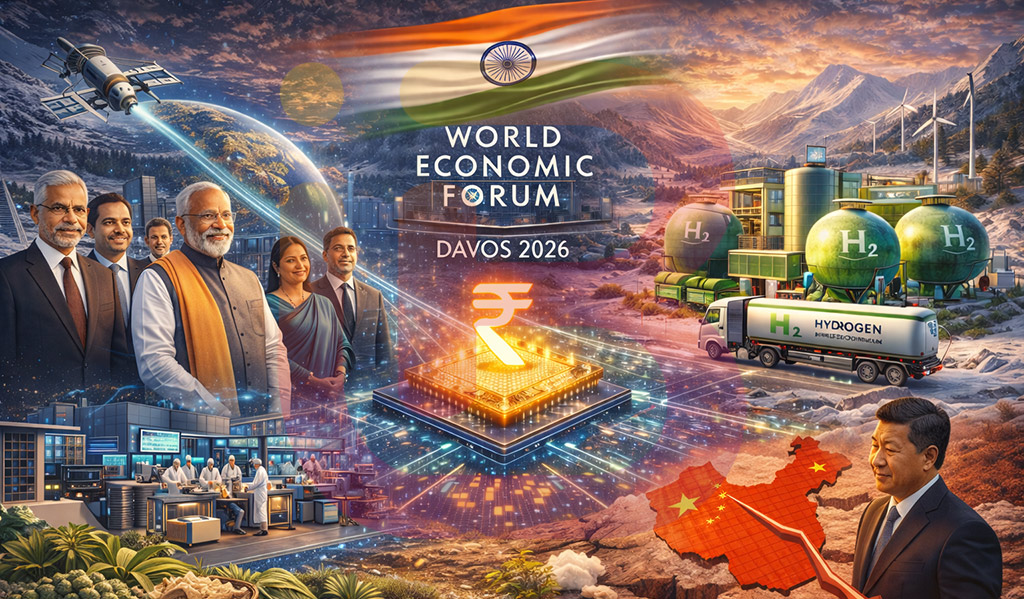
India at WEF, Davos 2026: Trillion-Dollar Investment Signals, Semiconductor Breakthroughs, and the Green Hydrogen Revolution — The Collapse of the China-Plus-One Model
For decades, India arrived at Davos as a promising market.
In 2026, India arrives as a system-shaping power.
The World Economic Forum 2026 marks a structural inflection point — not just for global geopolitics, capital flows, and industrial policy — but for how the world now positions India:
not as a destination for investment, but as a platform for global transformation.
Davos is no longer about panels and pledges.
It is about rebuilding the operating system of the world economy.
And India sits at the centre of that redesign.
From Growth Story to Global Architecture Partner
The dominant narrative around India has shifted decisively.
India is no longer discussed in terms of:
- Potential
- Demographics
- Consumption growth
India is now discussed in terms of:
- Supply chain sovereignty
- Digital public infrastructure
- Climate transition leadership
- Manufacturing realignment
- Capital market depth
- Geopolitical stability
At WEF 2026, India is positioned across five strategic axes:
1. The New Global Manufacturing Anchor
As the world diversifies away from single-country dependencies, India is emerging as the only large economy capable of absorbing industrial scale across sectors:
- Semiconductors & electronics
- Electric mobility
- Advanced materials
- Defense & aerospace
- Green hydrogen
- Sustainable manufacturing
This is not incremental relocation.
This is industrial reconfiguration at planetary scale.
2. The Digital Public Infrastructure Superpower
India’s DPI stack — Aadhaar, UPI, ONDC, DigiLocker — is now studied by:
- Governments
- Central banks
- Multilateral institutions
Not as technology.
But as state-level digital architecture.
At Davos 2026, India is no longer exporting software.
It is exporting governance frameworks for the digital age.
3. The Climate Transition Platform
India is no longer framed as a climate risk.
It is now framed as a climate solution economy.
Across Davos, the dominant themes converge around:
- Green hydrogen
- EV ecosystems
- Bio-materials
- Carbon markets
- Climate finance
- Circular economy
India is one of the few nations where:
Climate action = Economic expansion.
That is a rare strategic alignment.
And global capital is following it aggressively.
4. The Capital Magnet of the Global South
As Western economies slow and emerging markets fragment, India stands out as:
- Stable
- Scalable
- Regulatorily reforming
- Politically predictable
- Demographically advantaged
In Davos 2026 language:
India is no longer “emerging”.
It is the anchor economy of the Global South.
5. The Geopolitical Neutral Power
In a fractured world of competing blocs, India occupies a unique position:
- Strategic autonomy
- Diplomatic balance
- Defense credibility
- Trade flexibility
This makes India not just a market —
but a bridge economy between global power centres.
What Davos 2026 Really Means for Indian Business
For Indian enterprises, WEF 2026 is not about visibility.
It is about strategic repositioning.
The real opportunities lie in:
1. Global Partnerships, Not Exports
The new global model is not “sell to the world”.
It is co-build with the world.
Indian firms are now expected to:
- Form joint industrial platforms
- Build cross-border ecosystems
- Enter sovereign partnerships
- Co-invest with global funds
2. New Product Categories, Not Just Brands
India’s next unicorns will not be D2C brands.
They will be deep industrial and climate-tech platforms:
- Energy systems
- Mobility infrastructure
- Advanced materials
- Health-tech infrastructure
- Agri-tech ecosystems
3. India as a Testbed for the World
Global corporations are now using India as:
- Innovation sandbox
- Regulatory experiment zone
- Mass deployment market
- Digital governance lab
India is no longer a downstream market.
It is an upstream innovation engine.
The Strategic Role of iBluu Corporations at Davos 2026
This is precisely where iBluu Corporations positions itself — not as a consulting firm, but as a strategic interface between global systems.
Through:
iBluu Ventures Private Limited
Focused on:
- Investment strategy
- Venture building
- Innovation ecosystems
- Climate-tech platforms
- Emerging industry mapping
iBluu InfraVenture Private Limited
Focused on:
- Infrastructure strategy
- Industrial corridors
- Smart cities
- Energy & mobility systems
- Public-private partnerships
iBluu Consulting Venture Private Limited
Focused on:
- Business & strategic consulting
- Strategic government engagement
- Policy advisory
- International market entry
- M&A and partnerships
- Institutional alliances
Collectively, iBluu operates where:
capital meets policy,
where strategy meets governance,
where innovation meets sovereign ambition.
Not as intermediaries.
But as system architects.
Davos 2026 Is Not About Networking. It Is About Nation Positioning.
The real value of Davos is not access.
It is alignment.
Alignment between:
- National priorities and global capital
- Industrial policy and private innovation
- Climate commitments and economic growth
- Geopolitics and business strategy
Countries that use Davos well
do not attend panels.
They design the global agenda.
And in 2026, India is no longer reacting to that agenda.
India is co-authoring it.
Final Strategic Insight
The most important shift at WEF 2026 is this:
India is no longer asking:
“How can we integrate into the global economy?”
India is now shaping the question:
“How should the global economy be rebuilt — and around whom?”
That is not a narrative shift.
That is a power shift.
And institutions, enterprises, and investors who understand this early
will not compete in the next decade.
They will define it.