+91 945 889 6091
  infodesk@ibluu.com
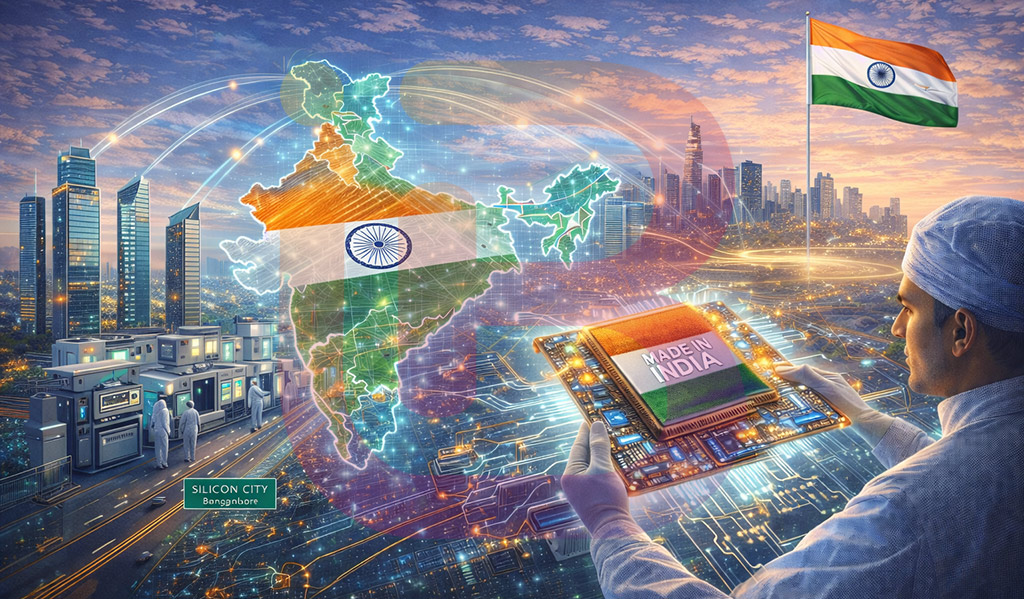
India as a Doctrine of Technological Sovereignty and National Intelligence: Architecting the Global Epicentre of Semiconductor Resilience and Logic Fabrication
For decades, India was the world’s largest consumer of semiconductors without owning the strategic leverage of semiconductor manufacturing. That era is ending.
India is now executing one of the most consequential industrial transformations of the 21st century: transitioning from a demand-driven electronics economy to a sovereign semiconductor power — spanning design, fabrication, advanced packaging, and system-level integration.
This is not merely an industrial policy.
It is a geopolitical, economic, and technological repositioning of India within the global order.
At the center of this shift stands the India Semiconductor Mission (ISM) — a national framework designed to embed India into the deepest layers of the global technology stack.
Semiconductors are no longer just components.
They are strategic infrastructure.
And India is now building that infrastructure at scale.
India’s Semiconductor Investment Wave: From Consumption to Capability
As of early 2026, India has approved over 10 large-scale semiconductor projects across six states, with cumulative investments exceeding ₹1.60 lakh crore. These projects collectively represent the first serious attempt in India’s history to internalize semiconductor manufacturing as a core national capability.
This investment wave spans the full value chain:
Key Manufacturing and OSAT Projects
Tata Electronics & PSMC (Gujarat – Dholera)
A ₹91,000 crore AI-enabled fabrication facility producing chips for 5G, automotive electronics, defence systems, and high-performance computing.
Micron Technology (Gujarat – Sanand)
A ₹22,500 crore assembly, testing, and packaging (ATMP) plant — already in pilot production — strengthening India’s role in memory and storage ecosystems.
CG Power & Renesas (Gujarat – Sanand)
India’s first end-to-end OSAT line, marking the country’s entry into commercial-scale chip backend manufacturing.
Tata Semiconductor (Assam – Morigaon)
A ₹27,000 crore advanced packaging and testing facility, strategically positioning Northeast India in global electronics supply chains.
HCL–Foxconn Joint Venture (Uttar Pradesh – Jewar)
Focused on display driver ICs for smartphones, laptops, and consumer electronics.
Together, these facilities establish India not as a peripheral node — but as a manufacturing pillar of the global semiconductor ecosystem.
What Type of Semiconductors Will India Manufacture?
India’s strategy is structurally pragmatic: it is not attempting to compete with Taiwan or Korea at sub-3nm frontier nodes in the short term. Instead, India is positioning itself where global demand is structurally deep, defensible, and geopolitically critical.
Primary Semiconductor Categories in India
1. Automotive Semiconductors
Power management ICs, sensors, control units, ADAS chips.
2. Memory & Storage
DRAM, NAND, and advanced packaging for cloud and enterprise systems.
3. Compound Semiconductors (SiC, GaN)
Critical for electric vehicles, renewable energy, charging infrastructure, and power electronics.
India’s first commercial Silicon Carbide (SiC) fab in Odisha targets the global EV transition.
4. Display Driver ICs
For smartphones, televisions, laptops, and consumer devices.
5. Defence and Space Chips
Including the indigenous Vikram 32-bit processor developed by ISRO.
6. Advanced Packaging & 3D Integration
Through glass substrates and next-gen chiplet architectures.
India’s focus is not volume alone.
It is strategic relevance across future technology sectors.
Where Will India-Made Semiconductors Be Used?
Indian semiconductors will power:
• Electric vehicles and battery systems
• 5G and 6G telecom infrastructure
• Defence electronics and aerospace systems
• Cloud data centers and AI servers
• Smartphones, laptops, and wearables
• Solar inverters and smart grids
• Industrial automation and robotics
• Smart cities and IoT platforms
Semiconductors will become India’s invisible export embedded in every major global technology system.
Global Demand and India’s Export Markets
The largest buyers of India-made semiconductors will be:
• United States
• European Union
• Japan
• South Korea
• Southeast Asia
• Middle East (smart infrastructure)
India is strategically positioned as a “China+1” semiconductor alternative — not in rhetoric, but in operational capacity.
By 2030, India’s semiconductor market is projected to reach $100–110 billion, accounting for nearly 10% of global demand.
Economic Impact: GDP, Employment, and Strategic Autonomy
Once operational at scale, India’s semiconductor ecosystem will:
• Create hundreds of thousands of high-skill jobs
• Generate $25–40 billion in annual exports
• Attract deep foreign capital and IP transfer
• Anchor India into critical global supply chains
• Reduce India’s electronics import dependency
• Strengthen national security and defence autonomy
Semiconductors will become for India what oil is for the Middle East —
a structural lever of economic and geopolitical power.
Government Vision: From Electronics Nation to Technology Sovereign
India’s semiconductor strategy rests on three pillars:
1. Fiscal Architecture
Up to 50% capital subsidy under the Modified Semicon India Programme.
2. Talent Infrastructure
The Chips to Startup (C2S) initiative aims to train 85,000 VLSI engineers, building a generational skill pipeline.
3. Design-Led Innovation
The Design-Linked Incentive (DLI) scheme supports Indian chip IP startups, enabling domestic intellectual property ownership.
This is not industrial policy.
This is technology statecraft.
India is not chasing supply chains.
It is owning strategic layers of the global stack.
The Strategic Role of Consulting Institutions in Semiconductor India
The semiconductor ecosystem is not built by fabs alone.
It requires capital structuring, policy navigation, geopolitical alignment, ecosystem design, and institutional orchestration.
This is where strategic consulting becomes system-critical.
At iBluu Corporations, through:
• iBluu Ventures Private Limited
• iBluu InfraVenture Private Limited
• iBluu Consulting Venture Private Limited
the role spans:
• Strategic government engagement and incentive advisory
• Investment structuring and cross-border partnerships
• Semiconductor M&A and joint venture strategy
• Ecosystem design and operating architecture
• Capital attraction and institutional positioning
In semiconductor economics, execution is not enough.
Only strategy compounds.
Conclusion: Semiconductors and India’s Technological Destiny
Semiconductors are no longer a sector.
They are the foundation of modern civilization.
Whoever controls semiconductors controls:
• Artificial intelligence
• Defence systems
• Energy transitions
• Digital economies
• Geopolitical influence
India’s semiconductor mission is therefore not industrial.
It is civilizational.
From being the world’s largest technology consumer,
India is now engineering itself into a technology sovereign.
The future will not be defined by who assembles devices.
It will be defined by who designs and fabricates intelligence itself.
And for the first time in history,
India is building the machines that power the world’s mind.