+91 945 889 6091
  infodesk@ibluu.com
iBluu Perspective: The US–India Trade Deal Is Not About Tariffs — It Is About Economic Power
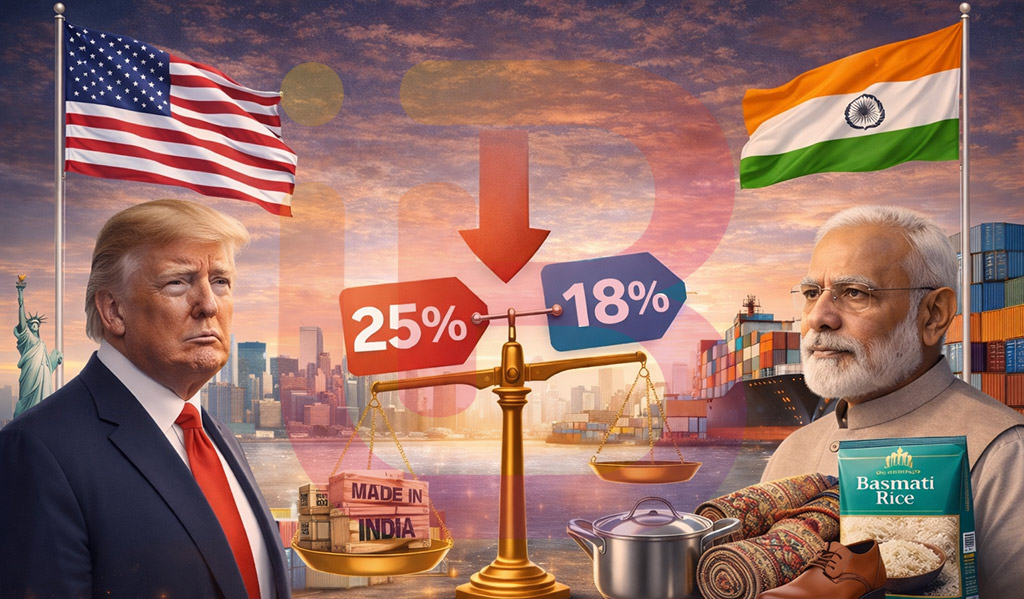
On 2 February 2026, the United States and India finalised a landmark trade agreement that dramatically reshapes bilateral commercial dynamics. Under the deal, reciprocal tariffs on Indian exports to the US have been reduced to 18 percent, down from punitive levels as high as 50 percent imposed during 2025 trade tensions. This development follows months of negotiations and represents one of the most consequential trade outcomes between the two largest democracies in recent decades.
At its core, the agreement reinstates predictability, competitiveness, and strategic partnership in what has been a volatile phase of bilateral trade — fundamentally shifting the trajectory of India–US economic relations.
Strategic Highlights of the Trade Deal
1. Immediate Tariff Reset
- Reciprocal tariff on Indian exports to the US cut to 18 percent from previously elevated punitive rates (up to 50 percent).
- The reduction is effective immediately, signalling an urgent détente in trade tensions.
2. Tariff Alignment & Market Access
- India committed to reducing its tariffs and non-tariff barriers on US-origin goods to zero, creating a more balanced trade framework and deepening market access.
- This reciprocal liberalisation unlocks broader two-way commerce and investment flows.
3. Energy & Strategic Commitments
- India agreed to cease significant purchases of Russian crude oil, aligning energy imports with diversified sources including the United States and potentially Venezuela.
- India has also pledged to purchase over $500 billion worth of US goods across key sectors including energy, technology, and agriculture as part of broader trade realignment efforts.
4. Leadership & Diplomacy
- The breakthrough emerged from direct engagement at the highest levels between US President and Indian Prime Minister, underscoring a personalised strategic rapport that accelerated negotiations.
Sectoral Implications & Product Coverage
While the official deal announcement has not yet published an exhaustive tariff schedule, a combination of previous tariff frameworks and exempted categories provides a clear picture of product-specific impacts:
A. Key Export Products Poised for Competitive Revival
| Product Category | India Original Exports to US (Est $) | Strategic Impact |
|---|---|---|
| Pearls, Gems & Jewellery | ~$8.5 B | Higher competitiveness with tariff relief |
| Pharmaceuticals | ~$8 B | Continues strong exports; potential broader regulatory alignment |
| Textiles & Apparel | ~$9.6 B | Cost competitiveness improved against regional rivals |
| Automotive Components | ~$2.6 B | Enhanced access; support for manufacturing exports |
| Consumer Goods (Tea, Coffee, Spices) | ~$>1 B* | Price competitiveness restored (subject to exemptions)* |
*Data from prior tariff environment, illustrating exposure sectors that stand to benefit most from tariff reduction.
In addition, several value-added industrial sectors — such as chemicals, specialty agrochemicals, and select machinery — are expected to benefit from lower barriers and improved margins.
B. Exemptions & Stability for Strategic Chains
Some sectors experienced preferential treatment in the original tariff regime, and likely continue under the deal due to strategic supply chain considerations:
- Pharmaceuticals and semiconductors enjoy tariff exemptions due to global supply chain importance.
- Electronics and telecom components continue to access US markets under favourable terms relative to competitive producers.
Strategic Benefits: A Win-Win Economic Recalibration
1. Export Competitiveness & Growth Revival
Reducing tariffs to 18 percent immediately restores cost competitiveness for Indian exporters, particularly in labour-intensive sectors like textiles, apparel, and consumer goods — potentially reversing export contractions triggered by earlier tariff shocks.
2. Market Diversification & Foreign Investment Flows
The trade deal reinforces the United States as a leading strategic export destination for India, strengthening investor confidence and unlocking opportunities in mid- and long-term capital flows across sectors.
3. Supply Chain Resilience & Strategic Value Chains
Greater integration with US supply chains — especially in technology, healthcare, and chemicals — enhances India’s role in critical global value chains while diversifying away from concentrated dependencies.
4. Diplomatic and Geopolitical Synergies
The transaction is not merely economic — it reinforces strategic alignment between two major democracies, shaping trade and technology governance in an era of geopolitical realignment.
Challenges & Forward Path
While the deal clears significant hurdles, a few structural questions remain for policymakers and businesses:
- Detailed product-by-product tariff schedules and implementation timelines are yet to be officially published.
- Sector-specific standards (e.g., regulatory compliance in agriculture and pharmaceuticals) may require harmonisation efforts to fully realise benefits.
- Non-tariff barriers and regulatory alignments will be crucial for long-term trade predictability.
These underscore the importance of strategic engagement and advisory services to guide businesses through the implementation phase.
The Role of iBluu Ventures & Affiliates
In this historic context, iBluu Corporations — through its specialised ventures — plays a pivotal role in catalysing value creation and strategic advantage:
iBluu Ventures Private Limited
- Trade strategy advisory and bilateral market entry frameworks.
- Export competitiveness roadmaps and global go-to-market execution plans.
iBluu InfraVenture Private Limited
- Sector-specific infrastructure deployment advisory, especially in logistics, warehousing, and industrial corridors enabling scale exports.
- PPP frameworks for market access expansions.
iBluu Consulting Venture Private Limited
- Government relations and policy advisory for navigating tariff regimes and regulatory harmonisation.
- Investment & M&A advisory to capture strategic opportunities arising from the tariff reset.
Together, these capabilities ensure that businesses and governments can translate the macro opportunity of the US–India trade deal into operational realities, investment flows, and sustainable competitive advantage.
Conclusion
The US–India tariff reset is more than a commercial adjustment — it is a strategic turning point in bilateral economic relations. It marks a transition from tariff friction to market integration and co-creation. For Indian businesses, this represents an epochal moment to reclaim export growth, enhance global competitiveness, and engage with the world’s largest economy on new terms. For the United States, it secures a diversified supply base and reinforces strategic partnerships.
Underpinning this shift is not just policy change but strategic foresight, diplomatic engagement, and economic resilience, a combination that will define the next chapter of Indo-US economic collaboration.
Read Article on LinkedIn: https://www.linkedin.com/pulse/ibluu-perspective-usindia-trade-agreement-new-architecture-economic-5ehxc