+91 945 889 6091
  infodesk@ibluu.com
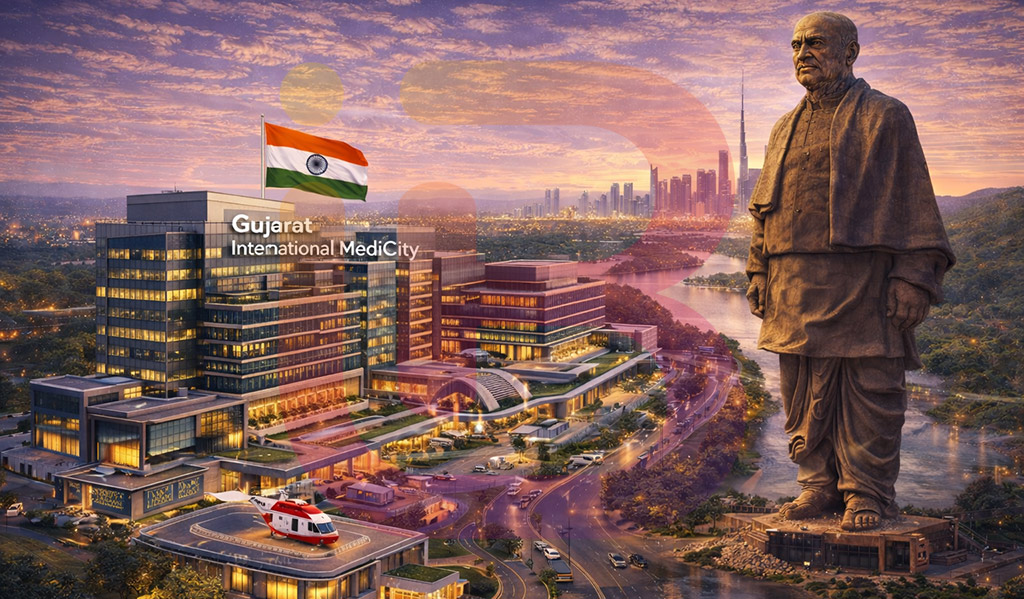
Gujarat Plans an International MediCity with ₹13,000 Crore Investment, Inspired by Dubai Healthcare City
The Gujarat government’s announcement to develop an International MediCity near Kalol, with a projected investment of ₹13,000 crore, marks more than the creation of a large healthcare complex. It signals a strategic inflection point in India’s economic architecture—where healthcare is no longer treated as a social sector alone, but as a globally competitive, capital-intensive, innovation-driven industry.
Inspired by the integrated ecosystem model of Dubai Healthcare City, Gujarat’s MediCity is envisioned as a multi-dimensional medical and life sciences hub—combining tertiary and quaternary care hospitals, medical universities, research and biotech parks, digital health platforms, wellness zones, and international patient infrastructure. In policy terms, this is not a hospital project. It is the industrialization of healthcare.
Why MediCity Matters: The Strategic Context
Globally, healthcare has emerged as one of the fastest-growing economic sectors, with the industry projected to cross $10 trillion by 2030. India, currently a ~$370 billion healthcare market, is expected to double to $600–650 billion by the end of the decade, driven by rising incomes, aging demographics, medical tourism, and digital health adoption.
Yet India’s healthcare system remains structurally fragmented:
- World-class private care exists alongside overstretched public infrastructure.
- Medical tourism thrives, but without integrated international ecosystems.
- Pharma and med-tech are strong, but disconnected from clinical innovation platforms.
The Kalol MediCity attempts to solve this structural paradox by converging healthcare delivery, research, education, technology, and global patient services into a single economic cluster—similar to how financial districts or semiconductor parks operate.
In effect, Gujarat is attempting to build India’s first true healthcare industrial city.
From Dubai to Kalol: Translating the Global Model
Dubai Healthcare City demonstrated that healthcare clusters succeed when they integrate:
- Regulatory autonomy
- International accreditation frameworks
- Academic partnerships
- Life sciences R&D
- Hospitality-grade patient experience
Gujarat’s advantage lies in translating this global model into a far larger domestic and regional opportunity. Unlike Dubai, India brings:
- A massive internal healthcare demand base
- Cost-efficient clinical talent
- One of the world’s largest pharmaceutical industries
- A rapidly expanding medical education system
If executed correctly, Kalol can become not just a medical destination, but a healthcare export platform for South Asia, Africa, the Middle East, and Central Asia.
Economic and Strategic Impact: Beyond Healthcare
The real significance of MediCity lies in its second-order effects:
- Medical Tourism as an Export Industry
India already attracts over 2 million international patients annually. A world-class integrated MediCity can institutionalize medical tourism as a formal export vertical, generating billions in foreign exchange. - Life Sciences and Innovation
By embedding biotech labs, clinical trial centers, genomics hubs, and med-tech incubators, MediCity can anchor a new innovation economy around healthcare IP. - Human Capital Development
Medical universities and training institutes within the ecosystem will create globally competitive clinical and research talent pipelines. - Urban Economic Multiplier
Large healthcare cities generate spillovers across:
- Real estate
- Hospitality
- Logistics
- IT services
- Insurance and fintech
In macro terms, MediCity is not just healthcare infrastructure—it is urban economic infrastructure of the highest order.
Execution Risks: The Critical Constraints
However, global experience shows that healthcare megaprojects fail not due to ambition, but due to execution gaps:
- Regulatory fragmentation across healthcare, education, research, and foreign investment.
- Talent bottlenecks in specialized clinicians and research scientists.
- Technology integration challenges, especially in AI, health data, and interoperability.
- International accreditation and governance standards, without which global patients will not come.
The success of MediCity will depend less on capital investment, and more on institutional design, governance frameworks, and global partnerships.
The Strategic Role of iBluu Corporations
This is precisely where iBluu Corporations and its specialized ventures become structurally relevant to the MediCity vision.
Through:
- iBluu Ventures Private Limited (investment structuring and strategic partnerships),
- iBluu InfraVenture Private Limited (infrastructure strategy and large-scale project advisory), and
- iBluu Consulting Venture Private Limited (policy, government engagement, digital and healthcare consulting),
iBluu operates at the intersection of capital, policy, infrastructure, and technology—the four pillars that determine whether projects like MediCity remain visionary announcements or become globally competitive ecosystems.
The analytical depth of this article itself has been shaped by the strategic lens of J Prasher, Founder and Managing Director of iBluu Corporations, whose work consistently focuses on national capability building, global industrial benchmarking, and long-horizon economic transformation. His perspective reframes healthcare not as a sectoral play, but as a strategic economic system with export potential, innovation leverage, and geopolitical relevance.
A New Economic Category for India
Kalol’s International MediCity represents the emergence of a new economic category for India:
Not healthcare as welfare.
Not healthcare as services.
But healthcare as strategic national infrastructure.
Just as:
- IT parks transformed India’s digital economy,
- Industrial corridors reshaped manufacturing,
MediCities can redefine India’s position in the global healthcare value chain.
If executed with global governance standards, deep private participation, strong institutional frameworks, and innovation-led design, Gujarat’s MediCity could become India’s first healthcare sovereign asset—a platform that exports healing, innovation, talent, and trust to the world.
In the coming decade, nations will compete not just on GDP or technology—but on their ability to engineer health systems as global economic engines.
Gujarat has just placed the first serious bet in that future.