+91 945 889 6091
  infodesk@ibluu.com
From Roads to Intelligence: Why Smart Traffic Management Systems Must Be Embedded in Every Highway Tender
India is constructing roads at an unprecedented scale.
Yet congestion, accidents, emergency delays, and economic inefficiencies persist—even on newly built highways.
This contradiction exposes a deeper structural flaw: India is still tendering roads as static assets in a dynamic mobility economy.
The next frontier of infrastructure excellence will not be defined by kilometers laid, but by how intelligently those kilometers move people, goods, and emergency services. This demands a fundamental rethink of how road and highway projects are conceptualized, tendered, and executed.
The Core Question Policymakers Must Now Ask
Should Smart Traffic Management Systems (STMS) be treated as optional, post-construction add-ons—or should they be mandated as an integral component of every road and highway development tender?
The evidence increasingly points to the latter.
Why the Traditional Tendering Model Is Structurally Inefficient
Today’s model separates:
- Infrastructure construction
- Traffic systems
- Digital intelligence
into different tenders, timelines, and accountability frameworks.
This fragmentation creates four systemic failures:
- Design Disconnect
Roads are engineered without embedded data architecture, limiting future optimization. - Delayed Impact
Traffic intelligence arrives years after construction, eroding early public value. - Operational Inefficiency
Fixed-timer signals and manual interventions dominate networks designed for real-time demand. - Accountability Dilution
No single entity owns end-to-end mobility outcomes.
The result: high-cost assets delivering sub-optimal performance.
What a Smart Traffic Management System Actually Delivers
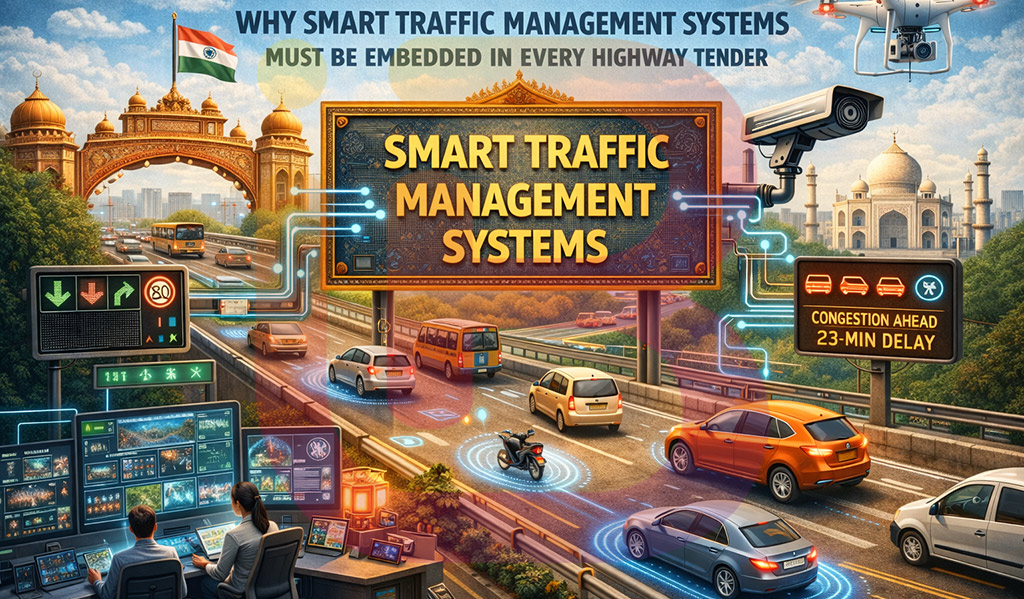
A Smart Traffic Management System (STMS) is not a technology upgrade—it is a mobility operating system.
Powered by AI, IoT sensors, advanced cameras, and real-time data analytics, STMS continuously monitors:
- Vehicle volumes and speed patterns
- Congestion build-up
- Accidents and incidents
- Emergency vehicle movements
Unlike fixed-timer systems, STMS dynamically:
- Adjusts signal timings in real time
- Reroutes traffic before choke points emerge
- Creates “green corridors” for ambulances and emergency responders
- Improves safety through predictive alerts and automated enforcement
The outcome is smoother flow, faster response times, lower emissions, and higher economic productivity.
The Strategic Case for Embedding STMS in Infrastructure Tenders
Mandating STMS within core road and highway tenders unlocks disproportionate value:
1. Superior Return on Public Capital
- Reduced congestion losses
- Lower accident-related healthcare and insurance costs
- Faster freight movement and logistics efficiency
2. End-to-End Accountability
An integrated Infra-IT consortium becomes responsible not just for building roads—but for delivering mobility outcomes.
3. Future-Ready Infrastructure
Roads become self-optimizing assets, capable of evolving with urban growth, vehicle density, and technology upgrades.
4. Faster Emergency Response
Lives are saved not by wider roads—but by intelligent priority routing.
Why Infra–IT Joint Ventures Are No Longer Optional
The future of infrastructure execution lies in structured joint ventures between:
- Infrastructure companies (engineering, execution, regulatory expertise)
- IT and technology firms (AI, analytics, IoT, command centers)
When brought together before tender submission, these alliances:
- Align design with digital intelligence
- Reduce cost overruns
- Eliminate post-construction retrofitting
- Deliver measurable public outcomes
This is how advanced economies build mobility systems—not just roads.
The Role of iBluu Consulting Venture Private Limited
iBluu Consulting Venture Private Limited, a venture of iBluu Corporations, operates at the intersection where policy intent, infrastructure execution, and digital intelligence must converge.
Our role is strategic and catalytic:
- Structuring Infra–IT joint ventures before tender participation
- Advising governments on integrated tender frameworks aligned with smart mobility goals
- Strategic government engagement and relations advisory to ensure policy alignment and execution clarity
- End-to-end consulting across infrastructure, real estate, and digital mobility ecosystems
We do not merely connect stakeholders—we design the system through which next-generation infrastructure is delivered.
A Defining Moment for Infrastructure Policy
India stands at a critical inflection point.
It can continue building roads that look modern but operate outdated.
Or it can embed intelligence at the tender table—where outcomes are truly decided.
The question is no longer technological.
It is institutional, strategic, and urgent.
Smart Traffic Management Systems must not follow roads.
They must be built into them—by design, by policy, and by contract.
That is how infrastructure becomes transformation.