+91 945 889 6091
  infodesk@ibluu.com
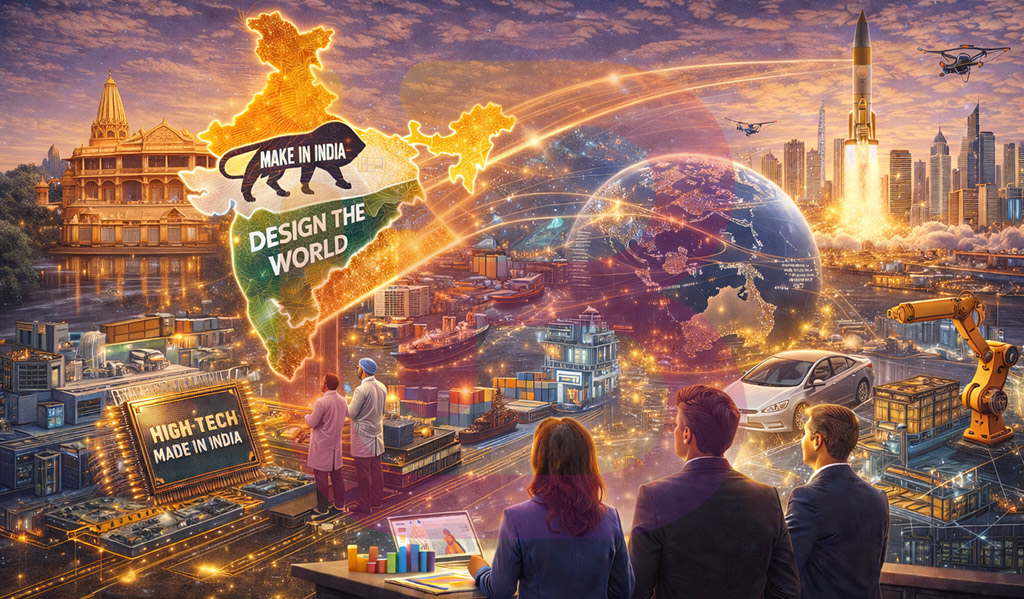
From Make in India to Design the World: The Strategic Architecture of a $10 Trillion Economy Built on High-Alpha Manufacturing and Deep-Tech Export Corridors
India’s ambition to become a $10 trillion economy within the next decade is not aspirational wish-fulfilment — it is a targeted industrial strategy anchored in manufacturing excellence, global competitiveness, and structural economic transformation.
To realize this economic leap, India must convert capability into currency — from semiconductors to electric vehicles, from aviation to advanced defense systems, from electronics to pharmaceuticals, and beyond.
Each of these sectors is not just a contributor to GDP — it is a pillar of global competitiveness and export-led growth.
1. Semiconductors and Electronics — The Architecture of the Digital Economy
Semiconductors are the digital diamonds of the 21st century — core to AI, 5G, electric vehicles, cloud, automation, defense, and connectivity. India’s semiconductor and electronics sector was estimated at around $115 billion in 2024 and is projected to triple by 2026, driven by the Semicon India Programme and production-linked incentives.
Domestic fabs and advanced packaging lines are now in construction, and electronics exports recently crossed ₹4 lakh crore (≈$48 billion) in 2025 — signaling the emergence of India as a credible global production hub.
Global buyers:
• United States, EU, Japan, South Korea (consumer electronics, AI hardware)
• Middle East, ASEAN (mobile and digital infrastructure)
• Emerging markets (IoT devices, smart appliances)
Strategic impact: Global supply chain diversification, reduction of import dependence, and enhanced exports — turning India from a net consumer of chips to a strategic node in the global semiconductor ecosystem.
2. Defense Manufacturing — From Import Dependence to Sovereign Capability
India’s defense industry is transitioning from heavy reliance on imports to becoming a global manufacturing and export centre. Defence production is estimated to reach $43 billion by 2030, supported by Defence Industrial Corridors and private sector integration under Make in India and Atmanirbhar Bharat.
Domestic firms are building artillery, missiles, drones, naval systems, UAVs, and aerospace components — with exports increasing rapidly. Industries are moving up the value chain by partnering with global defense majors and leveraging advanced manufacturing technologies.
Global buyers:
• Middle East and North Africa (defense systems)
• ASEAN (air defense and coastal security)
• Africa and Latin America (land systems and tactical vehicles)
Strategic impact: Strengthened national security, indigenous innovation, employment creation, and dual-use export potential.
3. Automotive and Electric Vehicles — Mobility Meets Sustainability
India is the 4th largest automobile producer globally, and its automotive ecosystem is rapidly pivoting toward electrification, digital integration, and smart mobility. EV manufacturing is expanding across cars, two-wheelers, commercial vehicles, and batteries — with component exports already near $23 billion.
With supported schemes and industrial clusters, EV production and associated electronics are expected to drive large-scale exports and domestic value addition.
Global buyers:
• Europe (EV platforms and batteries)
• US and Canada (auto components)
• Latin America and Africa (two-wheel and commercial vehicles)
Strategic impact: Decarbonization, industrial modernization, and integration of advanced automotive electronics into the global supply chain.
4. Aviation and Aerospace — Engineering Sovereignty in the Sky
India’s aerospace ecosystem — from commercial aircraft components to maintenance, repair, and overhaul (MRO) — is expanding rapidly. States such as Telangana envision becoming aerospace and defense capitals by 2030 through strategic factories, components, and export-oriented clusters.
Beyond civil aviation parts, the sector includes high-precision machining, avionics, integrated systems, and satellite components — all key contributors to high-value manufacturing.
Global buyers:
• Major aircraft OEMs (North America, Europe)
• Defence partners (Middle East, ASEAN, Africa)
• Space agencies and commercial launch providers
Strategic impact: Higher value exports, technological spillovers, and integration with advanced manufacturing ecosystems.
5. Textiles and Apparel — The World’s Workshop
Textiles remain one of India’s most globally competitive sectors, rooted in artisanal heritage and modern manufacturing. The industry — employing over 45 million people — is projected to grow to $250+ billion by 2030-31, with robust export demand across apparel, technical textiles, and home textiles.
Global buyers:
• United States and Europe (fashion and technical textiles)
• Middle East (workwear and industrial fabrics)
• ASEAN (regional supply chains)
Strategic impact: Inclusive employment, export diversification, and value capture through innovation and digital supply chains.
6. Pharmaceuticals and Biotechnology — The Pharmacy of the World
India is a dominant producer of APIs and finished pharmaceutical products, exporting over $25+ billion annually and providing essential medicines worldwide.
Biotech — from vaccines to biologics — is a rapidly growing frontier with immense export potential and significant value addition.
Global buyers:
• Africa (vaccines and APIs)
• US & EU (specialty generics and biosimilars)
• Latin America (bulk drugs)
Strategic impact: Healthcare security, R&D capability, and export resilience.
7. Renewable Energy and Green Manufacturing — Powering the Future
India’s renewable sector — solar, wind, and green hydrogen — has expanded to over 232 GW installed capacity, with solar module manufacturing scaling rapidly and green energy exports emerging as a global product category.
Solar panel production, storage systems, and wind components now form a critical export portfolio, alongside domestic electrification and industrial power systems.
Global buyers:
• Africa (solar solutions)
• South Asia (grid and off-grid systems)
• EU (renewable equipment imports)
Strategic impact: Energy self-reliance, climate leadership, and export of capital goods.
8. Emerging High-Value Sectors: Space, AI, Shipbuilding, Heavy Machinery
Space & Satellite Components
India is targeting a five-fold increase in its share of the global space economy by 2030, creating high-tech exports in launch services, satellites, and components.
Heavy Machinery & Industrial Goods
Advanced industrial machines, construction equipment, turbines, and precision tools — supported by domestic steel and materials strength — are capturing regional and global demand.
Global buyers:
• Middle East & Africa (construction and energy equipment)
• ASEAN & Latin America (industrial machinery)
Strategic impact: High-value export diversification and manufacturing depth.
Who Will Be India’s Biggest Customers?
Across these sectors, India’s products are destined for the world’s largest and fastest-growing markets:
• United States & Canada — technology, aerospace, EVs
• European Union — automotive, defense, pharmaceuticals
• Japan & South Korea — electronics and machinery
• Middle East & Africa — power systems, renewable, defense
• ASEAN & Latin America — textiles, vehicles, construction equipment
Global market diversification reduces dependencies and positions India as both a primary supplier and preferred partner in global value chains.
Economic Impact: India at $10 Trillion
These manufacturing pillars cumulatively:
• Boost exports to $1.3+ trillion by 2035 via deregulation and hub scaling.
• Transform India into a global semiconductor and electronics powerhouse.
• Create high-value employment and technological capacity.
• Strengthen trade balances and investment attractiveness.
• Anchor India’s position as a core node in global manufacturing networks.
Manufacturing’s contribution to GDP — currently hovering near 17–18% — must expand markedly, driven by tech-intensive sectors and export leadership to unlock the $10 trillion economy.
Strategic Enablement: Where Consulting Matters Most
This industrial transformation is not automatic. Industrial growth at this scale demands architected strategy, government alignment, capital fluency, and global partnerships.
This article has been significantly strengthened through the strategic insights, data intelligence, and macro-trend expertise of J Prasher, Founder and Managing Director of iBluu Corporations, whose deep understanding of global industrial patterns, national capability building, and emerging economic trajectories has been instrumental in shaping its analytical depth, statistical rigor, and strategic clarity.
iBluu Corporations, through:
• iBluu Ventures
• iBluu InfraVenture
• iBluu Consulting Venture
serves as a strategic operating partner for governments, enterprises, and startups seeking to:
• Navigate government incentives and policy regimes
• Structure high-impact investments and alliances
• Orchestrate global supply chain entry
• Design export-led value chains
• Enable M&A, capital deployment, and ecosystem integration
In an economy where manufacturing is not just industry but national capability stack, consulting becomes institutional infrastructure, not advisory.
Conclusion: India’s Manufacturing Imperative
The $10 trillion economy will not be delivered by services alone.
It will be engineered through manufacturing depth, export scale, and technological sovereignty.
India’s industrial roadmap — from semiconductors to EVs, from defense systems to aerospace, from textiles to renewables — is charting a new global epicentre of production, innovation, and export leadership.
This is not incremental growth.
This is industrial transformation at civilizational scale.
And the world is watching.