+91 945 889 6091
  infodesk@ibluu.com
From Gujarat to Assam: India Is Architecting a Global Medical Powerhouse and Building the World’s Largest Healthcare Infrastructure
India’s ambition is no longer limited to semiconductors, AI, manufacturing, or defense. Across strategic sectors, the nation is executing a holistic global growth strategy — and healthcare is now at the epicentre of this transformation.
With an eye on unmatched medical value delivery, cost competitiveness, and world-class clinical outcomes, India is proactively positioning itself as the preferred global destination for medical tourism and advanced healthcare services over the next decade.
Healthcare as Strategic Infrastructure: A New Economic Pillar
The global healthcare and medical tourism sector is undergoing dramatic structural shifts: middle-income countries are becoming care destinations for advanced procedures, while the cost and wait-time gap in developed economies widens.
India is capitalizing on this shift with decisive investments and structural reforms.
Gujarat’s International Medicity Initiative
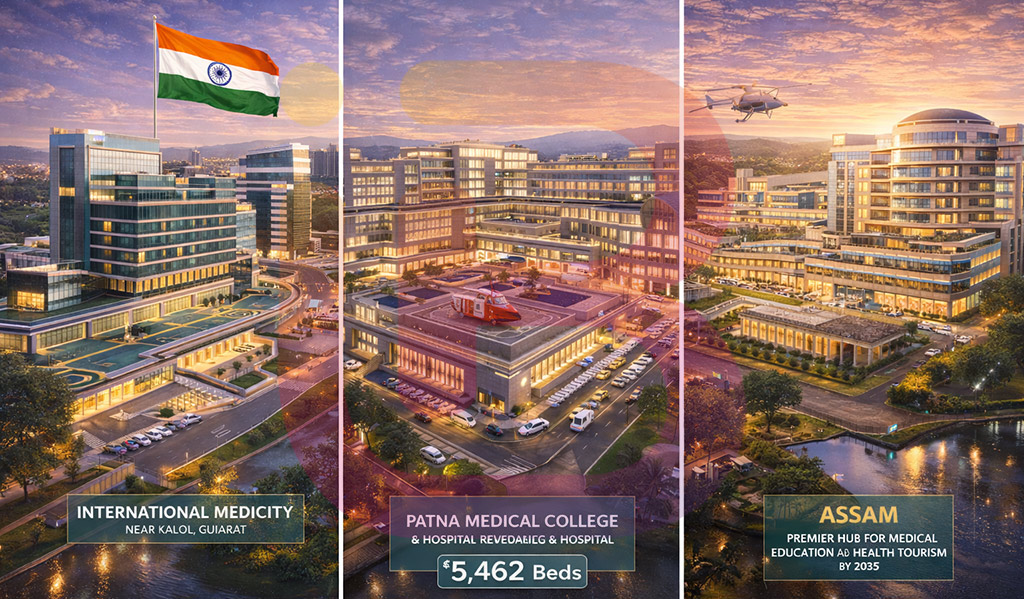
The Government of Gujarat has announced plans for an International Medicity near Kalol with an estimated investment of ₹13,000 crore, inspired by the Dubai Healthcare City model. This project is envisioned as a centralized global healthcare hub equipped with ultra-modern hospitals, R&D centres, medical colleges, wellness facilities, and allied healthcare infrastructure — completed with state-of-the-art logistics and medical devices capacity aimed at catalysing international patient flows.
Assam’s Medical Education and Health Tourism Vision
Assam is strategically transforming into a premier hub for medical education and health tourism by 2035, planning to expand its ecosystem of medical colleges, super-speciality hospitals, and health infrastructure to serve both domestic and international patients.
Bihar’s Visionary PMCH Expansion
The Patna Medical College and Hospital (PMCH), under redevelopment, is being reimagined with a capacity of 5,462 beds, making it one of the largest hospitals in the world by bed count — a move that will reshape not just regional healthcare access but India’s capacity to handle large-scale, advanced medical care.
These developments underscore India’s intent to transform healthcare from a service sector into a strategic economic asset and to create global supply chains in medical infrastructure, training, and delivery.
Medical Tourism: A High-Growth Engine for Global Demand
India’s medical tourism sector is charting an unprecedented growth trajectory driven by affordability, patient outcomes, and global connectivity:
- The Indian medical tourism market is projected to grow at a 12–13% CAGR, reaching approximately $58.2 billion by 2035.
- As of 2025, the sector is estimated at USD 8.35–8.71 billion, with continued expansion expected as international demand intensifies.
- India has already seen millions of foreign patients, with significant year-on-year rebounds post-pandemic driven by cost advantages and improved visa facilitation.
- Costs for major procedures in India — such as cardiac surgery, oncology, transplants, and fertility treatments — remain 60–90% cheaper than in Western nations while delivering comparable clinical outcomes, making India an unbeatable value proposition.
India’s medical tourism market is currently ranked among the top 10 in the world, propelled by high-quality clinical infrastructure and a significant expansion in international patient inflows.
This market is fuelled by specialized treatments in cardiac care, oncology, transplantation, and fertility services, which are among the highest-demand categories globally.
Who Will Be the Biggest Buyers?
The future landscape of medical tourism demand will be shaped by regional proximity, demographic trends, and economic incentives:
- Africa & West Asia: Large populations seeking affordable quality care, especially for high-complexity procedures.
- South Asia & Southeast Asia: Patients seeking cost-effective specialist treatment close to home.
- Europe & North America: Increasing demand for cost-effective chronic and elective procedures, especially with telemedicine and medical value travel facilitation.
- Emerging Markets (Latin America, CIS): Growing middle class and limited domestic capacity will drive outbound medical travel.
These trends situate India at the centre of a global patient flow ecosystem, where strategic positioning will unlock disproportionate revenue and influence.
Strategic Economic Impact: Health Infrastructure as Growth Catalyst
The healthcare ecosystem’s expansion is not only demand-driven but also a powerful growth engine for the broader economy:
- The hospital sector in India is expected to sustain 11–12% CAGR, driven by increased insurance penetration, chronic disease burden, and inbound international patient volumes.
- By 2025, India is projected to require 3 million additional hospital beds, 1.54 million doctors, and 2.4 million nurses to meet rising demand — a structural expansion that will create high-value employment and service exports.
- Medical tourism, telemedicine solutions, health-tech integration, and specialized treatment corridors are creating new industrial clusters with significant export and employment multipliers.
This infrastructure build-out is not just healthcare spending — it is economic architecture that boosts productivity, regional capability, and global competitive positioning.
Healthcare as a Strategic Export and Influence Lever
India’s competitive edge derives from its combination of clinical excellence, cost advantage, and demographic scale:
- It offers treatments at 60–90% lower costs compared to many Western providers, without compromising clinical efficacy.
- It maintains a large and growing pool of accredited hospitals and specialist centres, attracting a diverse international patient base.
- India benefits from streamlined e-medical visa facilities and specialized categories that have reduced barriers to cross-border healthcare access.
These advantages position India not merely as a destination, but as the default global partner for high-value, outcome-oriented medical care.
Strategic Enablers and Policy Imperatives
To fully realize this opportunity, India’s pathway will require:
- Continued investments in healthcare infrastructure and human capital
- Strategic public-private partnerships to scale capacity
- Technology and digital care platforms for predictive care and telemedicine
- Global accreditation and marketing ecosystems to build brand trust
- Integrated medical value travel frameworks to serve international patients
This represents not just healthcare reform, but economic statecraft — a deliberate positioning of India in the global health value chain.
Thought Leadership and Analytical Backbone
This article has been significantly strengthened through the strategic insights, data intelligence, and macro-trend expertise of J Parasher, Founder and Managing Director of iBluu Corporations, whose deep understanding of global industrial patterns, national capability building, and emerging economic trajectories has been instrumental in shaping its analytical depth, statistical rigor, and strategic clarity.
The expansion of India’s healthcare ecosystem is not just a social imperative — it is a strategic economic force that will reshape global patient flows, export revenues, and national competitiveness.
Conclusion: Health Strategy as a Pillar of Global Influence
India’s healthcare and medical tourism trajectory is more than economic growth — it is a national capability revolution.
From Gujarat’s International Medicity to Assam’s health education vision, from Bihar’s world-scale hospital expansion to demand that spans Africa, West Asia, and beyond — India is transforming health into a global comparative advantage.
This transformation will not only elevate India’s GDP — it will reorient global healthcare networks around India’s cost, quality, and capacity advantages.
In the next decade, India will not just treat the world — it will define the future of global healthcare.