+91 945 889 6091
  infodesk@ibluu.com

Designed and Made in India, Trusted by the World: Semiconductors Are Rewriting India’s Global Power and Dominance
For decades, semiconductors were treated as an invisible input—tiny components buried deep inside devices, systems, and supply chains. That illusion is over.
Today, semiconductors are economic power, strategic leverage, and national capability compressed into a few square millimeters of silicon. Whoever controls them does not merely manufacture technology—they shape the future of global trade, defense, innovation, and influence.
India understands this now. Not as a slogan. Not as a press release. But as a structural national priority.
The rise of semiconductors in India is not just another chapter in Make in India or Made in India.
It is the beginning of Build-in-India-for-the-World.
From Cost Arbitrage to Capability Arbitrage
Historically, global manufacturing flowed to where labor was cheap.
Semiconductor manufacturing flows to where capability is deep, governance is credible, capital is patient, and policy is predictable.
India’s shift is profound:
- From services-led growth to manufacturing-backed sovereignty
- From import dependence to strategic self-reliance
- From assembly ecosystems to end-to-end value chains
This is not about competing on wages.
It is about competing on scale, trust, talent, and time horizon.
Semiconductors force nations to grow up economically. India is doing exactly that.
Why the World Is Turning to India—Now
Global technology and semiconductor leaders are not sentimental. They are rational, ruthless allocators of capital. Their renewed interest in India is driven by five hard realities:
1. Supply Chain De-Risking Is No Longer Optional
Geopolitical shocks have exposed the fragility of over-concentrated semiconductor hubs. The world needs redundancy without chaos. India offers scale without volatility.
2. India Has the World’s Deepest Semiconductor Talent Pool—Outside the Fabs
Indian engineers already design chips that power global systems—from consumer electronics to defense platforms. Manufacturing is the missing layer—and it is now being built.
3. Policy Has Shifted from Incentives to Intent
India’s semiconductor mission is not fragmented. It is coordinated—across fiscal support, infrastructure, land, power, water, logistics, and fast-track clearances. Capital follows seriousness.
4. The Market Is Here
India is not just a manufacturing base; it is one of the world’s fastest-growing consumers of semiconductors—across EVs, telecom, data centers, AI, defense, and consumer electronics.
5. Trust Is the New Currency
For global tech leaders, India represents democratic stability, legal continuity, and strategic alignment—a rare combination in a fractured world.
Who Is India Competing With? And Why That’s the Wrong Question
India is often compared with Taiwan, South Korea, China, and the U.S.
That comparison is lazy.
India is not trying to replace any of them.
India is positioning itself to complement, absorb, and scale alongside them.
- Taiwan perfected foundry excellence.
- South Korea mastered vertical integration.
- The U.S. leads in design and frontier innovation.
- China scaled manufacturing at unprecedented speed.
India’s advantage lies elsewhere:
the ability to integrate talent, market, democracy, and scale into a single long-term platform.
This is not a race for dominance.
It is a race for resilience.
And resilience wins over time.
Economic Impact: Beyond Chips, Toward National Multipliers
Semiconductors are not an isolated industry. They are economic multipliers.
A mature semiconductor ecosystem triggers:
- Advanced manufacturing clusters
- High-value job creation
- Deep-tech startups and IP generation
- Defense and strategic autonomy
- Stronger currency fundamentals
- Long-term capital inflows
Every semiconductor fab pulls an entire economy upward—from chemicals and materials to logistics, real estate, education, and R&D.
This is why nations subsidize semiconductors not as costs—but as investments in future GDP stability.
India is making that bet deliberately.
Made in India. Designed for the World. Trusted by Global Capital.
The new narrative is not protectionist.
It is participatory.
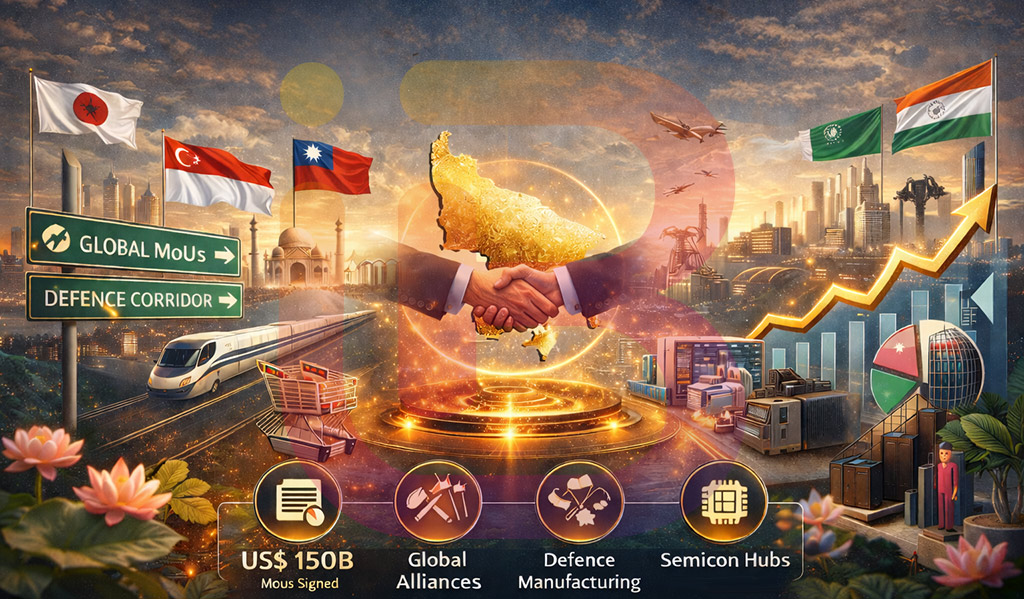
India’s semiconductor strategy is open, collaborative, and globally integrated. It welcomes:
- Joint ventures
- Global technology partnerships
- Capital alliances
- IP-sharing frameworks
- Co-innovation models
The message is clear:
If you want to build the future of technology, India is no longer optional.
The Strategic Role of Advisory Institutions
Building a semiconductor ecosystem is not only about fabs and funding. It requires:
- Strategic government engagement
- Cross-border capital structuring
- Regulatory navigation
- Land, infrastructure, and ecosystem alignment
- M&A and partnership orchestration
- Long-term stakeholder trust
This is where institutional-grade advisory becomes critical.
iBluu Ventures Private Limited and iBluu Consulting Venture Private Limited, ventures of iBluu Corporations, operate at this intersection—where strategy meets statecraft, and capital meets capability.
From strategic consulting and government engagement to investment advisory, M&A structuring, IT consulting, and alliance partnerships, iBluu supports organizations not just in entering India—but in building durable, scalable, future-proof platforms within India’s semiconductor and technology ecosystem.
The Final Word
Semiconductors are not about silicon.
They are about sovereignty, scale, and the future distribution of global power.
India is no longer asking whether it should participate.
India is deciding how big it intends to play.
And the world is already responding.
The next decade will not ask whether India becomes a semiconductor power.
It will ask how early you recognized it—and how wisely you aligned with it.