+91 945 889 6091
  infodesk@ibluu.com
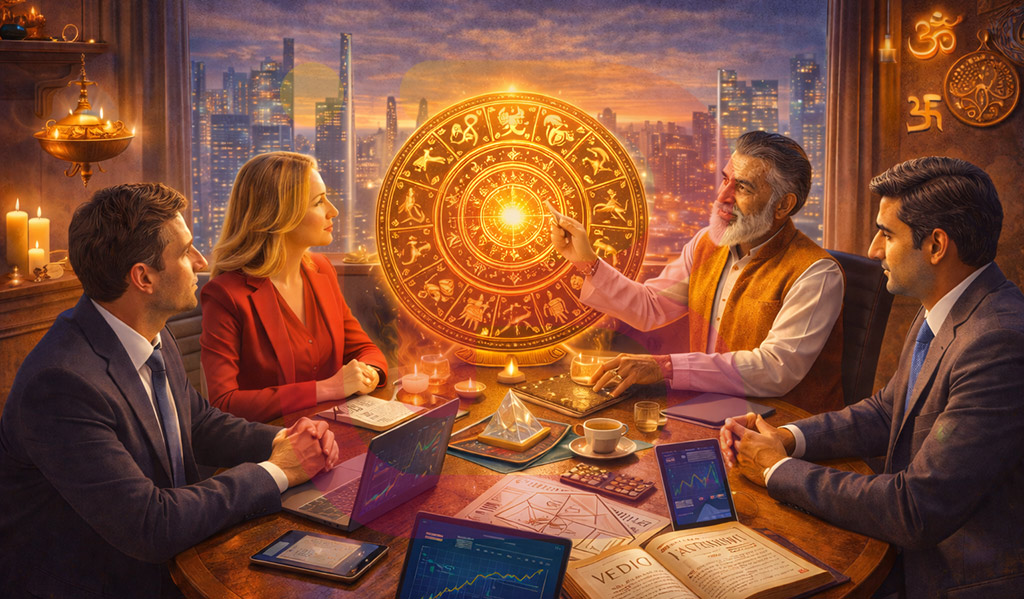
Beyond Belief: Why Fortune 500 Leaders Are Turning to Planetary Timing—and Why Vedic Astrology Repeatedly Appears in Successful Business Decisions
Vedic Astrology Still Shapes Indian Businesses — and Why the World Is Paying Attention
In global boardrooms, decisions are framed in spreadsheets, scenario models, and probability curves.
In India, decisions have always been framed one level deeper—in time itself.
This is not superstition.
This is civilizational strategy.
For over 5,000 years, Indian commerce, statecraft, and leadership have been guided not only by capital and capability—but by Kala (time), Gati (momentum), and Rta (cosmic order). What the modern world calls risk management, India once called Jyotisha—the science of light and timing.
And today, as uncertainty becomes structural rather than cyclical, the world is quietly rediscovering why.
Astrology in India Was Never Belief. It Was Governance.
Vedic Astrology was not practiced on the fringes of Indian society.
It sat at the center of power.
- Kings consulted astrologers before wars, treaties, and successions
- Traders timed voyages, contracts, and expansions by planetary cycles
- Temples acted as data centers—tracking celestial movements with mathematical precision
- Gurus were not mystics alone; they were strategic advisors
In ancient India, strategy without timing was considered incomplete.
Even today, many of India’s most successful entrepreneurs—often privately, sometimes openly—respect one principle deeply:
Right decision. Wrong time. Wrong outcome.
Why Indian Business Still Cares About Astrology and Numerology
Indian entrepreneurs operate in a reality where:
- Markets are volatile
- Regulations shift
- Human variables dominate outcomes
- Emotional intelligence often matters more than financial logic
Astrology and Numerology act as decision filters, not decision substitutes.
They answer questions modern analytics cannot:
- When to launch—not just what to launch
- Who aligns with leadership destiny—not just resumes
- Which phase favors risk vs consolidation
- Why identical strategies succeed for one firm and fail for another
This is why:
- Company names are numerologically calibrated
- IPO dates are astrologically vetted
- Leadership transitions are timed
- Major investments wait for planetary clearance
Not because Indians are irrational—
but because they understand time as a strategic variable.
The World’s Quiet Fascination With Indian Wisdom
Publicly, the West dismissed astrology.
Privately, it absorbed India’s deeper frameworks.
Consider the facts:
- Silicon Valley founders openly discuss Eastern philosophy
- Global CEOs meditate, fast, and follow lunar cycles
- Universities teach Indian mathematics, yoga, and Vedic logic
- Indian gurus attract global leaders—from tech to politics
- Temples like Tirupati, Kashi, and Rameshwaram draw global scholars, not just devotees
Astrology is no longer dismissed as belief.
It is being reframed as pattern recognition across time.
What finance calls cycles,
India called Dashas.
What economics calls leading indicators,
India called Graha Gati.
Astrology + Business: Not Control, But Clarity
The most misunderstood aspect of Vedic Astrology is this:
It does not remove free will.
It clarifies terrain.
Just as weather forecasting doesn’t stop rain—but helps pilots fly safely—
Astrology doesn’t control outcomes—but reduces blind risk.
For business leaders, this means:
- Strategic patience during adverse cycles
- Aggressive expansion during supportive periods
- Emotional detachment from temporary losses
- Alignment between personal destiny and corporate growth
As one ancient verse implies:
You don’t fight the river. You learn when to sail.
India’s Gurus, Vedas, and Temples: Soft Power Without Marketing
India never exported astrology aggressively.
It let results speak.
That is why:
- Indian gurus have global followings without advertising
- Vedas are studied worldwide without PR agencies
- Temples remain living institutions, not museums
- Indian spiritual leadership commands trust—not fear
This is soft power rooted in depth, not dominance.
The Future: Integrating Intelligence, Not Choosing Sides
The next era of Indian business leadership will not choose between:
- Analytics or astrology
- Data or destiny
- AI or ancient intelligence
It will integrate them.
The strongest leaders will be those who:
- Respect data
- Understand people
- Honor timing
- Align intent with cycles
Because in a world obsessed with speed,
those who master timing will always lead.
Final Thought
The West mastered scale.
India mastered time.
The future belongs to leaders who can hold both.
Read Full Article on LinkedIn: https://www.linkedin.com/pulse/beyond-belief-why-fortune-500-leaders-turning-planetary-timing-vedic-7tizc