+91 945 889 6091
  infodesk@ibluu.com
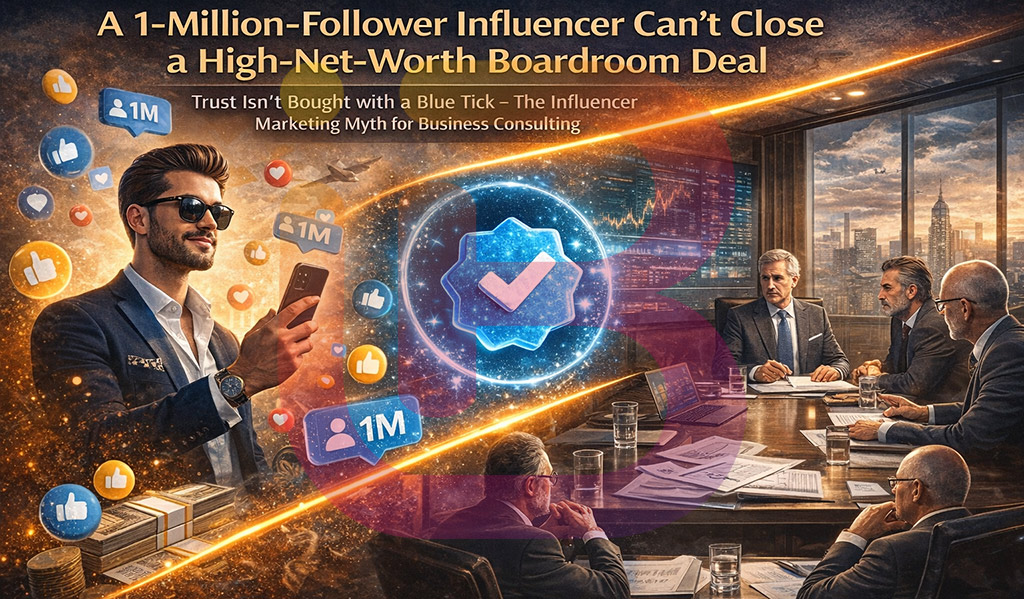
A 1-Million-Followers “Influencers” Can’t Close a High-Net-Worth Deal in the Boardroom: Trust Isn’t Bought with a Blue Tick – The Influencer Marketing Myth for Business Consulting
Business consulting firms operating in government liaison, policy advisory, HNI investment consulting, strategic real estate, and professional lobbying face a structural marketing paradox: the higher the trust requirement, the narrower the promotional runway.
Unlike consumer brands or technology products, firms such as iBluu Corporations and its venture iBluu Consulting Venture Private Limited (IBCV) operate in regulated, confidential, reputation-sensitive ecosystems. In these domains:
- 61–68% of new consulting mandates originate from referrals and word-of-mouth (RAIN Group, 2025).
- Only 18–22% of regulated B2B firms consider digital advertising effective (LinkedIn B2B Institute, 2025).
- Thought leadership content generates 3–5x more qualified leads than traditional advertising for high-value consulting services.
- Client acquisition cost in government advisory and lobbying verticals is 4–6x higher than general B2B services due to compliance and trust barriers.
The conclusion is counterintuitive:
In high-stakes consulting, marketing is not about visibility — it is about credibility architecture.
Why Marketing Options Are Structurally Restricted
1. Regulatory and Ethical Constraints
Government engagement and lobbying operate under strict regulatory scrutiny. In India, compliance frameworks, disclosure norms, and anti-corruption legislation limit aggressive promotion. Any perception of influence-for-sale damages credibility.
Overt marketing can create reputational risk — especially when dealing with:
- Senior bureaucrats
- Ministers
- HNI investors
- CXOs of regulated industries
In such ecosystems, discretion is currency.
2. Long, High-Stakes Sales Cycles
Mandates in policy advisory, strategic real estate, or investment structuring often have 6–24 month decision cycles. This eliminates the viability of mass funnel-based marketing.
The decision is rarely transactional.
It is relational.
3. Small, Elite Target Universe
The addressable market is not “millions of users.” It may be:
- 150 large corporates
- 200–300 HNI investors
- Select policy stakeholders
- Industry bodies
This makes broad digital advertising inefficient by design.
Ranking Marketing Effectiveness for Business Consulting
Tier 1 – Dominant & High Impact
| Strategy | Impact Level | Why It Works |
|---|---|---|
| Word-of-Mouth / Referrals | ★★★★★ | Trust transfer mechanism |
| Thought Leadership Research | ★★★★★ | Demonstrates intellectual authority |
| Founder/Partner Branding | ★★★★☆ | Humanizes expertise |
| Strategic Networking (CII, FICCI, ASSOCHAM) | ★★★★☆ | Relationship capital |
| Account-Based Marketing (ABM) | ★★★★☆ | Precision targeting |
Referral-driven ecosystems account for the majority of mandate wins in top-tier consulting globally.
Tier 2 – Supportive but Important
- Earned media in business press
- Closed-door policy briefings
- Co-branded reports with law firms or financial institutions
- Email nurture sequences (insight-driven, not promotional)
- LinkedIn Sales Navigator-driven outreach
LinkedIn remains the dominant discovery platform for senior decision-makers — over 90% of CXOs in India use it for professional engagement.
Tier 3 – Minimal or Misaligned
- Mass digital ads (Google, Facebook)
- Influencer marketing
- Gamified interactive content
- Broad cold calling
- Aggressive email blasts
These tactics dilute perceived seriousness and offer near-zero ROI in high-trust advisory verticals.
The Strategies Most Firms Overlook (But Actually Work)
Many consulting articles stop at “content + referrals.” That is incomplete.
1. Proprietary Research as a Marketing Engine
Firms with proprietary data close 3.2x more deals than firms without research assets.
Research transforms marketing into intellectual infrastructure.
Whitepapers, policy impact studies, and industry benchmarking reports serve as:
- Credibility signals
- Conversation starters
- Relationship anchors
2. Micro-Community Building
Invite-only CXO roundtables.
Private HNI policy briefings.
Closed WhatsApp or curated LinkedIn communities.
This is not social media marketing.
It is influence ecosystem design.
3. Executive Roundtables & Masterminds
Closed-door discussions create:
- Peer validation
- Trust layering
- Mandate acceleration
Deals in government and investment advisory often originate in curated environments — not advertisements.
4. AI-Powered Personalized Insights
Instead of pitching services, deliver:
- Customized policy impact simulations
- Land-use feasibility dashboards
- Investment scenario modelling
Insight-first engagement replaces persuasion.
5. Strategic Alliances
Co-authoring reports with:
- Law firms
- Investment banks
- Big 4 firms
This transfers credibility and expands reach without overt promotion.
What Global Leaders Actually Do
Top global consulting firms do not rely on advertising for growth.
Over 80% of new mandates at firms such as McKinsey & Company, Boston Consulting Group, EY, and Deloitte originate from:
- Existing client relationships
- Referrals
- Thought leadership
- Industry positioning
Advertising plays a brand role — not a revenue engine.
A 4-Pillar Framework for Restricted-Sector Consulting
For firms like iBluu Corporations and IBCV, marketing must be redefined through four strategic capitals:
1. Reputation Capital
Thought leadership, research, founder visibility.
2. Relationship Capital
Structured referral systems, industry bodies, curated networking.
3. Insight Capital
Proprietary data, benchmarking tools, analytical differentiation.
4. Ecosystem Capital
Alliances, institutional participation, policy positioning.
Marketing becomes ecosystem engineering.
The Role of IBCV and Strategic Positioning
IBCV, as the execution arm of iBluu Corporations, operates across:
- Business & Strategic Consulting
- Strategic Government Engagement
- IT Consulting
- Investment Advisory
- M&A Services
- Alliance Partnerships
Its positioning demands restraint.
Aggressive marketing would contradict strategic credibility.
The analytical lens shaping this model reflects the philosophy of J Parasher, Founder and Managing Director of iBluu Corporations, whose framework views consulting not as a transactional service sector — but as a national capability multiplier with export potential and geopolitical relevance.
This shifts marketing from promotion to strategic statecraft alignment.
Risks & Compliance Considerations
- DPDP Act compliance in data handling
- Strict documentation of government engagements
- Avoidance of perceived pay-for-influence positioning
- Transparent communication architecture
In restricted sectors, one reputational misstep outweighs ten successful campaigns.
Strategic Conclusion
Business consulting does not suffer from limited marketing options.
It benefits from them.
Constraints force discipline.
Discipline builds trust.
Trust builds mandates.
For firms operating in strategic advisory, the winning formula is:
Deep thought leadership.
Selective high-trust networking.
Proprietary insight creation.
Structured referral ecosystems.
In high-stakes consulting, the most powerful marketing is invisible.
It is the quiet accumulation of expertise, discretion, and relationships — compounding over time until the market seeks you, not the other way around.