+91 945 889 6091
  infodesk@ibluu.com
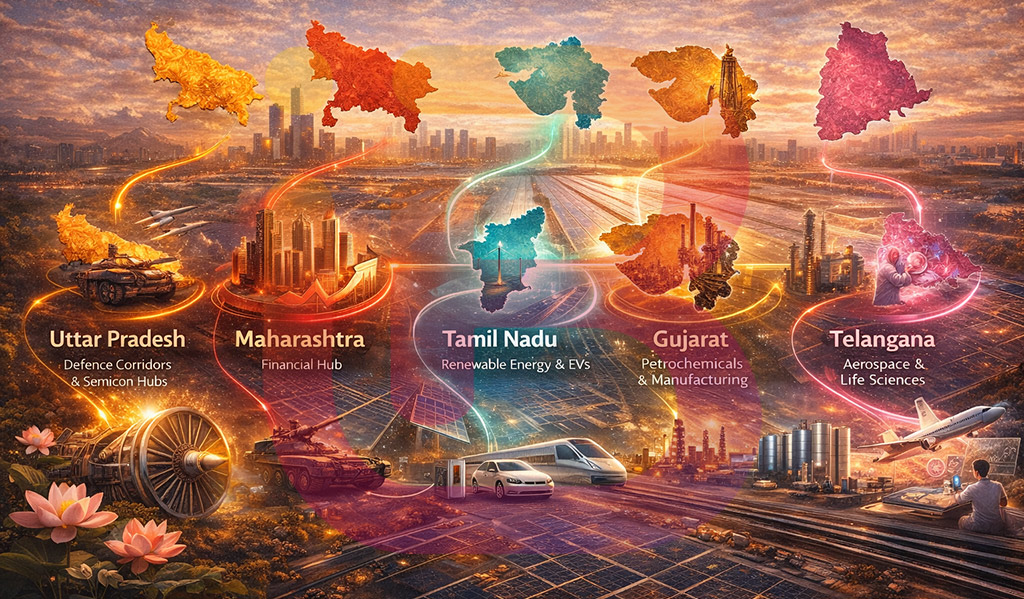
From Manufacturing Corridors to Semiconductor Hubs: Maharashtra, Gujarat, Uttar Pradesh, Tamil Nadu, and Karnataka Attracting Global Corporations and Investment
India is entering a decisive economic decade.
As global supply chains diversify under the “China+1” strategy, multinational corporations and domestic industrial giants are repositioning manufacturing, technology, and infrastructure investments toward India.
In FY2024-25 alone, India attracted approximately $81 billion in Foreign Direct Investment (FDI) while domestic industrial commitments exceeded ₹26.6 lakh crore, according to data from the Department for Promotion of Industry and Internal Trade (DPIIT) and banking sector estimates.
Yet this capital does not spread evenly across the country.
A handful of states have emerged as India’s strategic investment magnets, capturing a majority of global and domestic capital flows.
These states are not just economic regions — they are industrial ecosystems shaping the trajectory of India’s rise toward a $7–10 trillion economy by 2030.
India’s Top Investment Destinations
Five states dominate the investment landscape: Maharashtra, Karnataka, Gujarat, Tamil Nadu, and Uttar Pradesh.
Together, they represent over 70% of India’s major investment flows across manufacturing, technology, renewable energy, infrastructure, and electronics.
Top States Attracting Investments (FY2024-25)
| State | FDI Inflow | Major Sectors | Key Investors | Major Projects |
|---|---|---|---|---|
| Maharashtra | ~$19.6B (31% share) | Finance, Data Centers, Infrastructure | Microsoft, Tata, Adani | Data center parks, Nagpur industrial corridor |
| Karnataka | ~$6.6B | Technology, Semiconductor R&D | Intel, Qualcomm, Google | Semiconductor design hubs, AI clusters |
| Gujarat | ~$5.7B | Manufacturing, Green Energy | Micron, Suzuki, Adani | Dholera Semiconductor City, Khavda renewable park |
| Tamil Nadu | ~$3.7B | Electronics, Automotive | Foxconn, Samsung, Hyundai | iPhone manufacturing expansion |
| Uttar Pradesh | ~$2B+ | Infrastructure, Defense | Samsung, Adani, Reliance | Noida International Airport, Defence Corridor |
These investments reflect a strategic reconfiguration of India’s industrial geography.
The Investment Engines Behind Each State
Maharashtra: India’s Financial and Industrial Command Center
Maharashtra remains India’s undisputed investment leader.
With over $19.5 billion in annual FDI inflows, the state captures nearly one-third of the country’s foreign investment.
Mumbai’s role as India’s financial capital and the presence of advanced industrial clusters continue to attract global corporations.
Key projects include:
• Large-scale data center ecosystems led by Microsoft, Amazon Web Services, and Reliance
• Defense manufacturing partnerships such as Tata-Airbus aerospace production
• Green energy storage and infrastructure projects worth billions
The state government aims to build a $1 trillion state economy before 2030, making it one of the largest sub-national economies globally.
Karnataka: India’s Technology and Innovation Powerhouse
Karnataka — led by Bengaluru — is the technology brain of India.
The state attracts significant investments from global technology leaders including:
• Google
• Amazon Web Services
• Intel
• Qualcomm
Cloud computing, semiconductor design, artificial intelligence, and startup ecosystems have positioned Karnataka as Asia’s fastest-growing technology investment hub outside China.
The state economy is projected to approach $250–280 billion by 2030.
Gujarat: India’s Manufacturing and Green Energy Giant
Gujarat represents India’s industrial backbone.
Large-scale manufacturing ecosystems and investor-friendly policies have enabled massive projects including:
• Micron’s $2.75B semiconductor plant in Sanand
• Adani’s $100B renewable energy ecosystem
• Dholera Smart City and Semiconductor Hub
The Khavda Renewable Energy Park, expected to become the largest renewable energy project globally, is central to India’s clean energy transition.
Gujarat’s economy is projected to cross $340 billion by 2030, potentially overtaking several major economies globally.
Tamil Nadu: The Global Electronics and Automotive Hub
Often called the “Detroit of India,” Tamil Nadu leads India’s automotive and electronics manufacturing sectors.
Major investors include:
• Foxconn
• Pegatron
• Hyundai
• Samsung
These companies are expanding Apple’s global supply chain production, turning Tamil Nadu into a critical node in global electronics manufacturing.
The state’s economy could reach $320–350 billion by 2030.
Uttar Pradesh: India’s Emerging Infrastructure and Industrial Giant
India’s most populous state is undergoing an unprecedented infrastructure transformation.
Key projects include:
• Noida International Airport (Asia’s largest upcoming airport)
• Defence Industrial Corridor
• Electronics manufacturing clusters in Noida
Major investors include Samsung, Reliance, and Adani Group.
Uttar Pradesh aims to build a $1 trillion state economy, positioning itself as India’s next major manufacturing powerhouse.
Current GDP Rankings vs. Expected 2030
| Rank (Current) | State | GDP Size | Expected Rank 2030 | Projected GDP |
|---|---|---|---|---|
| 1 | Maharashtra | ₹40–45 lakh crore | 1 | $500–550B |
| 2 | Tamil Nadu | ₹27 lakh crore | 3 | $320–350B |
| 3 | Uttar Pradesh | ₹25 lakh crore | 4 | $250–300B |
| 4 | Karnataka | ₹22+ lakh crore | 5 | $250–280B |
| 5 | Gujarat | ₹21+ lakh crore | 2 | $340–345B |
These projections suggest significant structural shifts in India’s economic geography by 2030.
Global Investment Drivers
Several global forces are accelerating investment into these states:
1. China+1 Strategy
Up to 20% of global manufacturing relocations are shifting toward India.
2. Supply Chain Resilience
Companies are diversifying production bases to reduce geopolitical risk.
3. India’s Domestic Market
With 1.4 billion consumers, India remains one of the most attractive demand markets globally.
Government Policies Accelerating Investment
The Government of India has deployed multiple policy frameworks to sustain investment momentum.
Major Initiatives
Production Linked Incentive (PLI) Scheme
• Covering 14 sectors including semiconductors, electronics, EVs, and pharmaceuticals
• Expected to attract over $197 billion in investments
PM GatiShakti National Infrastructure Plan
• Multi-modal logistics infrastructure
• Reducing logistics costs from 14% to near global benchmark levels
Make in India 2.0
Digital India and Semiconductor Mission
Corporate tax incentives for manufacturing
These initiatives are designed to position India as the world’s next manufacturing and innovation hub.
Global Economic Impact
The investment surge across India’s leading states is already reshaping global markets.
Key expected impacts include:
• India capturing 15–20% of supply chain relocations from China
• Electronics exports expanding significantly
• Renewable energy leadership emerging from western India
• India becoming the third-largest economy globally by 2030
Strategic Implications for Companies and Investors
For multinational corporations, India now offers three powerful advantages:
• Access to the world’s largest consumer market
• Competitive manufacturing ecosystems
• Government-backed industrial policy
For domestic firms, the opportunity lies in building globally competitive industrial champions.
The Role of Strategic Advisory in India’s Investment Era
As investment flows scale in complexity and size, strategic consulting firms play a critical role in aligning capital, policy, and industrial execution.
Advisory platforms such as iBluu Consulting Venture Private Limited (IBCV) — a venture of iBluu Corporations — are increasingly positioned at the intersection of investment advisory, strategic government engagement, infrastructure planning, technology consulting, and mergers & acquisitions.
Through integrated advisory frameworks, organizations like IBCV support corporations and governments in navigating India’s rapidly evolving investment landscape.
The analytical depth of this perspective is shaped by J Parasher, Founder and Managing Director of iBluu Corporations, whose work consistently emphasizes national capability building, global industrial benchmarking, and long-term economic transformation.
His view reframes consulting not merely as a service industry but as a strategic economic system capable of strengthening national competitiveness and shaping global economic positioning.
Conclusion
India’s investment map is no longer defined by isolated projects.
It is defined by state-level economic engines capable of shaping global supply chains.
Maharashtra’s financial gravity, Gujarat’s manufacturing scale, Karnataka’s innovation ecosystems, Tamil Nadu’s electronics leadership, and Uttar Pradesh’s infrastructure transformation collectively represent the architecture of India’s next economic decade.
If the current trajectory continues, these states will not only drive India’s rise toward a $10 trillion economy but also redefine the global industrial order in the process.