+91 945 889 6091
  infodesk@ibluu.com
Inside India’s Renewable Energy Future and the National Strategy to Build a Global Solar Powerhouse
India’s energy transition has entered a decisive decade. What was once an incremental shift toward renewables has now evolved into a national industrial strategy with global geopolitical implications.
Solar energy sits at the center of this transformation.
India’s installed solar capacity has reached 140.60 GW, forming the backbone of a renewable energy ecosystem that now accounts for 50.56% of the country’s total installed power capacity of 520.51 GW. The pace of expansion is accelerating: 34,955 MW of solar capacity was added in FY2025–26 alone, marking the largest annual solar addition in the country’s history.
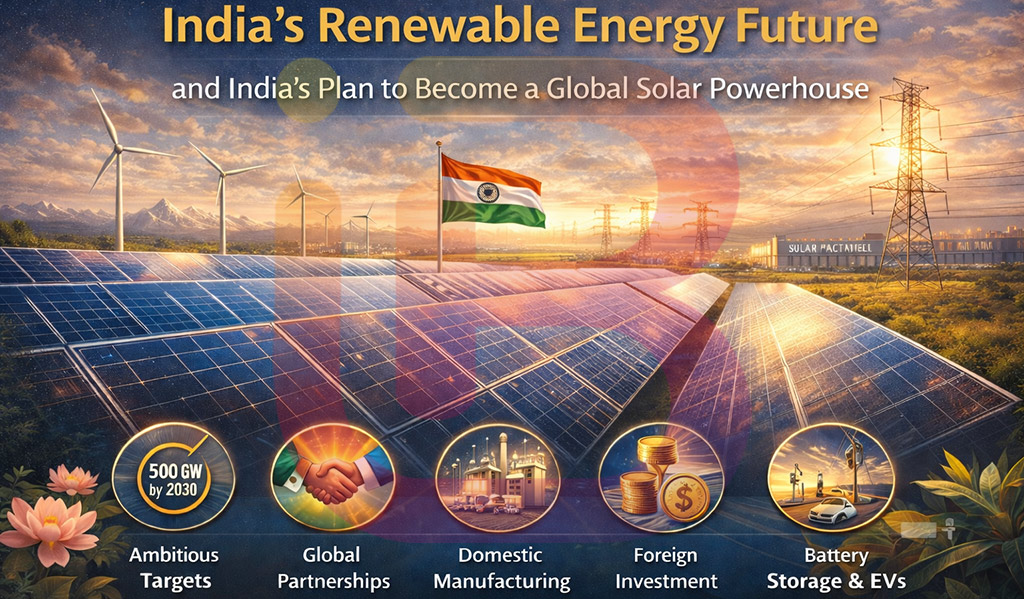
The ambition extends far beyond current achievements. India has committed to 500 GW of non-fossil fuel electricity capacity by 2030, an even more ambitious 1,800 GW renewable capacity target by 2047, and net-zero emissions by 2070.
This transformation is not just about climate commitments. It is about industrial competitiveness, energy sovereignty, and economic growth. Global studies suggest that every dollar invested in renewable infrastructure can generate 2.5–3 times economic output through industrial multipliers.
But the path forward is complex. The rise of AI data centers, electrified transport, and digital infrastructure will dramatically increase power demand, while renewable integration will require grid modernization, storage technologies, and new regulatory frameworks.
In short, India’s renewable energy journey is no longer a sectoral story. It is an economic transformation story.
Part 1: India’s Solar Energy Landscape — Current Capacity, Policies, and Industry Players
The Current State of Renewable Power
India has emerged as one of the fastest-growing renewable energy markets globally. Solar power is the dominant driver.
India’s Renewable Energy Capacity Snapshot (2026)
| Energy Source | Installed Capacity |
|---|---|
| Solar Power | 140.60 GW |
| Wind Power | 47.08 GW |
| Large Hydro | 46.66 GW |
| Bio Energy | 11.38 GW |
| Total Renewable Capacity | 278.72 GW |
Renewables now represent over half of India’s total installed electricity capacity, although their share in actual electricity generation stands at around 26%, reflecting intermittency and grid balancing constraints.
India’s total electricity demand has crossed 1,700 TWh annually, growing roughly 6–7% per year as industrialization and digital infrastructure expand.
National Targets Driving the Energy Transition
India’s renewable roadmap is anchored in three major milestones:
| Timeline | Target |
|---|---|
| 2030 | 500 GW non-fossil fuel electricity capacity |
| 2047 | 1,800 GW renewable capacity |
| 2070 | Net-zero emissions |
Reaching these targets would place India among the world’s largest renewable energy ecosystems alongside China, the United States, and the European Union.
Government Policies Accelerating Solar Expansion
India’s energy transition is being driven by a powerful combination of industrial policies and consumer incentives.
Key Policy Initiatives
PM Surya Ghar Muft Bijli Yojana
A ₹75,021 crore rooftop solar program targeting 1 crore households, offering up to 300 units of free electricity monthly. More than 1.8 million households have already adopted rooftop solar under the scheme.
Production Linked Incentive (PLI) for Solar Manufacturing
A ₹24,000 crore scheme aimed at building domestic manufacturing capacity for high-efficiency photovoltaic modules. By FY2027, the program is expected to support over 48 GW of domestic solar manufacturing capacity.
PM-KUSUM Scheme
Designed to solarize India’s agricultural sector by replacing diesel irrigation pumps with solar alternatives. The program aims to install 3.5 million solar pumps, with over 2.5 million already deployed.
Green Energy Corridors
Transmission infrastructure projects designed to integrate over 500 GW of renewable power into the national grid.
Leading Companies Driving India’s Solar Expansion
India’s renewable sector has attracted major domestic and international investors.
| Category | Key Players | Strategic Focus |
|---|---|---|
| Developers | Adani Green Energy, ReNew Power, Azure Power | Utility-scale solar parks |
| Integrated Energy Companies | Tata Power Solar | Solar manufacturing and project development |
| EPC Specialists | Sterling & Wilson | Global solar EPC engineering |
| Manufacturers | Vikram Solar, Saatvik Solar | PV modules and technology |
Large-scale solar parks in Rajasthan and Gujarat have become flagship projects powering India’s renewable expansion.
Among the most ambitious developments is the Khavda Renewable Energy Park in Gujarat, which could eventually reach 30 GW capacity, making it one of the largest solar projects in the world.
Part 2: The Coming Surge in Power Demand — AI Data Centers
India’s renewable energy ambitions are colliding with a new driver of electricity demand: AI data centers.
The rapid expansion of artificial intelligence infrastructure is expected to dramatically increase power consumption.
Data Center Electricity Demand in India
| Year | Power Demand |
|---|---|
| 2024 | 1.4 GW |
| 2030 | 8–10 GW |
Annual electricity consumption from data centers is projected to rise from 10–15 TWh today to 40–50 TWh by 2030.
While data centers currently account for less than 1% of India’s electricity usage, their share could rise to 2.5–3% of national consumption within the decade.
AI Data Centers: A New Energy Challenge
AI infrastructure is dramatically more energy intensive than traditional data centers.
| Infrastructure Type | Power Density per Rack |
|---|---|
| Traditional Data Centers | 10–20 kW |
| AI Data Centers | 100–200 kW |
AI training clusters generate highly volatile electricity demand cycles, creating “spiky” load patterns that place significant stress on power grids.
A single 100 MW hyperscale data center can consume up to 2 million liters of water per day for cooling, highlighting the growing water-energy nexus challenge.
Government Strategy to Power the AI Economy
India is already preparing for the energy demands of its digital economy.
Key initiatives include:
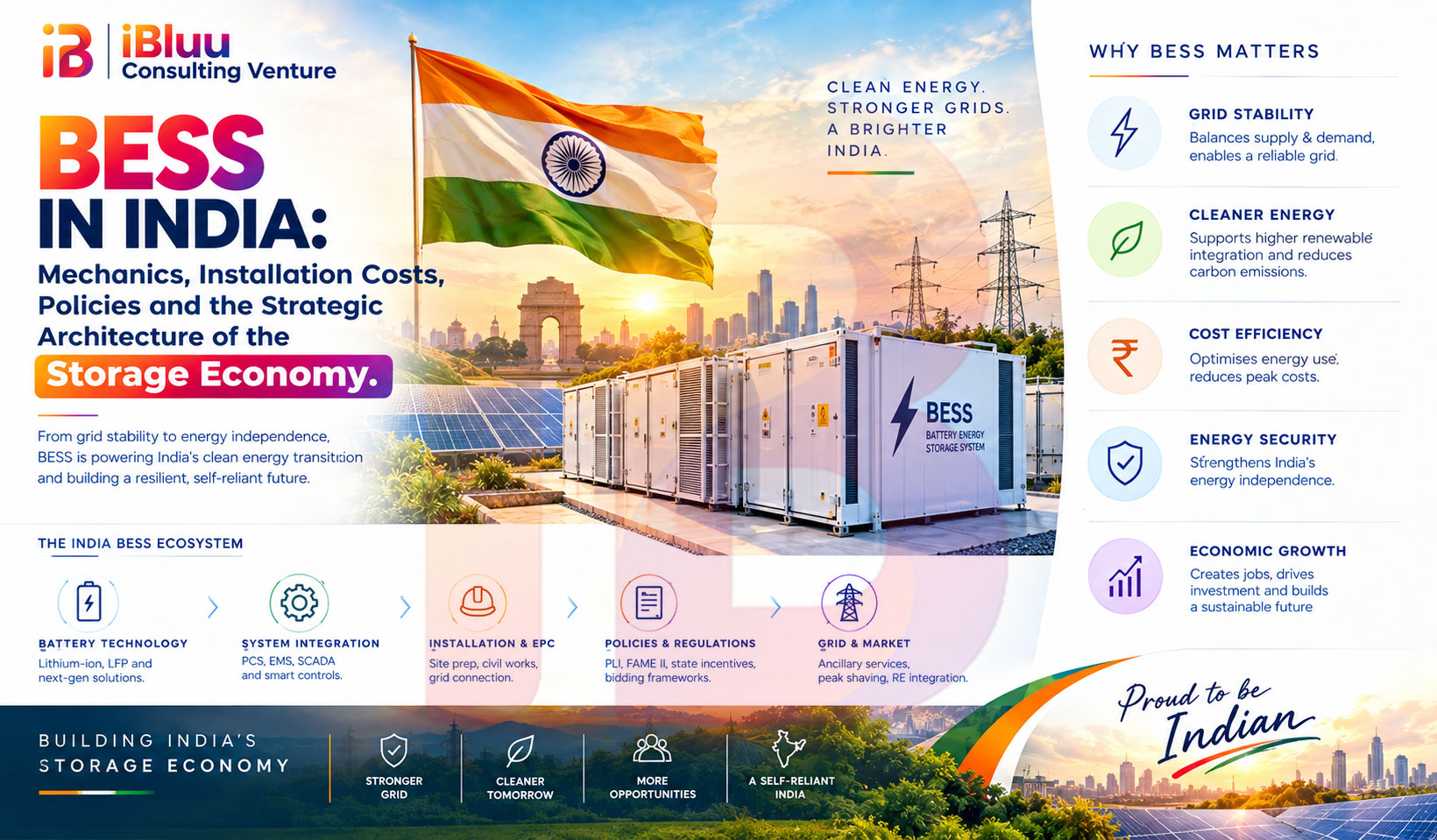
• 7.6 GW Battery Energy Storage Systems (BESS) awarded in 2025
• Green Open Access rules enabling large consumers to directly purchase renewable power
• Expansion of Green Energy Corridors to integrate 500 GW of renewable capacity
These measures are expected to enable round-the-clock renewable power supply for industries and digital infrastructure.
Part 3: Renewable Energy Embedded in India’s Mega-Infrastructure
India’s infrastructure strategy is increasingly integrating renewable energy directly into project design.
Solar power is becoming a mandatory component of many mega-projects through green certification frameworks such as IGBC and LEED.
Major Projects Integrating Solar Power
| Project | Renewable Energy Integration |
|---|---|
| Noida International Airport | Net-zero airport design with large solar installations |
| Multi-Modal Logistics Hub Greater Noida | Solar-powered logistics infrastructure |
| Yashobhoomi Convention Centre | Rooftop solar powering operations |
| Dholera Special Investment Region | 5,000 MW solar park |
| Ayodhya Solar City | Solar-powered public infrastructure |
| Delhi-Mumbai Expressway | Solar highway corridors |
| Indian Railways Stations | Solar rooftop systems under Amrit Bharat Scheme |
These projects represent a new design philosophy: infrastructure must generate energy, not just consume it.
Challenges and Risks in India’s Renewable Future
Despite impressive progress, India’s energy transition faces several structural challenges.
Grid integration remains a major constraint, as renewable capacity now exceeds its share in electricity generation.
Solar supply chains remain partially dependent on imports, with China dominating global photovoltaic manufacturing.
Water usage in large solar parks and cooling systems presents environmental challenges in water-stressed regions.
Additionally, India will need over one million skilled renewable energy professionals by 2030 to support project development and grid modernization.
Future Outlook: Can India Become a Global Solar Powerhouse?
The trajectory suggests strong momentum.
India could realistically achieve 500 GW non-fossil capacity by 2030, potentially making it one of the world’s largest renewable energy markets.
Solar manufacturing could evolve into a major export sector, with $5 billion in solar technology exports projected by 2030.
The expansion of green hydrogen projects, battery storage, and electrified transport will further deepen the renewable ecosystem.
If successfully executed, India’s renewable expansion could contribute 0.5–1% additional GDP growth through energy cost reductions, manufacturing expansion, and investment flows.
The iBluu Strategic Lens
From the perspective of IBCV (iBluu Consulting Venture Private Limited)—the strategic consulting arm of iBluu Corporations—renewable energy should be viewed not only as an environmental transition but as a strategic economic platform.
Energy security increasingly defines national competitiveness.
Countries that dominate renewable energy technologies, manufacturing ecosystems, and green infrastructure will shape the future architecture of global trade.
This analytical perspective aligns with the strategic thinking of J Parasher, Founder and Managing Director of iBluu Corporations, whose work consistently focuses on national capability building, industrial benchmarking, and long-horizon economic transformation.
In this view, renewable energy is not simply a sector.
It is a strategic economic system with implications for industry, geopolitics, and technological leadership.
Conclusion
India’s renewable energy transition is no longer just a climate initiative.
It is becoming a cornerstone of the country’s economic strategy.
From solar parks in Gujarat to net-zero airports, from rooftop solar programs to AI data center energy planning, the nation is redesigning its power infrastructure for the next generation of industry.
If executed effectively, India’s renewable energy ecosystem could become one of the defining pillars of its economic rise in the 21st century.
And at the center of that transformation will be solar power — the technology that could power not just India’s electricity grid, but its industrial future.