+91 945 889 6091
  infodesk@ibluu.com
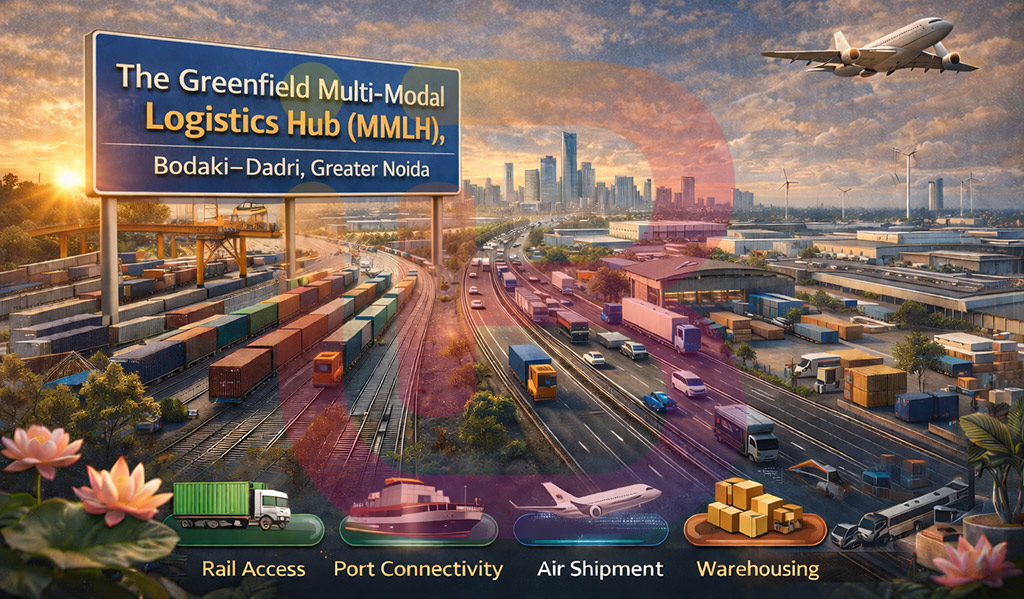
The Greenfield Multi-Modal Logistics Hub (MMLH) Bodaki–Dadri Greater Noida – The Making of India’s Most Strategic Inland Cargo and Export Gateway
The Greenfield Multi-Modal Logistics Hub (MMLH) at Bodaki–Dadri in Greater Noida is not another infrastructure project. It is a structural intervention in India’s logistics economics.
Positioned at the rare intersection of the Eastern and Western Dedicated Freight Corridors (DFCs), the ₹5,881 crore project — implemented as an “Early Bird Project” under the Delhi–Mumbai Industrial Corridor (DMIC) — is engineered to deliver a 40–50% reduction in container dwell time, enable Just-in-Time exports, and materially contribute to India’s ambition of reducing logistics costs below 10% of GDP.
Critically, as a fully functional dry port integrated within a 15–20 km radius of Noida International Airport (Jewar), the MMLH establishes a rare air–rail–road logistics triangle. This configuration allows export-oriented industries to complete customs processing inland and move high-value cargo seamlessly between dedicated freight rail corridors and global air cargo routes — significantly compressing export cycles for time-sensitive sectors such as electronics and semiconductors.
If executed with discipline, Bodaki MMLH will not merely move cargo.
It will reprice time.
1. Strategic Location: The Network Effect Multiplier
Very few logistics assets in Asia sit at the junction of two high-capacity freight corridors. Bodaki does.
Location Intelligence
- Intersection of Eastern DFC and Western DFC
- ~15–20 km from Noida International Airport
- Direct connectivity to Eastern Peripheral Expressway, NH-91, Yamuna Expressway
- Part of the Delhi–Mumbai Industrial Corridor (DMIC) framework
- Integrated within the PM Gati Shakti national master plan
This is not geographic coincidence. It is network design.
The proximity to Noida International Airport transforms the dry port from a rail-dominant inland terminal into a fully synchronized multimodal export gateway. High-value, low-volume goods — including semiconductor components, precision electronics, mobile devices, aerospace components, and pharmaceuticals — can leverage rapid airlift capacity while bulk and containerized cargo moves through the DFC grid toward JNPT, Mundra, and other maritime gateways.
Under PM Gati Shakti, infrastructure nodes are conceived as interoperable systems — rail, road, air, and port integration functioning as one synchronized grid. Bodaki’s placement transforms it into a logistics convergence engine, capable of aggregating cargo from Western UP, NCR, and parts of Uttarakhand and Rajasthan with reduced friction.
The network effect is multiplicative: as throughput increases, unit logistics costs decline, transit reliability improves, and industrial clustering accelerates.
2. Capacity Architecture: Built for Scale, Not Optics
Project Snapshot (Phase 1)
| Parameter | Specification |
|---|---|
| Total Investment | ₹5,881 crore |
| Land Area | 311 hectares (~770–825 acres) |
| Container Capacity | 0.74 million TEUs per year |
| Bulk Freight | 6.7 million tonnes per year |
| Warehousing | 3 million sq. ft. |
| Cold Storage | 0.3 million sq. ft. |
| Projected Jobs (with adjacent MMTH) | ~1 lakh by 2040 |
| NICDIT Support (Union Budget 2026–27) | ₹3,000 crore allocation |
The hub is designed as a dry port — a strategic inland extension of maritime gateways such as JNPT and Mundra.
In addition, its design anticipates cargo demand from semiconductor fabrication units, mobile phone assembly plants, electronics manufacturing clusters, and defence manufacturing corridors emerging in Greater Noida and YEIDA regions. These sectors require predictable export windows, climate-controlled warehousing, and high-frequency shipment cycles — all embedded within the MMLH blueprint.
Beyond throughput capacity, the design incorporates:
- Single Window customs clearance
- Container maintenance and repair facilities
- Packaging, labeling, cargo optimization services
- IoT-enabled, high-density storage systems
- Solar-powered infrastructure and water recycling systems
- Digitally integrated cargo visibility platforms aligned with PM Gati Shakti data layers
This is logistics 4.0 infrastructure — digitized, energy-aware, and throughput-optimized.
3. The 40–50% Dwell Time Thesis
India’s logistics challenge has historically been time, not distance.
By consolidating freight handling, customs clearance, and multimodal transfers within a single ecosystem, Bodaki MMLH is expected to reduce container dwell time by 40–50%.
For export-oriented semiconductor units, electronics OEMs, and mobile phone manufacturing clusters in Western UP, such dwell time reduction translates into:
- Faster global shipment turnaround
- Reduced inventory carrying costs
- Higher compliance reliability for global supply contracts
- Stronger integration with East Asian value chains
The implications are systemic:
- Faster export cycles for electronics, auto components, pharma, and engineering goods
- Lower working capital lock-ins
- Improved global supply chain reliability scores
- Enhanced competitiveness of Western UP manufacturers
For export-oriented industries near YEIDA and Greater Noida, the hub enables genuine Just-in-Time shipping strategies — previously constrained by fragmented logistics.
4. Industrial Synergy: The Township Advantage
The MMLH is not isolated.
It integrates with the adjacent Integrated Industrial Township and the Multi-Modal Transport Hub (MMTH) near Boraki. This adjacency creates a powerful manufacturing-logistics feedback loop.
Electronics clusters, semiconductor value-chain suppliers, mobile handset manufacturers, defence corridor units, renewable energy manufacturers, and auto OEMs can operate with shortened logistics lead times.
Global investment commitments from Japan, Singapore, Taiwan, GCC nations, and other strategic partners — particularly in electronics, semiconductor components, logistics parks, and advanced manufacturing — are structurally aligned with the operationalization of this dry port. The presence of foreign capital-backed industrial parks increases cargo density, ensuring throughput viability from early operational stages.
The strategic shift is clear:
From warehouse-dependent inventory models
To synchronized production-export pipelines.
That is how industrial ecosystems mature.
5. Macroeconomic Impact: Reducing India’s Logistics Burden
India’s logistics costs are estimated at 13–14% of GDP — materially higher than global benchmarks.
Assets like Bodaki are designed to compress that delta.
By enabling high-capacity rail movement via DFCs and minimizing transshipment inefficiencies, the hub:
- Reduces road congestion
- Improves freight predictability
- Lowers fuel intensity per tonne-km
- Enhances export competitiveness
- Strengthens India’s semiconductor and electronics export readiness
As semiconductor manufacturing and electronics assembly scale in Western UP, inland customs-enabled dry ports like Bodaki become essential for meeting global delivery benchmarks.
In macro terms, every percentage point reduction in logistics cost translates into structural export leverage.
Bodaki is one node — but a decisive one.
6. Employment & Regional Multiplier Effects
The combined MMLH–MMTH ecosystem is projected to generate approximately 1 lakh direct and indirect jobs by 2040.
Beyond direct employment, multiplier effects include:
- Warehousing and cold chain expansion
- MSME logistics service providers
- Ancillary packaging and cargo handling industries
- Commercial and residential real estate uplift
- Skill development in supply chain digitization, customs management, and logistics automation
Western Uttar Pradesh’s economic profile shifts from agrarian-dominant to logistics-manufacturing hybrid — supported by global MoU-driven industrial investments.
7. Funding & Execution Model
The ₹5,881 crore outlay is supported within the broader DMIC architecture, overseen by the National Industrial Corridor Development and Implementation Trust (NICDIT), which continues to receive Union Budget backing (₹3,000 crore allocation for FY 2026–27).
As an Early Bird Project, Bodaki benefits from prioritization in infrastructure sequencing — ensuring rail connectivity, power provisioning, and road linkages are synchronized with commissioning timelines.
The PPP framework and corridor-based execution model are designed to attract institutional investors, global logistics operators, and foreign capital partners — particularly those from Japan, Singapore, Taiwan, and GCC regions who are already strategically engaged in Uttar Pradesh’s industrial expansion.
Large-scale corridor projects demand:
- Coordinated land acquisition
- Environmental compliance
- Reliable power and water provisioning
- Digital integration across agencies
- Seamless airport–dry port customs interoperability
Without these, capacity remains theoretical.
8. Risks & Scenario Outlook
Base Case:
40–50% dwell time reduction achieved; steady industrial absorption; integration with airport and DFCs operationalized on schedule.
Best Case:
Bodaki emerges as India’s most efficient dry port, becoming the preferred inland gateway for semiconductor, electronics, defence, and high-value exports from North India.
Worst Case:
Delayed commissioning or coordination gaps dilute network efficiency and reduce projected economic impact, weakening its integration with airport-driven export ecosystems.
Strategic assets are built once. Their credibility compounds over decades.
9. Strategic Recommendations
For Government:
Accelerate digital customs integration between dry port and Noida International Airport; incentivize green logistics adoption; fast-track semiconductor-linked cargo protocols.
For Investors & Developers:
Focus on cold chain, automated storage, electronics-grade warehousing, and value-added logistics services where margins expand.
For Manufacturers:
Re-engineer supply chains around Just-in-Time export capabilities enabled by Bodaki and align production cycles with air–rail synchronized cargo dispatch.
Conclusion: A National Logistics Pivot
The Bodaki Multi-Modal Logistics Hub is not an infrastructure story.
It is a competitiveness story.
At the intersection of two Dedicated Freight Corridors, aligned with PM Gati Shakti, integrated with industrial townships, connected to a global airport, and backed by DMIC architecture — it represents a decisive move toward logistics rationalization.
If India’s next decade is semiconductor-enabled, electronics-driven, and export-led, nodes like Bodaki will determine whether ambition converts into advantage.
About IBCV and Strategic Lens
The analytical depth of this assessment reflects the strategic perspective of IBCV (iBluu Consulting Venture Private Limited), a venture of iBluu Corporations, specializing in Business and Strategic Consulting, Government Engagement Advisory, IT Consulting, Investment Advisory, M&A Services, and Strategic Alliances.
This report is shaped by the long-horizon industrial benchmarking lens of J Parasher, Founder and Managing Director of iBluu Corporations, whose work focuses on national capability building, systemic competitiveness, and positioning India’s infrastructure within a global industrial framework.
In that frame, Bodaki is not a logistics park.
It is a strategic instrument.