+91 945 889 6091
  infodesk@ibluu.com
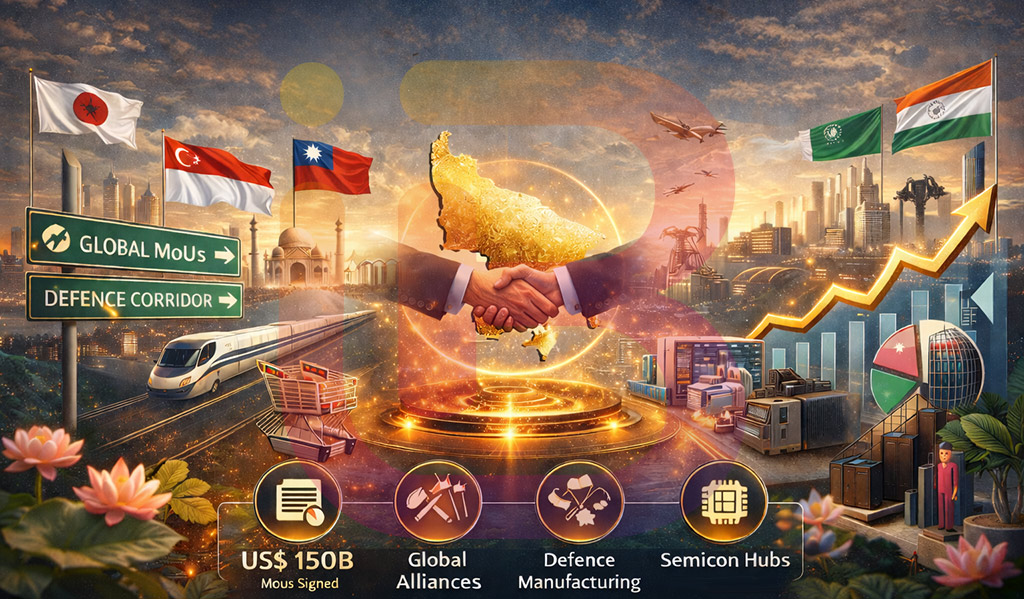
India’s Industrial Superstructure: Japan, Singapore, Taiwan, GCC Commitments — and Global MoUs, Defence Corridors, Semicon Hubs Redefining UP’s Investment Landscape
Uttar Pradesh (UP) is no longer competing for investment attention — it is commanding it.
With over ₹9.5 lakh crore ($110B+) in fresh commitments added through strategic global outreach in February 2026, and a total pipeline strengthened by the Global Investors Summit momentum, UP has positioned itself as one of India’s most assertive investment frontiers.
The state is projected to contribute 16.3% of India’s total capital expenditure in FY 2025–26, with its economy expected to reach ₹36 lakh crore, growing at ~15% year-on-year. The long-term ambition is clear: a $1 trillion state economy by 2030.
This transformation is not accidental. It is policy-engineered, infrastructure-backed, and globally networked.
The Global Outreach Strategy: Investment by Country
UP’s creation of dedicated “Foreign Desks” marks a structural shift from passive investment promotion to relationship-managed capital attraction.
Key Strategic Partners (February 2026 Momentum)
| Country/Region | Investment Commitments | Strategic Focus Areas |
|---|---|---|
| Japan | ₹90,000 crore | Japanese Industrial City (500 acres, YEIDA near Noida International Airport), manufacturing & advanced tech |
| Singapore | ₹60,000 crore | Cargo hubs, semiconductors, data centres, logistics |
| Taiwan | ₹100 crore pipeline (40+ firms identified) | Semiconductor ecosystem |
| GCC Nations | ₹5,000 crore proposals (83 companies engaged) | Renewables, defence, logistics |
| United States & United Kingdom | Strategic MoUs | Security, technology, defence, digital infrastructure |
The Japanese Industrial City in YEIDA, strategically located near the upcoming Noida International Airport, signals long-term manufacturing integration into global supply chains.
Singapore’s interest in semiconductors and logistics positions UP within Asia’s high-value electronics corridor.
Taiwan’s semiconductor engagement aligns with India’s “China+1” realignment, while GCC dialogues reflect energy-transition and defence collaboration.
Foreign Desks reportedly handled 200+ investment queries in FY25, improving project conversion rates to nearly 45% of earlier MoUs grounded into implementation.
This is institutional diplomacy at the state level.
Investment by Company & Sector: Capital in Motion
Major corporations — domestic and global — are now deploying serious capital into UP.
Landmark Commitments
| Company | Sector | Investment | Project Details |
|---|---|---|---|
| SAEL Industries | Renewable Energy | ₹8,000 crore | Waste-to-energy projects |
| Reliance Industries | Multi-sector | ₹75,000 crore | 5G rollout, retail, 10GW renewables |
| HCL–Foxconn JV | Semiconductor | ₹3,700 crore | OSAT facility, YEIDA (Greater Noida) |
| Sify Technologies | AI/Data Centres | ₹1,600 crore | AI-ready data centre, Noida |
| Aditya Birla Group | Multi-sector | ₹25,000 crore | Cement, metals, chemicals, finance |
| NSL Renewable Power | Solar | ₹4,499 crore | Integrated solar park, Meerut |
| Ashok Leyland | EV Manufacturing | Upcoming | EV bus plant, Lucknow |
| Uber Technologies | Mobility/Tech | Under exploration | Proposed GCC, Noida |
Renewables have emerged as the top investment intent sector (12.41% of MoUs), surpassing electronics — a signal of long-term energy transition alignment.
The semiconductor OSAT facility by HCL-Foxconn marks UP’s entry into high-value electronics manufacturing.
Industrial Hubs & Emerging Clusters
1. Semiconductors & Electronics
Noida and the Yamuna Expressway Industrial Development Authority (YEIDA) region are evolving into semiconductor hubs. Incentives for projects above ₹3,000 crore include:
- 10-year interest subsidies
- SGST exemptions
- Infrastructure-linked fiscal support
2. Defence Industrial Corridor
Spread across Aligarh, Lucknow, and Kanpur, seven companies have commenced production in FY26.
Notable examples:
- BrahMos Aerospace (₹300 crore, Lucknow)
- Aerolloy Technologies (₹320 crore, Lucknow)
UP is positioning itself as a defence manufacturing backbone under India’s self-reliance agenda.
3. Pharmaceuticals
The Lalitpur Pharma Park is being fast-tracked to attract global pharmaceutical manufacturing investments.
4. Renewable Energy
UP is emerging as a renewable powerhouse, aligning large-scale solar and waste-to-energy projects with national climate commitments.
5. Workforce & Industry 4.0
The state has committed ₹8,350 crore toward skill development, focusing on digital manufacturing, automation, and Industry 4.0 integration.
Approximately 56% of UP’s 25 crore population is of working age — a demographic dividend unmatched in India.
Investment Drivers: Why Capital Is Moving to UP
Infrastructure Leadership
- Largest rail network in India
- Expanding expressway grid
- Projected leader in capital expenditure (16.3% share of national capex FY25–26)
Market Scale
- India’s largest consumer base (25 crore population)
- Projected ₹36 lakh crore economy by FY26
Policy Depth
- Ranked 2nd in Ease of Doing Business in India
- 30+ sectoral policies tailored to semiconductors, EVs, renewables, logistics, and defence
- Digitized single-window clearance systems improving approval efficiency
UP’s model integrates infrastructure, policy incentives, labour availability, and global outreach into a unified investment narrative.
Comparative Positioning Within India
Historically, Maharashtra, Gujarat, Tamil Nadu, and Karnataka dominated cumulative FDI inflows.
However, UP’s recent momentum signals a transition:
- Strong MoU conversion rate (~45%)
- High-value sectoral investments in semiconductors, renewables, and defence
- Economy now among India’s top three state economies
While western and southern states maintain established industrial ecosystems, UP is emerging as India’s new industrial heartland — particularly in defence manufacturing and renewable energy.
Economic Impact & Multiplier Effect
- ₹36 lakh crore projected GSDP (FY26)
- Over 1.2 crore jobs linked to investment pipeline
- Infrastructure spending multiplier estimated at 2.5–3x GDP impact (global benchmarks)
If execution remains disciplined, UP’s investment inflows could catalyze a structural GDP acceleration toward the $1 trillion milestone by 2030.
Risks & Execution Imperatives
No transformation is risk-free.
- 55% of MoUs yet to be grounded
- Environmental clearance delays
- Regional development disparities (Western vs. Eastern UP)
- Talent absorption challenges
Sustained governance focus and PPP-driven implementation will determine long-term credibility.
Strategic Outlook: 2026–2030
Base Scenario:
15% annual growth; steady MoU conversion; strengthening export capability.
High-Growth Scenario:
Accelerated semiconductor and renewable exports; FDI surpassing $50B by 2030.
Downside Scenario:
Execution slippages reducing investor confidence.
UP’s trajectory now depends less on announcements and more on delivery.
The Strategic Lens
The analytical framing of this transformation reflects a broader national capability perspective — one that views state-level industrial acceleration as central to India’s long-horizon economic architecture.
This perspective aligns with the work of J Parasher, Founder and Managing Director of iBluu Corporations, whose strategic focus centers on industrial benchmarking, export competitiveness, and institutional transformation.
Through IBCV (iBluu Consulting Venture Private Limited) — spanning strategic consulting, government engagement advisory, IT consulting, investment advisory, M&A, and alliance partnerships — sectors such as semiconductors, renewables, and defence are evaluated not in isolation but as integrated economic systems.
UP’s rise is not a regional story.
It is a signal of India’s evolving industrial geography.
Conclusion: From Laggard to Contender
Uttar Pradesh is transitioning from historical underperformance in cumulative FDI to a high-momentum investment contender.
With scale, policy alignment, demographic strength, and international capital partnerships converging, the state is redefining India’s internal investment hierarchy.
If execution sustains pace, UP will not merely attract capital.
It will anchor it.