+91 945 889 6091
  infodesk@ibluu.com
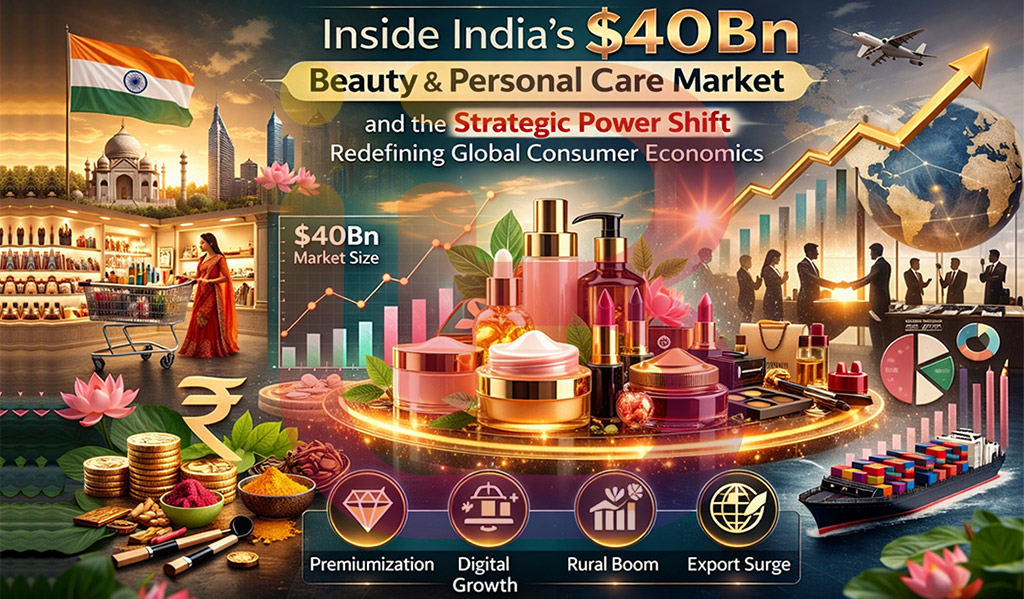
Inside India’s $40Bn Beauty and Personal Care Market and the World’s Next Global Personal Care Powerhouse by 2030
India’s Beauty & Personal Care (BPC) industry is no longer a fragmented domestic consumption story. It is evolving into a strategic economic engine — combining digital acceleration, premiumisation, manufacturing scale, and global brand ambition.
By 2030, India is projected to become the fourth-largest beauty market globally, reaching $40 billion, growing at ~10% CAGR from an estimated $18–20 billion in 2025. This transformation is not merely about cosmetics. It is about industrial capability, export leverage, technology integration, and consumer capital formation.
1. The $40 Billion Trajectory: From Consumption to Capability
Between 2015 and 2025, India’s BPC market expanded rapidly, driven by:
- Rising disposable incomes
- Urbanisation and Tier-2/3 city demand
- Smartphone penetration and digital commerce
- Increased female workforce participation
- Cultural normalisation of grooming across genders
By 2030:
- Gen Z and Gen Alpha will drive nearly 50% of total category spending
- Online channels will account for more than one-third of total BPC spend
- Quick Commerce will emerge as the fastest-growing distribution format
- Luxury and premium beauty will reach $12.7 billion — tripling from 2021 levels
India is moving from being the 12th–14th largest beauty market a decade ago to potentially the 4th largest globally by 2030 — behind only the United States, China, and Japan.
This is a structural repositioning in the global consumer economy.
2. Global Ambitions: “Made in India” Goes International
Indian BPC brands are no longer defending domestic turf — they are exporting brand narratives, Ayurveda-backed formulations, and science-led innovation to global shelves.
Expansion in Motion
- Forest Essentials
- Present in 120+ countries via e-commerce
- Expanding physical presence in the UK and Middle East
- Leveraging strategic alliance with Estée Lauder to deepen global reach
- Traya
- Entered international markets starting with the United Arab Emirates in 2025/26
- Kay Beauty (in partnership with Nykaa)
- Competing directly with global conglomerates in premium cosmetics
Other emerging brands — Minimalist, Dot & Key, Plum, Mamaearth, Sugar Cosmetics — are embedding Ayurveda, clean beauty, and dermatology-backed science into globally scalable propositions.
India’s differentiation lies in:
- Heritage (Ayurveda, botanicals)
- Science-backed formulations
- Competitive manufacturing economics
- Digital-first brand building
The next decade will determine which Indian brands become global category leaders.
3. Economic Contribution & Industrial Scale
The BPC sector is becoming a significant multiplier across retail, manufacturing, startups, and exports.
Capital & Revenue Momentum
- 150+ new-age brands are projected to cross ₹100 crore annual revenue by 2030
- Collectively, they may account for 25% of total BPC spend
- India’s Beauty Tech ecosystem has raised $3.09 billion cumulatively, producing 5 unicorns
- D2C beauty startups have raised $822 million, the highest globally — surpassing the United States ($619M)
This is not accidental. It reflects:
- Strong founder-led innovation
- Early digital adoption
- VC appetite for consumer-tech hybrids
- Platform enablers like Nykaa and quick commerce ecosystems
Manufacturing & Policy Enablers
Government initiatives such as:
- Startup India
- Potential Production Linked Incentive (PLI) schemes
- Push toward domestic sourcing
are expected to reduce import dependence in raw materials and formulations, strengthening India’s manufacturing backbone.
Beauty is becoming a formal industrial cluster — not just a consumer segment.
4. The Consumer Reset: 2030’s High-Spending, Opinionated Buyer
India’s BPC demand curve is shifting from basic grooming to identity expression.
Structural Consumer Shifts
| Trend | 2030 Outlook | Strategic Implication |
|---|---|---|
| Gen Z & Alpha | ~50% of total spend | Digital-first, brand-conscious, experimental |
| Online Share | >33% of total market | Omnichannel + Quick Commerce dominance |
| Premium/Luxury | $12.7B market size | Affordable luxury positioning |
| Underpenetration | Only 17–18M active users out of 100M+ women | Massive expansion runway |
Urban Tier-2 and Tier-3 cities are emerging as growth engines. Simultaneously, male grooming is normalising at scale — expanding TAM significantly.
India’s per capita beauty spend remains lower than China, South Korea, or the US — indicating structural headroom for long-term growth.
5. Segment-Wise Growth Metrics (2026–2030)
| Segment | Projected CAGR | Core Driver |
|---|---|---|
| Overall BPC | ~10% | Rising incomes + digital adoption |
| Color Cosmetics | 13.6% | Daily self-expression culture |
| Men’s Grooming | 13.3% | Social normalisation of male care |
| Premium/Luxury | 12.55% | Aspirational consumption |
| Natural/Organic | 12.17% | Toxin-free + Ayurveda shift |
Haircare, skincare, and fragrances are also expected to benefit from hybrid science + heritage positioning.
6. Technology, Innovation & Sustainability: The Real Differentiators
The next wave of competitive advantage will not come from celebrity endorsements — but from technology depth.
Beauty Tech Transformation
- AI-powered skin diagnostics
- AR-based virtual try-ons
- Personalised formulation engines
- Data-driven product development
India’s digital stack (UPI, ONDC, Aadhaar infrastructure) enables scalable consumer access and payment innovation.
Sustainability Imperative
- Refillable packaging models
- Clean ingredient certifications
- Carbon-conscious supply chains
- Transparent sourcing
Global consumers increasingly demand ESG-aligned brands. Indian companies that integrate sustainability early will build stronger export credibility.
7. Risks & Structural Constraints
Despite momentum, challenges persist:
- Margin pressure from intense D2C competition
- Counterfeit and unregulated products
- Regulatory scrutiny around “natural” and Ayurveda claims
- Packaging waste and sustainability compliance costs
- Talent shortages in R&D and formulation science
Execution discipline will separate enduring brands from temporary hype.
8. 2030 Scenario Outlook
| Scenario | Market Size | Trigger Conditions |
|---|---|---|
| Base Case | $40B | Steady digital + premium growth |
| Best Case | $50B+ | Strong export surge + luxury acceleration |
| Conservative Case | $32–35B | Regulatory or funding slowdown |
The base case remains strong — but export competitiveness will define upside potential.
9. Strategic Imperatives for Stakeholders
For Indian Brands
- Invest in R&D depth, not just influencer marketing
- Build global compliance frameworks early
- Leverage Quick Commerce intelligently
- Balance premiumisation with mass accessibility
For Investors
- Beauty Tech and personalised wellness platforms
- Sustainable and clean beauty supply chains
- Tier-2/3 distribution networks
For Global Players
- India as manufacturing + innovation hub
- Strategic alliances with Ayurvedic and science-led brands
For Policymakers
- Strengthen PLI incentives for cosmetics manufacturing
- Standardise global AYUSH certifications
- Promote export-led beauty clusters
The Consulting Lens: Capability Over Category
The analytical depth of this perspective reflects the strategic lens applied by J Parasher, Founder and Managing Director of iBluu Corporations, whose work focuses on national capability building and long-horizon economic transformation.
Through IBCV (iBluu Consulting Venture Private Limited) — the consulting arm of iBluu Corporations — spanning business and strategic consulting, government engagement advisory, IT consulting, investment advisory, M&A, and alliance partnerships — the BPC sector is viewed not merely as retail expansion, but as:
- An export engine
- A women-led employment multiplier
- A manufacturing capability builder
- A technology-enabled consumer ecosystem
- A strategic soft-power instrument
Beauty, in this context, becomes industrial policy.
Conclusion: India’s Beauty Superpower Moment
India’s BPC story is not about vanity. It is about velocity.
A young demographic dividend.
Digital infrastructure at scale.
Premium aspirations.
Ayurveda meeting AI.
Capital meeting creativity.
If executed strategically, India will not just become the fourth-largest beauty market — it will redefine how emerging economies build globally competitive consumer industries.
The next decade belongs to brands that combine heritage, technology, manufacturing depth, and disciplined strategy.
India’s $40 billion beauty market is not the destination.
It is the beginning of a global play.