+91 945 889 6091
  infodesk@ibluu.com
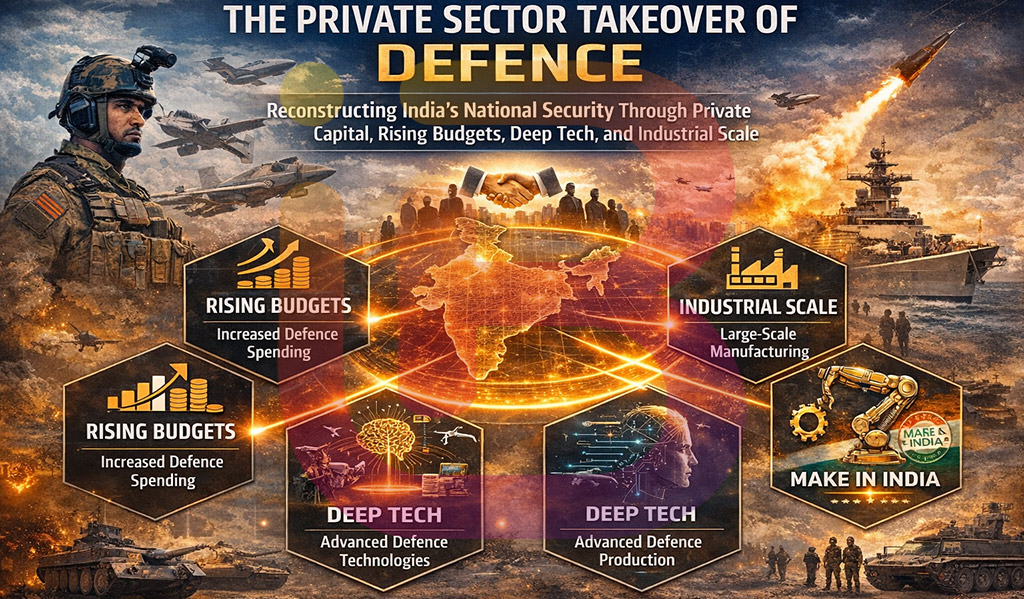
The Private Sector Takeover of Defence: Rebuilding India’s National Security Through Private Capital, Rising Budgets, Deep Tech, and Industrial Scale
Global security architecture is undergoing its most profound reconfiguration since the Cold War. Defence spending is no longer cyclical—it is structural. According to industry forecasts, global defence expenditure is projected to reach approximately $2.6 trillion in 2026, up from $2.4 trillion in 2025 (an 8.1% real-term increase), reflecting sustained multi-year escalation driven by geopolitical fragmentation, rapid technological disruption, and the accelerating obsolescence of legacy systems.
SIPRI data indicates that the top global spenders in 2025 include the United States (~$860B), China (~$245B), Russia (~$157B), and India (~$60B). Ukraine alone has increased military spending by nearly 19% since 2015, underscoring the permanence of geopolitical instability. Global defence expansion is no longer episodic. It is systemic.
Within this global inflection, India represents one of the most decisive structural transformations.
With a defence budget allocation of ₹7.85 lakh crore for FY 2026-27—a 15.2% year-on-year increase and the highest in its history—India is not merely modernizing its armed forces. It is redesigning its industrial base. Capital outlay has expanded sharply, with approximately ₹2.19 lakh crore allocated to capital expenditure (up over 21%), and nearly three-quarters earmarked for domestic procurement. Within this, roughly ₹1.85 lakh crore represents immediate acquisition momentum.
Revenue expenditure stands near ₹3.65 lakh crore. As a percentage of GDP, defence spending is approximately 1.9%—down from 2.4% in FY21—signaling fiscal discipline alongside modernization.
This is not maintenance expenditure. It is strategic dry powder.
The implications are systemic. Defence is no longer a state monopoly. It is evolving into a whole-of-nation enterprise, where private firms, startups, MSMEs, and global partnerships are becoming co-architects of national security.
Private sector contribution to India’s defence production has reached approximately 23% in FY 2024-25, up from roughly 21% a year earlier. Indigenous production has crossed ₹1.5 lakh crore (up 18% YoY). More than 90% of Ministry of Defence contracts in recent cycles have been awarded to domestic industry, signaling structural exit from import dependency.
Exports have grown from ₹686 crore in 2014 to ₹23,622 crore in FY 2024-25, representing a 46% CAGR between FY17–FY24. India now exports defence equipment to over 100 nations—subtly counterbalancing supply-chain concentration risks in a world where China dominates nearly 90% of rare earth processing.
Security in 2026 is no longer about stockpiles.
It is about industrial velocity.
1. The Capital Inflection: Beyond Linear Budgets
Defence budgets today are not reactive responses to border tensions. They are proactive hedges against technology obsolescence.
Globally, defence outlays have surged to historic highs. The United States continues to spend above $800 billion annually. China and Russia are accelerating force modernization. Europe is rebuilding arsenals at scale. The signal is clear: defence is re-entering the core of national economic strategy.
India’s trajectory is sharper still. From approximately ₹2.53 lakh crore in FY14 to ₹7.85 lakh crore in FY26-27, defence spending has more than tripled over a decade—a 210% expansion.
Capital allocation at this magnitude creates multi-year industrial visibility. Hindustan Aeronautics Limited (HAL) holds an order book exceeding ₹2.3 lakh crore, offering 6–7 years of production visibility. Private players collectively hold confirmed orders of approximately ₹55,000 crore, up nearly 37% year-on-year. Private sector revenue growth for FY26 is projected in the 16–18% range.
Return metrics are equally revealing. Leaders such as Bharat Electronics Limited (BEL) report ROCE levels near 22%, while HAL maintains approximately 18%, placing defence manufacturing among the more capital-efficient heavy industries in India.
In strategic terms, defence capital is now functioning as industrial stimulus—with multiplier effects across metallurgy, electronics, precision engineering, AI systems, advanced materials, and sovereign digital infrastructure.
Modernization now accounts for roughly one-quarter of total allocations. This is not budgetary inflation. It is structural reallocation.
2. The Private Sector: From Supplier to Strategic Architect
For decades, private industry operated at the periphery of defence manufacturing—fabricating sub-assemblies while state-owned enterprises dominated platform integration.
That era is closing.
Private contribution has expanded from below 20% in FY14 to approximately 23% in FY25—representing nearly ₹34,000 crore of production. Policy enablers include 74% FDI under automatic route, revised procurement norms, and indigenization lists covering over 5,000 items under the Atmanirbhar framework.
Private defence revenues have grown at approximately 20% CAGR over FY21–FY25. EBITDA margins for leading firms range between 18–25%, with ROCE between 15–20% across diversified engineering leaders such as L&T.
Execution capability has matured. Private fulfillment rates in flagship programs exceed 90%. Supply-chain ecosystems are deepening, including rare earth corridors emerging in states such as Odisha.
Yet, risks remain. Private participation still accounts for less than one-third of total output. Structural scale-up—not episodic contracting—will determine the next phase.
Security is no longer a ministry function alone.
It is an ecosystem outcome.
3. The Silicon–Steel Convergence: Innovation as the New Lead
Future conflict will not be decided by mass alone. It will be decided by algorithms, autonomy, and resilience.
Artificial intelligence, agentic robotics, quantum-resistant cybersecurity, edge analytics, electronic warfare, and drone swarm architectures are redefining force multiplication.
India’s defence innovation ecosystem is expanding rapidly. Over 600 startups and MSMEs are engaged through iDEX and Technology Development Fund initiatives. Funding support has increased threefold in recent years, with approximately $247 million mobilized in 2025 alone.
Private innovators such as Data Patterns have accelerated radar and electronic warfare cycles. AI integration into battlefield systems is moving from pilot phase to operational integration.
However, R&D intensity remains approximately 5.5% of total defence allocation—below global benchmarks near 10%. Scaling sovereign AI initiatives, including India’s ₹10,300 crore AI Mission, will be central to closing this gap.
Globally, private sector participation in defence manufacturing exceeds 70% in the United States, while China operates a hybrid state-private structure approximating 40%. India’s trajectory suggests convergence toward higher private integration over the next decade.
Industrial power is no longer measured solely in tonnage.
It is measured in code density.
4. India’s Structural Transformation: The Export Velocity
The clearest evidence of industrial metamorphosis is export acceleration.
Defence exports have risen from ₹686 crore in 2014 to ₹23,622 crore in FY 2024-25—a more than thirty-fold expansion. Production CAGR has averaged roughly 15% over the past decade.
The government has articulated a target of ₹3 lakh crore in total defence production by 2029, alongside export ambitions exceeding ₹50,000 crore and longer-term aspirations toward $10 billion in exports by 2030.
Macro alignment strengthens this trajectory. Production-linked incentive (PLI) programs across manufacturing sectors have attracted nearly ₹1.97 lakh crore in investments, reinforcing supply-chain depth.
Exports are strategically significant for three reasons:
- They validate certification and reliability.
- They diversify revenue beyond domestic procurement cycles.
- They embed India within allied security architectures.
In geopolitical terms, this shifts India from being predominantly a buyer to emerging as a credible supplier—an “arsenal partner” within the democratic world order.
Big Picture: The Whole-of-Nation Enterprise
India’s defence market was valued near $27 billion in 2024 and is projected to approach $54 billion by 2033 under current growth trajectories.
Scenario modeling suggests:
• Base case: ~18% growth trajectory
• Upside case: >20% export acceleration
• Downside case: ~15% growth under procurement delays
Private sector share could exceed 35% by 2030 if structural reforms continue.
Industrial corridors in Uttar Pradesh, Tamil Nadu, and Odisha are emerging as defence manufacturing clusters. Talent requirements could exceed one million skilled roles by 2030, supported by nearly 16,000 MSMEs integrated into the value chain.
Industrial velocity will determine competitive advantage.
Challenges, Risks & Mitigation
Risks are real.
• R&D intensity remains below global standards.
• Procurement delays can disrupt working capital cycles.
• Fiscal pressure constrains long-term expansion.
• Talent gaps in advanced manufacturing and AI remain material.
• ESG and carbon intensity in heavy manufacturing require active transition planning.
Mitigation pathways include procurement reforms, green financing instruments, sovereign technology funds, and stronger academia-industry collaboration.
Execution discipline will define outcomes.
The Role of IBCV: Strategy at the Intersection of Policy and Scale
This transformation is not accidental. It requires structured advisory, calibrated capital allocation, synchronized public-private alignment, and cross-border strategic partnerships.
IBCV (iBluu Consulting Venture Private Limited), a venture of iBluu Corporations, operates precisely at this intersection—integrating business and strategic consulting, government engagement advisory, IT consulting, investment strategy, M&A structuring, and alliance partnerships.
The analytical depth of this perspective is shaped by J Parasher, Founder and Managing Director of iBluu Corporations, whose work consistently frames industrial sectors not as standalone markets but as strategic economic systems with export leverage, innovation compounding, and geopolitical relevance.
Defence is not merely a vertical.
It is a national capability platform.
Conclusion: The Private Sector Sprint Has Begun
Global security in 2026 is no longer defined by centralized state control. It is defined by collaborative velocity.
Nations that succeed will not be those that spend the most.
They will be those that industrialize security most effectively.
India has initiated the pivot.
Capital is aligned.
Policy is activated.
Private industry is mobilizing.
The decisive question now is not whether the transformation is underway.
It is whether execution can match ambition.
Because in the new security order,
industrial depth is deterrence.