+91 945 889 6091
  infodesk@ibluu.com
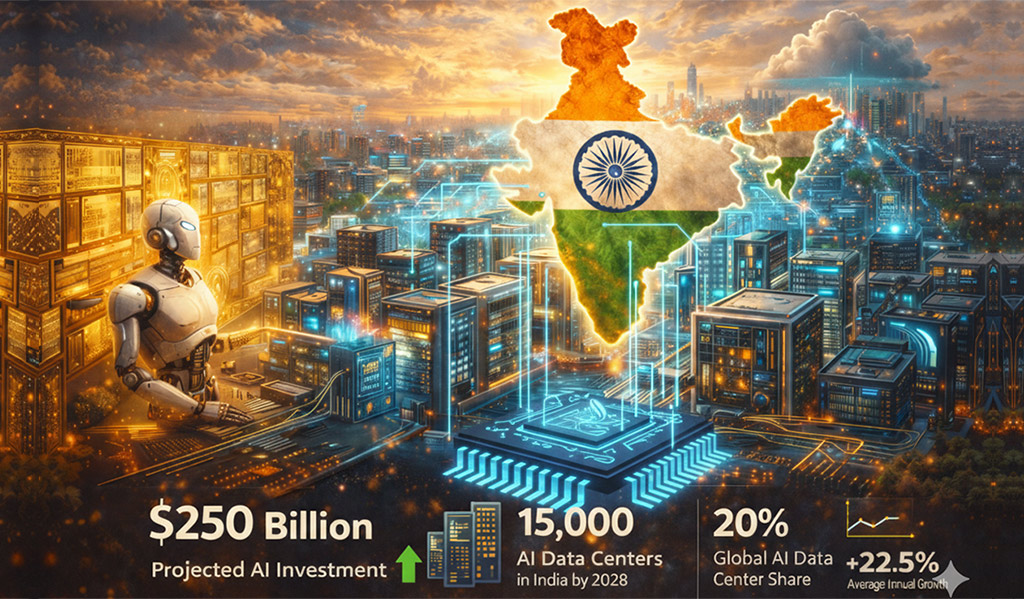
Sovereign AI Rising: The $250 Billion Global Intelligence Infrastructure — How India Is Quietly Racing to Become the World’s AI Data Center Superpower
India has entered a decisive phase in its economic and geopolitical evolution — one where data and artificial intelligence are no longer enablers of growth, but the architecture of power itself.
What is unfolding across the country is not merely a surge in data center investments. It is a strategic race for digital sovereignty. States, conglomerates, global hyperscalers, sovereign funds, and technology giants are competing to build AI-native, hyperscale data infrastructure that will determine where intelligence is trained, where decisions are computed, and where future economic value is captured.
India today hosts over 1.5 GW of installed data center capacity, projected to cross 1.7 GW by end-2026 and 2 GW+ by 2027, making it one of the fastest-growing data infrastructure markets globally. More importantly, this capacity is no longer storage-led — it is compute-led, designed for AI training, inference, and real-time intelligence processing.
This is not digital expansion.
This is digital reindustrialisation.
The Strategic Context: Why Data Centers Are the New Oil Refineries
In the 20th century, economic power was built on oil refineries, steel plants, ports, and highways.
In the 21st century, it is built on GPU clusters, AI clouds, sovereign data lakes, and edge compute networks.
Every AI model, every digital service, every fintech transaction, every defence system, every smart city, every health platform — ultimately collapses into one physical reality: compute infrastructure.
Data centers have therefore become:
- Strategic national assets
- Sovereign economic infrastructure
- Geopolitical leverage points
The countries that control compute do not merely host platforms.
They shape global intelligence flows.
India’s policy ecosystem has already recognised this shift:
- India AI Mission (₹10,300 crore) to build national AI capability.
- Data localisation norms across finance, telecom, defence.
- Long-term tax incentives and infrastructure status for data centers.
- Aggressive state-level competition for hyperscale investments.
The result is a digital gold rush — not for apps, but for infrastructure that trains the future itself.
India’s Data Center Supercycle: From Storage to Sovereign Compute
India’s digital economy is now consuming 25+ GB of data per user per month, and its AI market is projected to triple by 2030. But what is truly transformative is the shift in purpose.
This is no longer about hosting websites or enterprise storage.
This is about:
- AI model training
- Large-scale inference
- Defence and space compute
- Real-time financial systems
- Autonomous and edge intelligence
India is moving from being a data consumer to becoming a global compute factory.
Major AI-Enabled Data Center Developments in India
(Ongoing, Under Construction, Announced)
1. AdaniConneX (Adani Group + EdgeConneX)
Locations: Noida (UP), Chennai (TN), Hyderabad (Telangana), Vizag (Andhra Pradesh)
Investment: $5B+ committed; $100B long-term AI infrastructure vision
Purpose: AI-hyperscale campuses, green-powered compute parks, sovereign cloud backbone
Status: Multiple campuses operational; Vizag mega-campus under construction
AdaniConneX is not building data centers.
It is building India’s first integrated AI-industrial cloud grid.
2. Reliance Industries (Jio Platforms + Global AI Partners)
Locations: Navi Mumbai, Chennai, Vizag
Investment: ~$11B+ phased
Purpose: Sovereign AI stack, indigenous models (Jio Brain), national AI cloud
Status: Under development
Reliance is positioning itself as India’s sovereign AI hyperscaler — vertically integrated from data to models to applications.
3. Google
Locations: Navi Mumbai, Bengaluru, Vizag
Investment: ~$15B AI infrastructure commitment
Purpose: Global AI cloud regions, enterprise AI services, India as Asia-Pacific compute hub
Status: Announced, construction starting
India is now one of Google’s largest AI infrastructure bets outside the United States.
4. Microsoft
Locations: Hyderabad, Pune, Chennai
Investment: $17.5B by 2029
Purpose: Azure AI services, global AI workloads, enterprise compute backbone
Status: Multiple regions under construction
Hyderabad is emerging as one of Microsoft’s largest AI clusters globally.
5. Amazon Web Services
Locations: Mumbai, Hyderabad
Investment: $12.7B by 2030
Purpose: Generative AI platforms, enterprise cloud, startup ecosystem
Status: Ongoing expansions
6. Yotta Data Services (Hiranandani Group)
Locations: Greater Noida, Navi Mumbai, Guwahati
Investment: ₹30,000+ crore
Purpose: AI supercomputing, GPU clusters, Shakti Cloud
Status: Under construction
Yotta is building one of India’s largest domestically owned AI compute clouds.
7. CtrlS
Locations: Mumbai, Hyderabad, Chennai
Investment: $2B+
Purpose: AI-ready hyperscale with liquid cooling
Status: Ongoing expansions
State-Level Competition: The New Federal AI Race
India’s states are now competing not on factories — but on compute ecosystems.
| State | Strategic Positioning |
|---|---|
| Maharashtra | ~40% national capacity, global cable landings |
| Tamil Nadu | Subsea connectivity, semicon + AI clusters |
| Telangana | Fast-track clearances, AI-first policies |
| Uttar Pradesh | Noida as hyperscale capital |
| Andhra Pradesh | Vizag positioned as India’s AI port city |
| Assam & Tier-2 | Edge AI, low-latency regional compute |
This is the first time in Indian history that federal competition is centred on intelligence infrastructure.
Why This Boom Is Structural, Not Cyclical
1. AI Is 3–4x More Power Intensive
AI chips require liquid cooling, high-density energy grids, and dedicated power corridors.
This creates long-term infrastructure lock-in.
2. Global GPU Shortage
India is strategically localising high-end compute hardware to avoid geopolitical chokepoints.
3. Data Sovereignty
Financial systems, defence networks, and public AI cannot depend on foreign compute.
4. Edge Computing
Tier-2 and Tier-3 cities are becoming real-time AI nodes for logistics, mobility, and smart governance.
Economic Impact: Data Centers as GDP Infrastructure
By 2035, India’s AI-data ecosystem could:
- Generate $250B+ in economic value
- Create 1M+ high-skill jobs
- Add 0.5–1% structurally to GDP
- Position India as a neutral global AI hub between US–China
This is not digital services.
This is economic infrastructure at civilisational scale.
Risks and Constraints
No strategic transformation is without friction:
- Power stress: AI clusters consume massive energy.
- Water intensity: Cooling demands millions of litres.
- Talent gaps: AI infrastructure engineers are scarce.
- Cybersecurity: Sovereign AI requires sovereign defence systems.
But these are not deterrents.
They are signals of scale.
The Geopolitical Meaning
Data centers are becoming the new military bases of the digital world.
The nations that host AI compute:
- Shape global supply chains.
- Control financial intelligence.
- Influence defence systems.
- Dictate platform power.
India is not merely participating in the AI economy.
It is architecting its physical foundation.
The Role of IBCV – iBluu Consulting Venture
At this inflection point, IBCV (iBluu Consulting Venture Private Limited) positions itself as a strategic partner in:
- National AI infrastructure strategy
- Public–private investment frameworks
- Sovereign digital policy advisory
- Data center investment structuring
- AI ecosystem partnerships and alliances
IBCV operates at the intersection of policy, capital, infrastructure, and technology — where data centers cease to be assets and become economic weapons of scale.
Strategic Lens by J Parasher
Founder & Managing Director, iBluu Corporations
The analytical depth of this article is shaped by the strategic lens of J Parasher, whose work consistently focuses on national capability building, industrial sovereignty, and long-horizon economic transformation.
His perspective reframes consulting not as advisory work, but as economic system engineering — where AI infrastructure is not a technology decision, but a civilisational investment thesis.
Final Thought: The Real Story Is Not About Data Centers
The real story is this:
India is no longer exporting labour.
It is exporting intelligence.
And the countries that control intelligence do not just compete.
They govern the future.
India’s data center supercycle is not a technology boom.
It is the foundation layer of the next world order.