+91 945 889 6091
  infodesk@ibluu.com
Made in India Smartphones vs China and Vietnam: Apple, Samsung, and India’s Rise in the Battle for Global Manufacturing Supremacy
India has moved from being one of the world’s largest smartphone consumption markets to becoming one of the world’s most consequential smartphone manufacturing platforms.
In less than a decade, under the Make in India and Production Linked Incentive (PLI) regimes, India has emerged as the second-largest smartphone manufacturer globally, with over 300 million units of annual production capacity and exports crossing USD 24 billion in FY25.
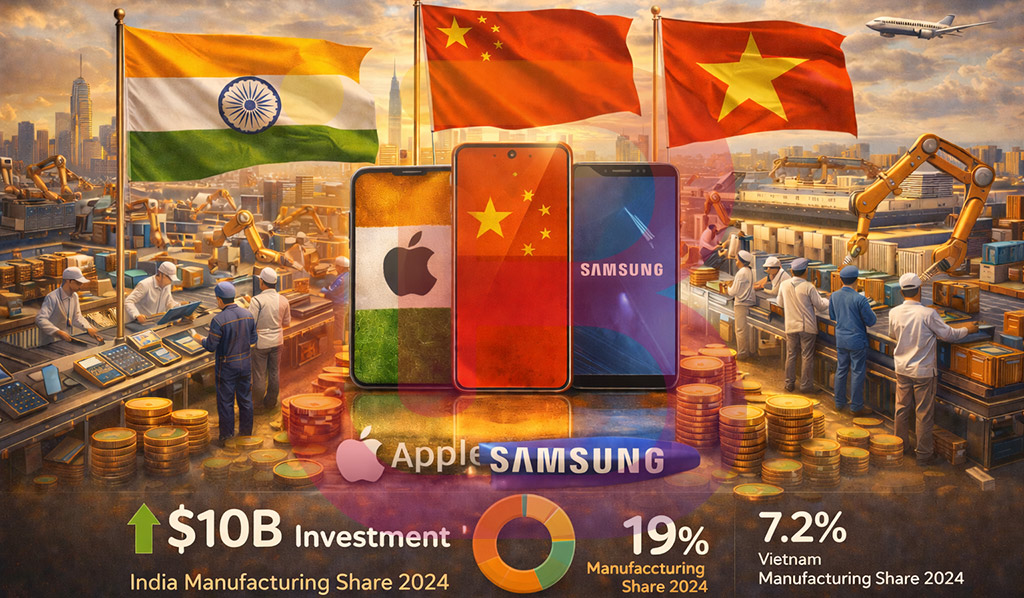
Apple and Samsung now treat India not as a peripheral assembly hub, but as a core pillar of their global operating model — alongside China and Vietnam. By 2026–27, India is projected to manufacture 20–25% of all iPhones globally and over 30% of Samsung’s mid-to-premium devices for export markets.
This is not industrial relocation.
This is global supply-chain re-architecture.
1. Daily Production Capacity: India vs China vs Vietnam vs Rest of World
India
- Current capacity: ~1 million smartphones per day
- Annual target: 300–320 million units by FY26
- Apple alone now produces 120,000–150,000 iPhones per day in India.
- Samsung’s Noida facility has a capacity of 330,000 units per day.
China
- Global share: ~65–67%
- Daily output: 5–6 million units
- Remains the world’s largest manufacturing base, but growth is flat to declining due to geopolitics and cost pressures.
Vietnam
- Global share: ~10–12%
- Daily output: 600,000–800,000 units
- Samsung produces nearly 60% of its global phones in Vietnam.
Others (Brazil, Indonesia, South Korea, Mexico)
- Combined share: ~10%
- Primarily regional assembly hubs.
Strategic Insight:
India is the only major geography showing triple-digit growth in smartphone manufacturing capacity between 2020–2025.
2. Market Position, Exports & Domestic Demand
India’s Position
- 2nd largest smartphone producer globally
- Produces ~12–14% of global smartphones today
- Projected to reach 20% global share by 2026
Exports
- FY25 smartphone exports: USD 24.1 billion
- Growth: +119% in two years
- Apple accounts for ~70% of exports
- Samsung contributes ~USD 17 billion annually
Domestic Market
- India shipments FY25: 152–153 million units
- Premium segment (>$500): growing at 50%+ CAGR
- Apple now controls 66% of India’s premium market
Interpretation:
India has achieved what no other emerging economy has:
Simultaneous dominance in consumption + export manufacturing.
3. Market Size of OEMs Under “Made in India”
Apple (India)
- Production value FY25: USD 22 billion
- India revenue: USD 9.5 billion
- YoY growth: 19%
- Profit margin in India: ~16%
Samsung (India)
- Production/export value: USD 17 billion
- India revenue: USD 7.8 billion
- Largest mobile manufacturing plant globally (Noida)
Chinese OEMs (Combined)
- Xiaomi, Vivo, Oppo, Realme, OnePlus
- Combined volume share: ~70% of units
- But export share < 25%
Google / Nothing / Motorola / HMD
- Emerging exporters via India
- Pixel production now fully localized
4. Indian States Powering Global Smartphone Manufacturing
Tamil Nadu
- Foxconn (Apple)
- Pegatron (Apple)
- Tata Electronics (Apple)
Karnataka
- Wistron → Tata takeover (Apple)
Uttar Pradesh
- Samsung Noida mega-factory
- Dixon Technologies (Google, Motorola)
Andhra Pradesh
- Sunny Opotech
- Celkon / BYD
Cluster Reality:
UP + TN together now account for ~65% of India’s smartphone output.
5. Earnings: India vs Other Countries
| Company | India Revenue | China Revenue | Vietnam Revenue |
|---|---|---|---|
| Apple | USD 9.5B | USD 78B | ~USD 6B |
| Samsung | USD 7.8B | ~USD 35B | USD 52B |
But the growth differential is decisive:
- Apple India CAGR: >35%
- Apple China CAGR: <5%
- Samsung Vietnam: plateauing
India is now the only large geography delivering scale + growth + geopolitical safety.
6. Why Apple & Samsung Are Expanding Aggressively in India
The China+1 Reconfiguration
- US tariffs on Chinese electronics: 25–30%
- Vietnam exposed to US trade risk (46% tariff discussions)
- India offers FTA pathways to US, EU, Middle East
Structural Advantages
- PLI subsidies: USD 2.46 billion already disbursed
- Labour cost: 30–40% lower than China
- Domestic market: 700M+ smartphone users
- Political stability + IP protection
Future Plans
- Apple: 32% of global iPhone production in India by 2027
- Samsung: Display + semiconductor assembly integration
- Foxconn: USD 1.5B Chennai expansion
7. Other Companies Expanding in India
- Google: Pixel manufacturing
- Motorola: Shifting from China/Vietnam
- Nothing: 95% localized
- HMD (Nokia): Export hub strategy
- Transsion (Itel/Infinix): Africa exports via India
8. Why India Is Strategically Critical for Every Mobile Brand
India is the only country that simultaneously offers:
- Scale demand (2nd largest market)
- Export arbitrage
- Policy incentives
- Demographic consumption engine
- Geopolitical neutrality
- Digital ecosystem (AI, fintech, cloud)
No other geography offers all six.
Not China.
Not Vietnam.
Not Mexico.
9. Competitive Benchmarking: India vs Vietnam vs Mexico
| Metric | India | Vietnam | Mexico |
|---|---|---|---|
| Domestic market | Massive | Small | Medium |
| Labour cost | Low | Medium | High |
| PLI incentives | Strong | Weak | None |
| Geopolitical risk | Low | Medium | Medium |
| Export scalability | High | Medium | Low |
Conclusion:
Vietnam is an assembly node.
Mexico is a regional node.
India is becoming a global platform.
10. Scenario Modeling: India’s Smartphone Manufacturing Trajectory
Base Case (Most likely)
- 20% global share by 2026
- USD 35B exports
- 18–20% local value addition
Best Case
- 25% global share
- USD 45–50B exports
- Semiconductor integration
- India becomes Apple’s largest manufacturing base globally
Worst Case
- Infra bottlenecks
- Policy stagnation
- Share stagnates at 15%
11. Strategic Risks & Constraints
- Power and water stress in TN/UP
- Supply chain still China-dependent for chips
- Higher manufacturing cost (5–10%)
- Skill depth in advanced electronics
12. Strategic Recommendations
For Government
- Create semiconductor-to-mobile corridors
- Power + water MOUs for OEM clusters
- Push value addition to 40%+
For Apple / Samsung
- Integrate display, camera, battery ecosystems
- Move R&D and product design to India
- Use India as Africa + Middle East export HQ
For Investors
- Back EMS firms: Dixon, Tata Electronics
- Bet on component ecosystems
- Focus on TN, UP, Karnataka corridors
The iBluu Strategic Lens
At IBCV (iBluu Consulting Venture), a venture of iBluu Corporations, we interpret India’s smartphone manufacturing story not as an industrial success — but as a systemic economic transformation.
Under the strategic leadership of J Parasher, Founder and Managing Director of iBluu Corporations, this shift is seen as:
India transitioning from a consumption economy to a global production economy — where electronics manufacturing becomes a geopolitical instrument, not just a business vertical.
Smartphones are only the beginning.
The same template is now replicating across:
- Semiconductors
- Defense electronics
- AI hardware
- EV systems
India is no longer competing for factories.
India is becoming the factory system of the world.
Final Thought — The Real Comparison
China built the world’s factory.
Vietnam built the world’s assembly line.
Mexico built the world’s nearshore hub.
India is building the world’s manufacturing operating system.
And Apple and Samsung are no longer testing it.
They are betting their future on it.