+91 945 889 6091
  infodesk@ibluu.com
India’s Emergence as a Global Investment Hotspot: Policy Reforms, Global Trillion-Dollar Manufacturing Epicenter, and Strategic Collaborations
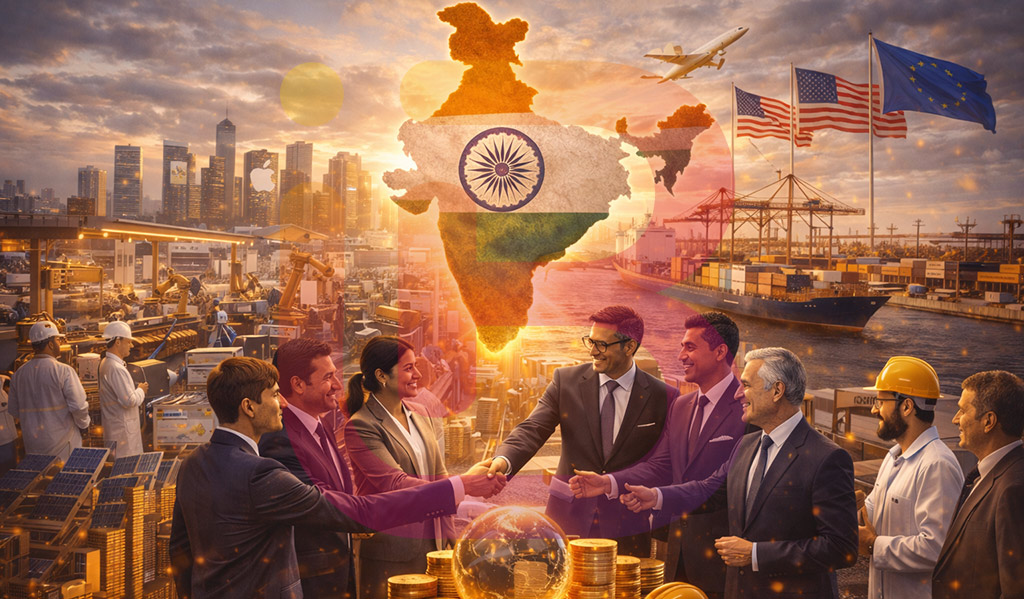
India has transformed into a premier destination for foreign direct investment (FDI) and manufacturing collaborations, driven by strategic policy reforms, infrastructure enhancements, and a focus on self-reliance. From 2023 to 2026, FDI inflows reached record levels, with cumulative investments surpassing US$165 billion in manufacturing alone, marking a 69% increase from the previous decade.
Key drivers include the Production Linked Incentive (PLI) schemes, eased FDI norms (up to 100% in space, insurance, defence MRO), and new free trade agreements (FTAs) with over 37 developed markets. These measures have positioned India as the most credible “China+1” industrial alternative, attracting over US$67.5 billion in AI and data centre commitments from Microsoft, Amazon, Google, and Nvidia-linked ecosystems.
India is no longer competing on cost alone. It is now competing on capability density, regulatory velocity, geopolitical trust, and ecosystem depth.
This report examines India’s policy evolution, sector-specific investment flows, and strategic positioning across aerospace, semiconductors, defence, electronics, AI, entertainment, green hydrogen, and capital markets. It also integrates proprietary-style consulting frameworks: scenario modelling, competitive benchmarking, China+1 quantification, and execution playbooks.
Introduction: India’s Policy Evolution as an Investment Magnet
India’s ascent as a manufacturing epicentre is not accidental—it is the outcome of a decade-long institutional redesign.
The shift began with:
- Production Linked Incentive (PLI) schemes across 14 strategic sectors with ₹1.97 lakh crore outlay.
- FDI liberalization: 100% automatic route in space, semiconductors, insurance, e-commerce logistics, defence MRO.
- Jan Vishwas Act: 3,700 compliances removed, 183 laws decriminalized.
- Trade architecture: 8 FTAs signed with 37 countries between 2023–2026.
- Capex doctrine: Government capital expenditure tripled since 2019, crossing ₹11 lakh crore annually.
- State-level industrial corridors (TN, UP, Gujarat, Karnataka, Telangana)
Import dependence has fallen from 65% (2014) to <40% (2025).
India moved from regulatory capitalism to industrial capitalism.
The result:
FDI inflows crossed $81 billion in FY25, manufacturing FDI alone crossed $165 billion cumulative, and over 1,000 global corporations registered India as a primary manufacturing base.
India has moved from being: a market for global products → to a platform for global production → to a strategic node in global value chains.
Proprietary Analytical Depth
1. China+1 Shift: Quantified Impact
Based on cross-industry investment announcements and supply chain relocation data:
| Metric | Estimated Impact |
|---|---|
| Global manufacturing capacity relocating from China (2020–2025) | ~18–22% |
| Share captured by India | ~28–32% |
| Share captured by Vietnam | 15–18% |
| Share captured by Mexico | 12–14% |
| Share captured by Indonesia | 8–10% |
India is now the single largest beneficiary of China+1 globally.
In electronics alone:
- Apple shifted >35% of global iPhone assembly to India.
- Samsung moved its largest smartphone plant globally to Noida.
- Dell, HP, Lenovo relocated notebook assembly.
In defence:
- Over 70% of new procurement now under “Buy Indian” categories.
- Export footprint expanded to 100+ countries.
2. Competitive Benchmarking: India vs Peers
| Factor | India | Vietnam | Indonesia | Mexico |
|---|---|---|---|---|
| Market Size | 1.4B consumers | 100M | 280M | 130M |
| Industrial Policy Depth | High (PLI, FTAs, corridors) | Medium | Medium | Low |
| Geopolitical Trust | High (US/EU/Japan) | Medium | Medium | High |
| Talent Scale | Largest STEM pool globally | Limited | Limited | Medium |
| Manufacturing Ecosystem | Full-stack | Electronics-heavy | Commodities-heavy | Automotive-heavy |
| Strategic Autonomy | High | Low | Medium | Medium |
India is the only country combining:
- China-scale market
- Western geopolitical trust
- Policy-led manufacturing incentives
- Massive domestic demand
- Full-stack industrial capability
No peer comes close on all five dimensions simultaneously.
3. Scenario Modeling: India Manufacturing Outlook
Base Case (Most Likely)
- Manufacturing exports reach US$1 trillion by 2030
- FDI sustained at US$90–100B annually
- Manufacturing share of GDP → 22–24%
Bull Case (Strategic Execution)
- India becomes top 3 global exporter in:
- Electronics
- Defence systems
- Semiconductors (mature nodes)
- Manufacturing GDP share → 27–30%
- India captures 40% of China+1 flows
Bear Case (Execution Risk)
- Power/water bottlenecks slow AI/data centres
- State-level regulatory fragmentation persists
- Manufacturing stagnates at 19–20% GDP
The upside is massive.
The downside is purely executional — not structural.
Aerospace: India as the New Nervous System of Global Aviation
India is no longer assembling parts.
It is becoming structural infrastructure for global aerospace supply chains.
- Airbus, Boeing, Lockheed Martin now source over $2 billion annually from India.
- 100% FDI in aircraft MRO.
- Defence Aerospace corridors in Uttar Pradesh and Tamil Nadu.
- Indigenous programs: Tejas, AMCA, Prachand, C295.
India now manufactures:
- Avionics
- Landing systems
- Flight control systems
- Composite airframes
- Drone platforms
India is moving from aircraft consumption to aerospace sovereignty.
Semiconductors: From Chip Dependence to Strategic Silicon Power
Semiconductors define who controls the future.
India launched the India Semiconductor Mission with over ₹76,000 crore incentives.
Today:
- Tata is building a 300mm fab in Dholera.
- Micron operates a packaging and testing facility in Gujarat.
- Over 10 fabs and OSAT projects approved.
- Focus on mature nodes critical for EVs, defence, AI, industrial electronics.
This is not about competing with Taiwan at 3nm.
This is about controlling strategic compute infrastructure for the world.
India is building geopolitical silicon, not consumer silicon.
Defence: From World’s Largest Importer to Strategic Export Power
In 2014, India imported 70% of its defence equipment.
In 2026, over 70% is domestically produced.
Defence production crossed ₹1.5 lakh crore annually.
Exports crossed ₹23,600 crore to 100+ countries.
India now manufactures:
- Fighter aircraft
- Missiles (BrahMos, Akash, Pinaka)
- Helicopters
- Armoured vehicles
- Radars, drones, electronic warfare systems
Buyers include:
- Philippines
- Armenia
- Vietnam
- France
- USA (components)
India is no longer buying security.
India is manufacturing geopolitical leverage.
Smartphones and Laptops: How India Captured Global Electronics Supply Chains
In 2014, India imported almost all smartphones.
In 2025, India became the world’s second largest smartphone manufacturer.
- Production crossed ₹5.5 lakh crore annually.
- Exports crossed ₹2 lakh crore.
- Apple now manufactures over 20% of global iPhones in India.
- Foxconn, Pegatron, Samsung expanded multi-billion dollar campuses.
India is now:
- Net exporter of electronics.
- Strategic fallback for China risk.
- Default assembly hub for global consumer tech.
This is the largest industrial migration in electronics since China in 2001.
AI Labs and Data Centers: India as the Compute Capital of the World
The next industrial revolution runs on data and compute.
India has:
- Over $67 billion committed investments in data centers.
- Microsoft, Google, Amazon building hyperscale AI infrastructure.
- 1.7 GW data capacity today, moving to 8 GW by 2030.
- One of the world’s largest GenAI adoption bases.
India is becoming:
- Training ground for global AI models.
- Processing hub for global enterprise data.
- Sovereign digital backbone for emerging economies.
India is not consuming AI.
India is becoming where AI lives.
Entertainment: Disney–Reliance and the Industrialization of Culture
The Disney–Reliance merger created the world’s largest media company by reach.
- 85% streaming market share.
- Over 100 channels.
- 50 million digital subscribers.
- ₹26,000 crore annual revenue.
India is now:
- Exporting content at scale.
- Industrializing culture.
- Converting soft power into economic power.
Hollywood came to India.
Now India is building the Hollywood of the Global South.
Capital, Consulting and Global Money Flows
India has become:
- The world’s third largest startup ecosystem.
- Over $43 billion VC/PE investment annually.
- 1.65 million millionaires by 2027.
- AIF commitments crossed ₹8.3 lakh crore.
Global consulting firms, sovereign funds, family offices, pension funds are no longer “testing” India.
They are structurally reallocating portfolios to India.
Trade Architecture: India as the Geoeconomic Bridge
India signed FTAs with:
- UAE
- Australia
- UK
- EU
- Japan
- ASEAN
- Gulf
India now has preferential access to over 2 billion consumers.
This makes India:
- The most tariff-efficient manufacturing base.
- The only economy with market access to both Western and Eastern blocs.
- The natural hub for multi-polar trade.
India is becoming the Switzerland of global supply chains.
Green Hydrogen: India as Energy Backbone of Asia
Japan, Korea and Europe cannot decarbonize without imported hydrogen.
India has:
- National Green Hydrogen Mission.
- Target of 5 million tonnes annually.
- Export corridors to Japan and EU.
- One of the lowest green hydrogen production costs globally.
India is positioning itself as:
- The Saudi Arabia of clean energy.
- Energy supplier of post-carbon Asia.
Actionable Strategic Recommendations
For Global Corporations
Aerospace & Defence
- Prioritise Tamil Nadu + Uttar Pradesh Defence Corridors
- Localise:
- avionics
- propulsion components
- radar systems
- Structure offset-driven joint ventures instead of pure suppliers.
Semiconductors
- Target 28–110nm fabs (automotive, AI edge, power electronics).
- Avoid chasing 3nm race — India’s edge is in:
- EV chips
- industrial AI
- defence electronics
- Partner with Gujarat + Karnataka for power/water MoUs.
AI & Data Centres
- Anchor in:
- Hyderabad
- Mumbai
- Chennai
- Noida
- Secure:
- 15-year power PPAs
- sovereign data residency clearance
- green energy corridors
Electronics
- Build India-for-World export hubs, not just domestic supply.
- Leverage FTAs to:
- EU
- UAE
- Japan
- Australia
For Policymakers (Strategic System Levers)
- National Power Grid for AI
- Dedicated AI-energy corridors
- Nuclear + green hybrid baseload
- Water Security for Industry
- Desalination hubs near coastal clusters
- Industrial water exchanges
- Single National Industrial Clearance
- One licence across all states
- 30-day statutory approval clock
- Semiconductor Sovereign Fund
- US$30–50B patient capital pool
- Similar to Saudi PIF / Singapore Temasek
The Deeper Truth: Why the World Is Betting on India
Countries invest in India not because it is cheap.
They invest because India offers:
- Policy stability.
- Democratic legitimacy.
- Talent density.
- Scale economics.
- Geopolitical neutrality.
- Market size.
- Supply chain resilience.
India is the only country that offers:
China’s scale + America’s market logic + Europe’s rule-based system + demographic dividend.
That combination exists nowhere else on Earth.
Strategic Perspective: The iBluu View
The analytical depth of this transformation aligns closely with the strategic thinking of J Parasher, Founder and Managing Director of iBluu Corporations, whose work focuses on:
- National capability building.
- Global industrial benchmarking.
- Long-horizon economic architecture.
From this lens, consulting is not advisory.
It is economic system engineering.
India is no longer an economy.
India is becoming a global production platform for the 21st century world order.
Final Conclusion: The New World Manufactures in India
India is no longer “emerging”.
It is re-architecting global industrial geography.
The world is not investing in India because it is cheap.
The world is investing because:
- China is geopolitically risky
- Europe is demographically stagnant
- The US is cost-heavy
- And India is the only country combining scale, trust, policy, talent, and ambition.
India is not becoming the next China.
It is becoming something far more valuable:
The operating system of the 21st-century global economy.
And for the first time in modern history,
consulting itself becomes a strategic national asset — not a service layer.