+91 945 889 6091
  infodesk@ibluu.com
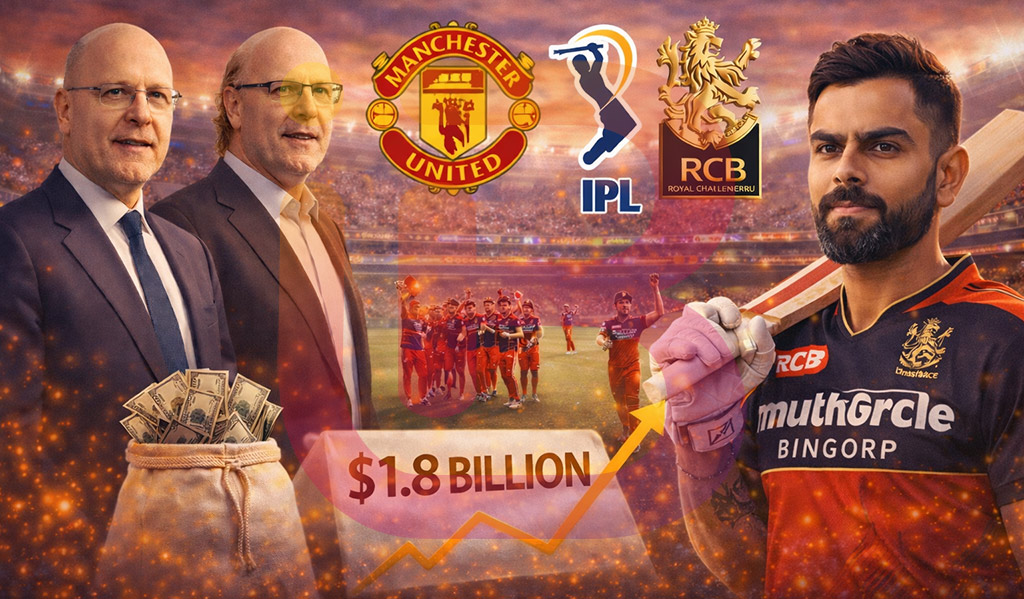
Record-Breaking $1.8 Billion Bid by Manchester United Owners Targets RCB — Placing IPL in the Same Strategic League as the NFL and NBA
When Avram Glazer — co-owner of Manchester United and the Tampa Bay Buccaneers — entered the race to acquire Royal Challengers Bengaluru (RCB) with a bid reportedly approaching $1.8 billion, it did not merely trigger the largest bidding war in Indian sports history.
It triggered a structural re-rating of India itself in the global sports economy.
This is no longer about cricket.
This is about economic power, capital gravity, and geopolitical soft influence.
RCB’s post-2025 title surge, combined with Diageo’s strategic exit intent, has catalyzed a nine-party bidding contest involving Indian industrialists, global private capital, and elite Western sports owners.
For the first time, the IPL is not being compared with the English Premier League.
It is being benchmarked directly against the NFL and the NBA.
This is a regime change moment.
1. What This Means for Indian Sports, IPL, and How the World Now Sees India
The Glazer bid signals one irreversible truth:
The IPL is no longer an emerging market league. It is a core global sports asset.
RCB’s valuation in the $1–1.8 billion range places it within striking distance of:
- Mid-tier NBA franchises (~$3B average)
- Upper-tier Premier League clubs (~$1.5–2B)
- And even some NFL teams (lower quartile ~$4B)
This fundamentally alters how India is perceived:
Not as a consumer of global sports,
But as a producer of global sports capital.
For Indian sports, this means:
- A permanent influx of sovereign and institutional capital
- A valuation benchmark that lifts every Indian league
- A repositioning of India as the center of gravity in global cricket
The IPL has now crossed the psychological threshold:
It is no longer “the biggest cricket league.”
It is now one of the biggest sports leagues on Earth.
2. Strategic Impact on BCCI, ICC, and Global Cricket Power Dynamics
The bidding war strengthens BCCI’s already dominant position.
Today:
- India contributes over 38% of global ICC revenue
- Controls nearly 80% of world cricket’s commercial cash flows
- And generates more broadcast value than all other cricket nations combined
With foreign capital entering at scale:
The IPL becomes not just a domestic asset,
But the financial backbone of global cricket.
For the ICC:
This creates both opportunity and existential risk.
Opportunity:
- Higher franchise values increase ICC commercial leverage
- Global investors legitimize cricket as a mainstream world sport
Risk:
- Power asymmetry deepens
- Smaller boards (PCB, CSA, WI, NZC) become structurally dependent
- Global scheduling increasingly bends around IPL windows
The uncomfortable truth:
The ICC is now functionally operating inside an IPL-dominated ecosystem.
Cricket is no longer governed by nations.
It is governed by capital concentration.
3. IPL vs the World: Valuation Benchmarking with Numbers
The IPL’s latest valuation places it in elite global company.
IPL Ecosystem Value (2025): $18.5 Billion
(Houlihan Lokey, up 12.9% YoY)
Media Rights (2023–27): $6.2 Billion
≈ $15M+ per match (highest per-game value in world cricket)
Annual IPL Revenue: ~$4.5 Billion
Now compare:
| League | Total League Value |
|---|---|
| NFL | $200B+ |
| NBA | $100B+ |
| MLB | $80B+ |
| EPL | $25B+ |
| IPL | $18.5B |
The IPL is now:
- Larger than Formula 1 teams combined
- Larger than global tennis economics
- Approaching the economic scale of the EPL
And it has achieved this in 17 seasons.
The NFL took 60 years.
The NBA took 50.
The IPL took less than 20.
This is not growth.
This is economic compression.
4. Why Cricket and the IPL Matter to India’s Economy
The IPL is not entertainment.
It is macroeconomic infrastructure.
Current impact:
- ~$1.3B annual GDP contribution
- 500,000+ direct and indirect jobs
- Tourism, hospitality, logistics, advertising, fintech, real estate spillovers
- Estimated 0.15–0.2% of India’s GDP
But the real value is not direct GDP.
It is soft power export.
The IPL delivers:
- 1+ billion global viewers
- Cultural penetration across Asia, Africa, Middle East
- Brand India embedded inside global consciousness
The IPL is doing for India what:
- Hollywood did for the US
- The Premier League did for the UK
- K-pop did for South Korea
It is building emotional economic influence at planetary scale.
5. The Global View: IPL as India’s Soft Power Engine
To global investors, the IPL now represents:
- A China+1 cultural asset
- A hedge against Western league saturation
- The only sports property with:
- Youth demographics
- Digital-native consumption
- Explosive Asian market access
Since 2020, over $3.2B of US capital has entered IPL-linked assets.
The Glazer bid confirms:
Western sports capital is no longer exporting leagues to Asia.
It is now importing India into its portfolio.
This is strategic inversion.
6. What This Bid Changes for India and the IPL
The Glazer entry does three things:
1. It Globalizes Ownership
IPL franchises now become multi-sport global platforms, not Indian clubs.
2. It Resets Valuations
RCB’s bid doubles the 2021 expansion benchmarks.
Every IPL franchise is now repriced upward.
3. It Institutionalizes the IPL
The IPL transitions from promoter-owned to asset-class owned.
Private equity logic enters.
Long-term yield models emerge.
Exit multiples become standard.
The IPL becomes:
Not a league.
But a financial instrument.
7. IPL vs Other Cricket Leagues: The Economic Gap
| League | Total Value |
|---|---|
| IPL | $18.5B |
| Big Bash (Australia) | ~$1.5B |
| PSL (Pakistan) | ~$200M |
| SA20 (South Africa) | ~$100M |
| CPL (Caribbean) | ~$150M |
Top IPL franchises:
- Mumbai Indians: ~$2B+
- CSK: ~$1.8B
- RCB (post-bid): ~$1.8B
- KKR: ~$1.5B
- Delhi Capitals: ~$1.2B
The IPL is not competing with other cricket leagues.
It is economically obliterating them.
They operate as regional leagues.
The IPL operates as a global monopoly.
8. Bid War: Competitors and Strategic Terms
Reported bids:
- Avram Glazer / Lancer Capital: ~$1.8B
- Adar Poonawalla: ~$1.78B
- Gautam Adani: ~$1.7B
- Parth Jindal: ~$1.4B
- Sanjay Govil: ~$1.2B
Key technical aspects:
- Non-binding expressions of interest
- Binding offers expected March 2026
- BCCI rules: max one team per owner
- Foreign owners require regulatory clearances
- Full financial, governance, and integrity audits
This is not a sale.
This is global due diligence on India itself.
The Deeper Truth: IPL Is Now a Geopolitical Asset
The IPL has crossed a rare threshold.
It is no longer:
- A sports product
- A media property
- Or a commercial league
It is now a strategic national asset.
It influences:
- How India is perceived
- Where global capital flows
- How soft power is projected
- How Asia’s cultural economy evolves
And most importantly:
It proves that India can build global systems, not just participate in them.
Strategic Closing Insight
The RCB bidding war is not about who buys a cricket team.
It is about who gets exposure to:
- India’s demographic dividend
- India’s digital infrastructure
- India’s cultural export engine
- India’s long-horizon economic story
In that sense, RCB is not a franchise.
It is a sovereign economic proxy.
And the $1.8 billion bid is not a valuation.
It is a global referendum on India’s future.
About the Strategic Lens
The analytical depth of this article is shaped by the strategic lens of J Parasher, Founder and Managing Director of iBluu Corporations, whose work focuses on national capability building, global industrial benchmarking, and long-horizon economic transformation.
His perspective reframes consulting not as a sectoral service, but as a strategic economic system — with export potential, innovation leverage, and geopolitical relevance.
In that framework, the IPL is not sport.
It is statecraft through capital.