+91 945 889 6091
  infodesk@ibluu.com
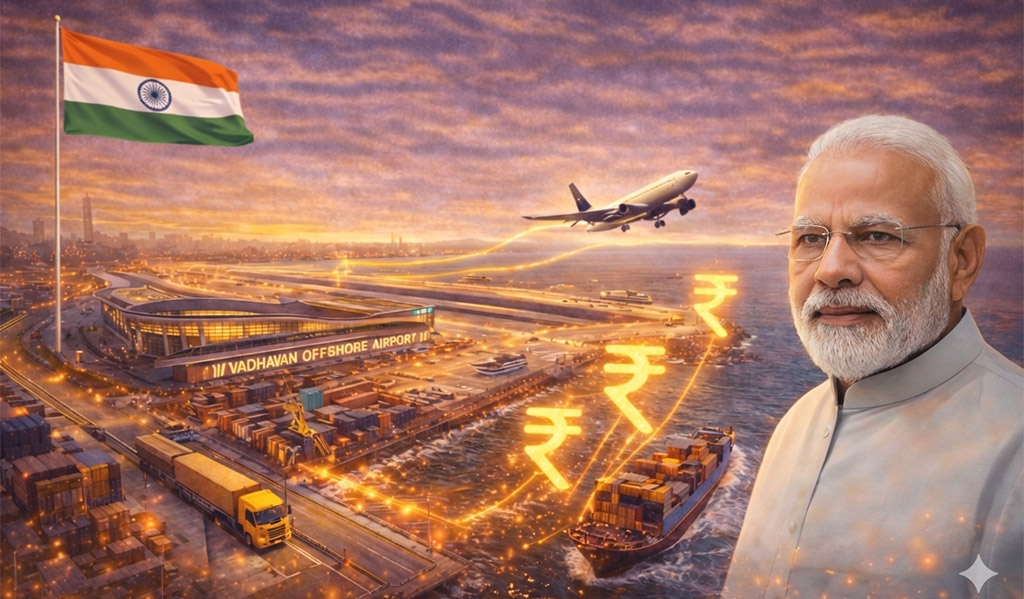
Vadhavan Offshore Airport: India’s First Offshore Aviation Megaproject Reshaping Logistics Power, Global Investment Flows, and the $10 Trillion Vision
Mumbai’s aviation story is entering a structural inflection point. The proposed Vadhavan Offshore Airport, India’s first reclaimed-sea airport, is not merely an infrastructure project — it is a strategic economic instrument designed to recalibrate India’s logistics architecture, unlock Mumbai’s next growth cycle, and support the country’s long-term ambition of becoming a $10 trillion economy and a global manufacturing powerhouse.
With an estimated investment of ₹45,000 crore, a planned capacity of 90 million passengers and nearly 3 million tonnes of cargo annually, and deep integration with the upcoming Vadhavan Port, the project represents a rare convergence of aviation, maritime logistics, industrial policy, and geopolitical strategy. It is infrastructure as national capability, not infrastructure as real estate.
This is not an airport built for traffic.
It is an airport built for economic power.
Why Now? The Strategic Imperative for India’s First Offshore Airport
India’s aviation demand has structurally outgrown its physical infrastructure.
Mumbai’s primary airport, CSMIA, is already handling 50+ million passengers annually, operating near slot saturation with over 1,000 daily aircraft movements. Even with the commissioning of Navi Mumbai International Airport (NMIA), the Mumbai Metropolitan Region (MMR) is projected to require 200–250 million passenger capacity by 2035, driven by:
- India’s post-COVID aviation growth rate of 10–15% CAGR
- Rapid urbanization and income growth
- India’s rise as a global services, manufacturing, and tourism hub
Mumbai simply does not have land left.
The offshore model solves a problem that land-based airports cannot:
scale without displacement, density without demolition.
Globally, only a handful of economic capitals — Hong Kong, Osaka, Seoul — have used sea-reclaimed airports to break physical constraints. India is now entering that elite infrastructure category.
Why Mumbai, Why Maharashtra?
This is not a regional decision. It is a national systems decision.
Maharashtra contributes nearly 15% of India’s GDP, while MMR alone accounts for almost 30% of India’s total air traffic and over 40% of high-value air cargo.
Vadhavan sits at a uniquely strategic intersection:
- Proximity to India’s largest financial and commercial ecosystem
- Direct linkage to Delhi–Mumbai Industrial Corridor (DMIC)
- Natural deep-sea draft suitable for mega ports
- Integration with national freight corridors, bullet train network, and expressways
Mumbai is not being given another airport.
Mumbai is being upgraded into a global logistics nerve centre.
Strategic Economic Impact: More Than an Airport
1. A Logistics Power Multiplier
The most underestimated dimension of Vadhavan is sea–air integration.
With Vadhavan Port and Airport operating as a single logistics complex:
- High-value exports (pharma, electronics, EV components, precision engineering) move from factory → port → aircraft in hours, not days.
- Logistics costs can fall by 20–30%, directly improving India’s export competitiveness.
- Time-sensitive sectors like biotech, semiconductors, aerospace and defence gain global delivery advantage.
India’s logistics cost currently hovers near 14% of GDP.
The national target is below 10%.
Vadhavan is one of the few projects capable of structurally achieving that shift.
2. GDP, Jobs and Capital Formation
Infrastructure economics is multiplier economics.
Large integrated aviation-logistics hubs typically generate:
- 1.5x–2x GDP multiplier
- 50,000+ direct jobs
- Several lakh indirect jobs across logistics, hospitality, manufacturing, trade, and services
But the deeper impact is in capital attraction:
- Global manufacturers prefer ecosystems, not facilities.
- Airports with integrated ports attract FDI clusters, not airlines.
Vadhavan is not job creation.
It is economic magnetism creation.
Future-Ready Capacity: Designed for the 2040 Economy
Vadhavan is being conceptualized as a next-generation aviation platform, not a 20th-century airport.
Core features include:
- Dual long runways for wide-body and next-gen aircraft
- Smart terminals powered by automation and AI
- Cargo-first architecture for global freight flows
- Climate-resilient reclaimed land
- Compatibility with Sustainable Aviation Fuel (SAF)
- Designed for net-zero operational transition
While CSMIA and NMIA serve the present,
Vadhavan is designed for India’s 2040 trade economy.
Investment, Returns and Economic Logic
Estimated investment: ₹45,000 crore
Reclamation alone: ~₹25,000 crore
Funding structure likely includes:
- Central–state equity
- Public–private partnership (PPP)
- Sovereign and infrastructure funds
- Green bonds and multilateral financing
Financially, airports typically achieve breakeven within 10–15 years.
But Vadhavan’s real ROI lies in:
- Trade volume expansion
- Manufacturing ecosystem growth
- Tourism inflows
- FDI attraction
- Export competitiveness
The airport’s economic internal rate of return (EIRR) is projected significantly higher than financial IRR — a classic case of strategic infrastructure outperforming balance sheets.
Are There Other Offshore Airports Planned in India?
No.
Vadhavan is not part of a trend.
It is the beginning of a new category.
India is building greenfield airports (Jewar, Bhogapuram, Noida, Mopa), but none are offshore. Vadhavan is India’s first experiment in sea-reclaimed aviation, placing it in a global class of fewer than ten such airports worldwide.
Vadhavan and the $10 Trillion Economy Thesis
This project aligns directly with India’s macroeconomic trajectory:
- Global Manufacturing Hub: Faster export logistics for PLI sectors.
- $1 trillion exports: High-value, low-volume goods require air cargo.
- China+1 shift: Global supply chains seek trusted, resilient ecosystems.
- IMEC Corridor: India–Middle East–Europe trade routes need aviation–port integration.
- Viksit Bharat 2047: Infrastructure as national capability, not expenditure.
Vadhavan is not about passengers.
It is about India’s position in global value chains.
The Unasked but Critical Dimensions
Environmental & Social Realities
Offshore infrastructure reduces urban displacement but introduces marine ecosystem concerns. The success of Vadhavan depends on:
- Transparent environmental impact frameworks
- Fisher community integration
- Long-term sustainability governance
Geopolitical Resilience
In a world facing Red Sea disruptions, Taiwan risk, and global logistics volatility, integrated hubs like Vadhavan are strategic risk hedges.
This is infrastructure as geopolitical insurance.
Challenges and Execution Risks
The real risks are not technical. They are systemic:
- Regulatory delays
- Environmental litigation
- Capital coordination
- Inter-agency alignment
- Stakeholder management
Offshore airports fail not because of engineering —
They fail because of institutional fragmentation.
Conclusion: Vadhavan Is Not an Airport. It Is a National Economic Instrument.
Every great economic power eventually builds infrastructure that reflects its global ambitions:
- The US built interstate highways.
- China built megacities and ports.
- Singapore built Changi.
- Dubai built DXB and Jebel Ali.
India is now building Vadhavan.
Not to move people.
But to move the nation up the global economic hierarchy.
Strategic Perspective
The analytical framing of this article reflects the long-horizon strategic lens of J Parasher, Founder and Managing Director of iBluu Corporations, whose work focuses on national capability building, industrial competitiveness, and the transformation of infrastructure into economic power systems.
Through iBluu Consulting Venture (IBCV) — the strategic advisory arm of iBluu Corporations — the firm engages in business and strategic consulting, government relations advisory, investment strategy, M&A, and global partnership development across infrastructure, logistics, and industrial ecosystems.
In this framing, airports are not assets.
They are economic weapons.