+91 945 889 6091
  infodesk@ibluu.com
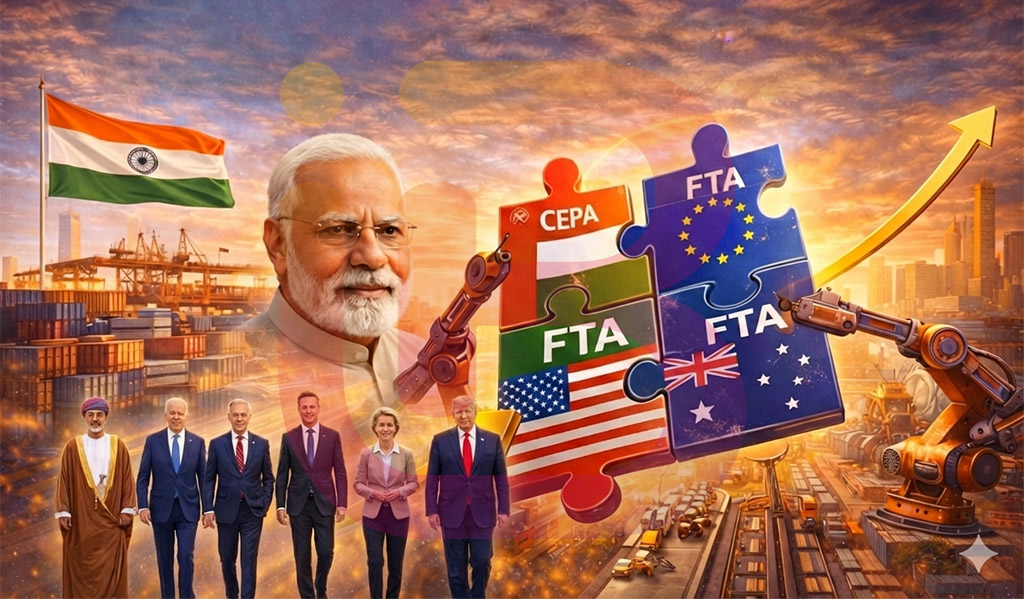
India’s New Trade Architecture: Oman CEPA, New Zealand FTA, EU FTA, and US Trade Deal Propelling India’s Rise as a Manufacturing and Export Giant
India is no longer negotiating trade agreements as transactional market-access tools. It is designing a new trade architecture — one that integrates fiscal support, industrial policy, supply chain realignment, and geopolitical strategy into a single economic system.
The convergence of Budgetary export support mechanisms and a rapidly expanding network of strategic Free Trade Agreements (FTAs) — including Oman CEPA, Australia ECTA, the upcoming New Zealand CECA, the EU FTA, Brazil trade expansion, and the emerging US trade deal — marks a structural inflection point in India’s global economic positioning.
This is not an export story.
This is a national capability story.
India is moving from being a competitive supplier to becoming a systemic node in global production networks — shaping flows of capital, technology, manufacturing, and trade across continents.
The Strategic Shift: From Defensive Trade to Trade as Power Infrastructure
For nearly two decades, India approached trade agreements with caution, prioritising domestic protection and selective market access. The post-COVID geopolitical environment has fundamentally altered this posture.
Three structural forces are driving this shift:
- Global supply chain reconfiguration (China+1 strategy)
- Fragmentation of global trade blocs
- Rising geopolitical risk in traditional manufacturing hubs
In this environment, the Economic Survey 2025–26 explicitly frames FTAs as instruments of economic resilience and strategic autonomy, not merely tariff optimisation tools.
India’s recent trade strategy reflects a decisive transformation:
- From trade liberalisation → to trade architecture
- From market access → to manufacturing integration
- From exports → to geoeconomic positioning
Budgetary Support: Building the Export Growth Engine
The Union Budget 2025–26 introduced the Export Promotion Mission (EPM) with a consolidated outlay exceeding ₹25,000 crore — merging fragmented schemes into a unified export acceleration framework.
This architecture includes:
- Credit-linked interest subvention
- Trade finance access for MSMEs
- Digital trade infrastructure
- Export insurance and risk mitigation
- Sector-specific incentive stacking with PLI
This marks a critical shift:
India is no longer subsidising exporters.
It is engineering an export operating system.
The EPM effectively converts exports into a macro growth lever — lowering capital costs, increasing firm survival rates, and improving competitiveness across manufacturing and services.
The FTA Portfolio: A New Global Trade Geometry
India now has 8 major FTAs or CEPAs covering 37+ countries, with active negotiations extending across the US, EU, UK, Middle East, and Latin America.
This portfolio is strategically designed, not opportunistic.
Australia ECTA
Delivers 100% tariff-free access for Indian exports by 2026. Utilisation rates exceed 80%, with strong growth in:
- Engineering goods
- Textiles and garments
- Pharmaceuticals
- Agri-processing
Oman CEPA
Creates duty-free access on over 98% of Indian tariff lines, especially in:
- Gems and jewellery
- Chemicals
- Auto components
- Heavy engineering
Oman becomes a logistics and re-export gateway into the Gulf and East Africa.
New Zealand CECA (Upcoming)
Positions India as a preferred supplier across:
- Pharma and healthcare
- Processed food
- Renewable technologies
- Digital services
Expected to double bilateral trade within 3–5 years.
EU FTA
Arguably India’s most strategic deal.
Provides preferential access to a $17 trillion economic bloc, accelerating:
- Automotive exports
- Electronics
- Green manufacturing
- Industrial machinery
This is where India transitions from “low-cost producer” to trusted industrial partner.
Brazil & Latin America Expansion
India’s Mercosur engagement counters Chinese dominance in:
- Agriculture
- Energy equipment
- Pharmaceuticals
- Defence manufacturing
Latin America becomes India’s next industrial frontier.
The US Trade Deal
This is not about tariffs.
This is about strategic alignment of industrial systems.
Reduced duties, regulatory harmonisation, and supply chain integration open the US market for:
- Electronics
- Defence manufacturing
- Semiconductor components
- Clean energy systems
This embeds India directly into Western industrial security architecture.
Quantitative Impact: From Exports to Economic Multipliers
Despite global trade headwinds, India’s total exports reached approximately $634 billion (Apr–Dec 2025) with positive momentum across FTA partners.
FTA-linked trade share has increased from ~11% (FY21) to ~16.5% (FY25) — a structural shift, not cyclical noise.
The macro implications are significant:
- Export growth contributes 1–2% incremental GDP growth
- Manufacturing employment expands through PLI + FTA synergy
- FDI inflows rise as tariff barriers on inputs fall
- Trade deficits become structurally manageable through value-added exports
India is not just exporting more.
It is compounding growth through industrial integration.
India as a Global Manufacturing Hub: The Real Strategic Play
FTAs alone do not create manufacturing power.
They only work when combined with:
- Production-linked incentives
- Logistics infrastructure
- Digital trade systems
- Financial deepening
- Industrial clusters
India is now one of the few economies aligning all five simultaneously.
This creates a rare strategic outcome:
India becomes not a supplier — but a global production platform.
Electronics, EVs, medical devices, chemicals, aerospace components, and green technologies are already witnessing supply chain migration into India under the China+1 strategy.
The FTAs convert this migration into permanent trade corridors.
The Geopolitical Layer: Trade as Strategic Influence
India’s trade architecture is now shaping geopolitical influence across:
- Quad economies (US, Australia, Japan)
- Europe
- Middle East
- Latin America
Trade agreements are no longer commercial instruments.
They are diplomatic infrastructure.
India’s ability to embed itself into Western, Gulf, and emerging market supply chains simultaneously is a rare geopolitical advantage.
This creates:
- Strategic interdependence
- Diplomatic leverage
- Economic resilience
- Global bargaining power
India is quietly building geoeconomic sovereignty.
Risks and Execution Challenges
No strategic system is without friction.
Key risks include:
- Rules of origin complexity
- Low awareness among MSMEs
- Compliance costs for sustainability standards
- Sector-specific trade deficits
- Global protectionist resurgence
The solution is not caution.
The solution is institutional execution capability.
The Strategic Conclusion
India’s trade strategy has entered a fundamentally new phase.
This is not export promotion.
This is economic system design.
Budgetary support mechanisms are lowering structural barriers.
FTAs are opening industrial corridors.
PLI schemes are anchoring manufacturing.
Infrastructure is reducing friction.
Geopolitics is aligning incentives.
Together, they form a single architecture:
India’s Global Economic Power System.
The next decade is not about whether India can export more.
It is about whether India can shape the structure of global production.
And for the first time in modern economic history,
the answer is structurally — yes.
Institutional Lens: The iBluu Perspective
At iBluu Ventures, iBluu InfraVenture, and iBluu Consulting Venture — ventures of iBluu Corporations — this transformation is analysed not as a policy shift, but as a national capability build-out.
Our advisory work spans:
- Strategic government engagement
- Industrial policy design
- Trade corridor strategy
- Investment structuring
- M&A and cross-border partnerships
Because modern consulting is no longer sectoral.
It is systemic, national, and geoeconomic.
Strategic Note
The analytical depth of this article is shaped by the strategic lens of J Parasher, Founder and Managing Director of iBluu Corporations, whose work consistently focuses on national capability building, global industrial benchmarking, and long-horizon economic transformation.
His perspective reframes consulting not as a services industry —
but as a strategic economic system with export potential, innovation leverage, and geopolitical relevance.
In the coming decade, countries will not compete on GDP.
They will compete on system design.
And India has now entered that race — structurally.