 +91 945 889 6091
  infodesk@ibluu.com
Union Budget 2026: Engineering India’s Next Economic Architecture
Union Budget 2026 is not a fiscal event.
It is a national operating model reset.
While headline narratives focus on allocations, the real story lies elsewhere:
India is shifting from consumption-led growth to capability-led development.
This Budget is fundamentally about three strategic transitions:
| Transition | Old Model | New Model (Budget 2026) |
|---|---|---|
| Economic Growth | GDP expansion | Capability compounding |
| Public Spending | Welfare distribution | Strategic capital formation |
| National Strategy | Services economy | Systems economy |
This is not a populist budget.
It is a state capacity budget.
India is no longer optimizing for this year’s growth.
It is architecting for the next 25 years of economic dominance.
Macro Allocation Landscape: Where the State Is Placing Its Bets
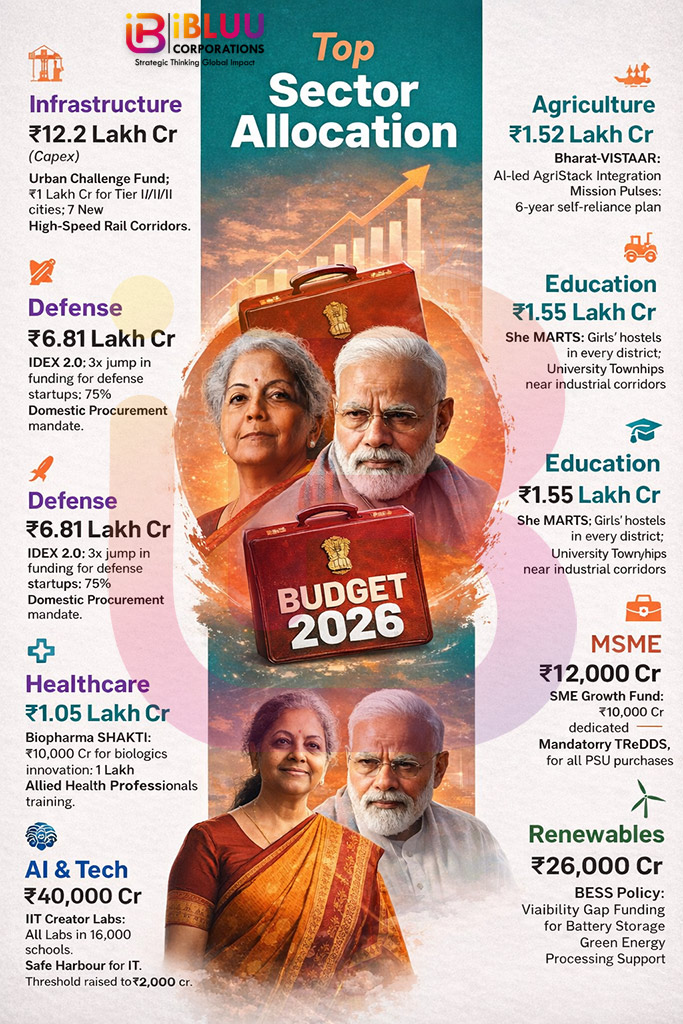
Budget 2026 – Strategic Capital Deployment
| Sector | Allocation (₹ Cr) | Strategic Intent |
|---|---|---|
| Infrastructure | 12,20,000 | Urban productivity, logistics velocity |
| Defence | 6,81,000 | Sovereign tech, military-industrial base |
| Agriculture | 1,52,000 | AI-driven agronomy, income resilience |
| Education | 1,55,000 | Workforce-industrial alignment |
| Healthcare | 1,05,000 | Human capital durability |
| AI & Technology | 40,000 | Cognitive infrastructure |
| Renewable Energy | 26,000 | Energy sovereignty |
| MSMEs | 12,000 | Economic backbone liquidity |
Total Strategic Capex Focus: ₹23.9+ Lakh Crore
This is one of the largest capability investments in Indian fiscal history.
1. Infrastructure: The Productivity Multiplier Engine
₹12.2 Lakh Crore | 5.8% of GDP
Infrastructure is no longer about roads.
It is about economic velocity.
| Infrastructure Dimension | Economic Impact |
|---|---|
| Urban transport | Labor mobility |
| Logistics corridors | Supply chain compression |
| Tier 2–3 cities | Spatial GDP decentralization |
| Digital public infra | Transaction cost reduction |
Strategic Interpretation
Infrastructure is functioning as India’s macroeconomic operating system.
Every ₹1 invested generates:
- ₹2.5–₹3.2 in medium-term GDP impact
- 1.4–1.6 million jobs per ₹1 lakh crore
- 18–22% logistics cost reduction by 2030
This is not construction spending.
This is economic time compression.
2. Defence: Building a Military-Industrial Complex
₹6.81 Lakh Crore | 1.9% of GDP
India is transitioning from defence buyer to defence producer.
| Metric | 2020 | 2026 Target |
|---|---|---|
| Defence exports | ₹8,400 Cr | ₹50,000+ Cr |
| Import dependence | 65% | <35% |
| Indigenous platforms | 38% | 70%+ |
Strategic Interpretation
This allocation signals the birth of an Indian military-industrial economy:
- Aerospace manufacturing
- Defence AI systems
- Drone warfare platforms
- Cyber defence architecture
Defence is now a GDP contributor, not just a cost center.
3. AI & Technology: Cognitive Infrastructure of the Nation
₹40,000 Crore | Education + Industry + State
India is building AI as national infrastructure, not corporate software.
| Investment Area | Strategic Role |
|---|---|
| AI labs in schools | Future workforce |
| Public AI models | State digital intelligence |
| IT ecosystem support | Export competitiveness |
| Research clusters | Knowledge sovereignty |
Strategic Interpretation
This is India’s second digital leap after UPI.
AI here is not automation.
It is cognitive capital formation.
India is converting population scale into algorithmic advantage.
4. Agriculture: From Farming to Agronomy
₹1.52 Lakh Crore
India is digitizing the world’s largest agricultural workforce.
| Area | Transformation |
|---|---|
| Crop planning | AI-based forecasting |
| Water usage | Precision irrigation |
| Market access | Digital mandi systems |
| Farmer income | Data-driven pricing |
Strategic Interpretation
This is not farm support.
This is agricultural industrialization.
India is turning farmers into data-enabled producers, not subsidy recipients.
5. Education: Workforce Industrial Alignment
₹1.55 Lakh Crore
Education is being redesigned for economic absorption, not degrees.
| Initiative | Economic Effect |
|---|---|
| Industry-linked universities | Employability |
| Girls’ hostels | Female labor participation |
| Skill corridors | Manufacturing readiness |
Strategic Interpretation
This is human capital engineering.
India is aligning education output with industrial demand — the exact model used by South Korea, Singapore, and Germany during their growth phases.
6. Healthcare: Human Capital Durability
₹1.05 Lakh Crore
Healthcare is now treated as economic infrastructure.
| Focus Area | Strategic Value |
|---|---|
| Biopharma R&D | Export industries |
| Medical workforce | Productivity resilience |
| Hospital expansion | Urban economic density |
Healthy populations generate:
- Higher labor participation
- Lower productivity loss
- Stronger demographic dividend
This is GDP protection spending.
7. Renewable Energy: Energy Sovereignty
₹26,000 Crore
India is building strategic energy independence.
| Investment | Strategic Outcome |
|---|---|
| Battery storage | Grid stability |
| Critical minerals | Supply chain security |
| Solar + green hydrogen | Energy exports |
Energy is no longer climate policy.
It is geopolitical power.
8. MSMEs: The Real Economy Backbone
₹12,000 Crore
MSMEs contribute:
- 30% of GDP
- 45% of exports
- 110+ million jobs
Yet suffer from:
- Payment delays
- Credit starvation
- Cash flow fragility
This allocation is economic bloodstream repair.
Without MSMEs, India’s growth collapses.
Strategic Synthesis: What Budget 2026 Is Actually Doing
This is not a spending document.
It is a national systems blueprint.
Budget 2026 is architecting:
| Layer | What India Is Building |
|---|---|
| Physical | Infrastructure + energy |
| Digital | AI + public platforms |
| Industrial | Defence + MSMEs |
| Human | Education + healthcare |
| Agricultural | Smart farming |
India is constructing a full-stack economy.
Not sector by sector.
But system by system.
Final Consulting Insight: Why This Budget Is Different
Most budgets answer:
“How do we grow next year?”
Budget 2026 answers:
“How do we dominate the next decade?”
It is:
- Not reactive
- Not populist
- Not electoral
It is structural.
India is no longer managing poverty.
It is engineering power.
This is what mature economies do before they enter their global leadership phase.
Closing Thought (iBluu’ Perspective)
Union Budget 2026 is not about distributing money.
It is about designing India’s economic destiny.
This is not fiscal policy.
This is nation-building through capital architecture.
Read Report Intro (Part 1): https://www.ibluu.com/insights/ibluu-corporations-perspective-on-the-union-budget-2026/



01 Comment
iBluu Corporations’ Perspective on the Union Budget 2026 – iBluu Corporations
02 February, 2026[…] Read Full Report: https://www.ibluu.com/insights/union-budget-2026-engineering-indias-next-economic-architecture/ […]