+91 945 889 6091
  infodesk@ibluu.com
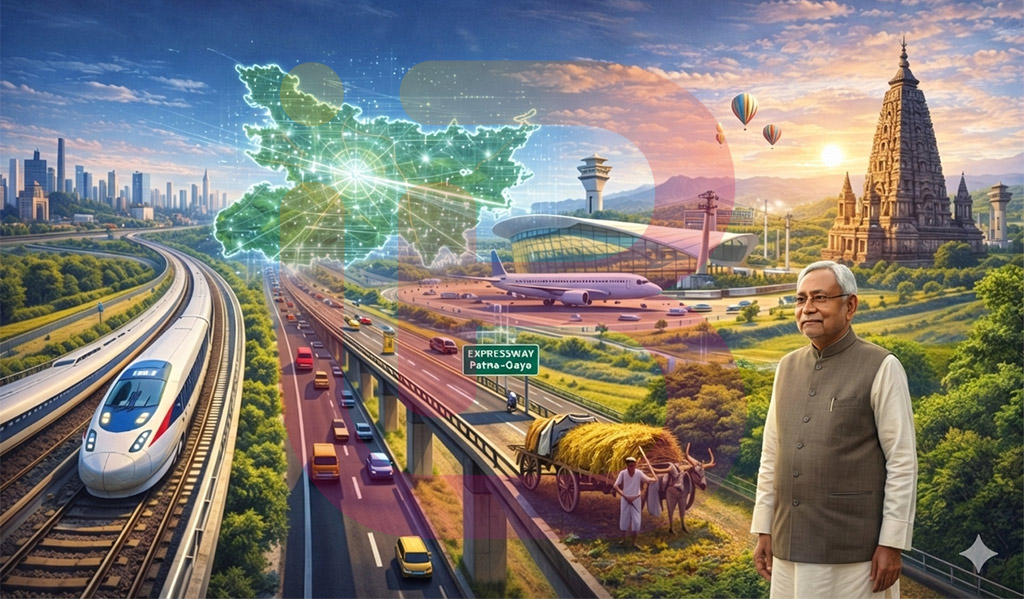
Blueprint for a Modern Bihar 2.0: A Mega Infrastructure Makeover Driven by High-Speed Rail, Modern Airports, and National Highways
For decades, Bihar was discussed in the language of potential.
In 2026, Bihar is being discussed in the language of projects, capital, execution, and corridors.
With infrastructure investments now crossing ₹5 lakh crore across transport, energy, urban systems, healthcare, and industrial development, Bihar is undergoing one of the most consequential economic rewiring exercises in modern India. This is not incremental development. This is structural transformation.
What is unfolding is not merely the building of roads, bridges, and stations. What is unfolding is the repositioning of Bihar from a consumption state to a logistics, manufacturing, and services hub for Eastern and Northern India.
From Geography to Geoeconomics: Why Bihar Suddenly Matters
Bihar sits at one of the most under-leveraged strategic locations in Asia:
- At the heart of the Ganga economic belt
- Bordering Uttar Pradesh, Jharkhand, West Bengal, and Nepal
- Direct access to Eastern India’s trade routes
- A natural connector between North India and the Northeast
For years, this geography was underutilized due to weak infrastructure.
In 2026, that constraint is disappearing.
Bihar is now being re-engineered as:
- A logistics gateway
- A mobility spine
- A regional industrial platform
- A future urban cluster network
Infrastructure is no longer about access.
It is about economic positioning.
Transport Infrastructure: The New Circulatory System of Bihar’s Economy
High-Speed Road Corridors and River Crossings
Bihar’s road strategy is built around one powerful idea: connect everything, remove friction, compress travel time, and unlock trade velocity.
Key expressways and corridors such as:
- The Patna–Arrah–Sasaram greenfield corridor
- The Amas–Darbhanga expressway
- Strategic Ganga river bridges like Kacchi Dargah–Bidupur and Bakhtiyarpur–Tajpur
are not isolated projects. They form a statewide logistics grid.
This grid achieves four strategic outcomes:
- Integrates North and South Bihar into a single economic zone
- Reduces logistics costs for agriculture and MSMEs
- Enables regional industrial clusters
- Positions Patna as a multi-modal hub
The Ganga is no longer a barrier.
It is becoming Bihar’s economic spine.
Railways: From Mobility Infrastructure to Economic Infrastructure
Railway investments crossing ₹10,000 crore annually signal a deeper shift. Bihar’s rail network is being redesigned not just for passengers, but for economic throughput.
With:
- Nearly 100 stations under Amrit Bharat redevelopment
- New lines connecting Bihar to spiritual, tourism, and industrial corridors
- High-speed services like Vande Bharat and Namo Bharat
Rail is becoming a growth multiplier, not a transport utility.
This unlocks:
- Labour mobility for industrial zones
- Tourism circuits for religious and heritage economy
- Freight movement for agri-processing and manufacturing
Railways are no longer moving people.
They are moving GDP.
Aviation and Energy: The Twin Engines of Investment Readiness
Aviation: Bihar Enters the National Air Grid
The expansion of Patna Airport and the development of Bihta Airport mark a critical shift: Bihar is entering India’s serious aviation map.
This is strategically important because:
- Air connectivity drives investment perception
- Global firms require executive mobility
- Tourism, healthcare, and education scale faster with air access
Aviation is not about flights.
It is about investor confidence.
Energy: From Power Deficit to Energy Security
Projects like the Buxar thermal plant and solar initiatives such as Kajra are redefining Bihar’s energy posture.
Energy is now being treated as:
- Industrial infrastructure
- Investment prerequisite
- Digital economy enabler
No state industrializes without power.
Bihar is finally building the electrical backbone of growth.
Urban Infrastructure: From Cities to Economic Platforms
Urban Bihar is shifting from population management to urban productivity.
Through agencies like BUIDCO and IDA, Bihar is investing in:
- Metro systems
- Smart city infrastructure
- Sewerage, water, housing, and transit-oriented development
- PPP-led urban redevelopment models
Cities like Patna, Gaya, Bhagalpur, Muzaffarpur, and Darbhanga are being redesigned as economic platforms, not administrative centers.
Urban infrastructure is no longer about livability alone.
It is about urban competitiveness.
Healthcare, Education, and Human Capital Infrastructure
Bihar’s next growth phase is not infrastructure-led alone.
It is human capital-led.
With new:
- Super-specialty hospitals
- Medical colleges
- University campuses
- Skill development zones
Bihar is investing in productive population economics.
This is a decisive break from welfare-centric policy.
This is capability-centric development.
Industrial and Logistics Clusters: The Missing Layer Now Being Built
Perhaps the most underestimated shift is Bihar’s entry into corridor-based industrialization.
Through:
- The Amritsar–Kolkata Industrial Corridor
- Gaya and regional industrial nodes
- Food processing parks
- Textile, leather, and agro-based clusters
Bihar is transitioning into:
- A manufacturing support state
- A processing economy
- A logistics and warehousing hub
This is where infrastructure converts into employment, exports, and enterprise creation.
Without industrial clusters, infrastructure remains concrete.
With them, it becomes economic machinery.
Why This Is Bihar’s Most Strategic Decade
This is not about development.
This is about repositioning Bihar in India’s economic hierarchy.
Bihar is now moving from:
- Aid recipient → Investment destination
- Migration economy → Manufacturing economy
- Consumption state → Production state
- Administrative governance → Strategic governance
Infrastructure is acting as economic leverage, not political optics.
For policymakers, Bihar represents:
- One of India’s largest untapped growth markets
- A massive labour pool entering productive systems
- A high-return infrastructure investment zone
For corporates and investors, Bihar represents:
- Greenfield opportunity
- First-mover industrial advantage
- PPP-driven project pipelines
- Low-competition high-scale growth
The Consulting Layer: Where iBluu Becomes Strategically Relevant
Large infrastructure transitions do not fail because of capital.
They fail because of coordination, governance, and strategic execution.
This is precisely where iBluu Corporations and its ventures operate as a critical interface between:
- Government policy and private capital
- Public infrastructure and private execution
- Strategic vision and on-ground delivery
Through:
- Strategic Government Engagement and Relations Advisory
- Infrastructure and PPP consulting
- Investment advisory and project structuring
- Mergers, acquisitions, and alliances
- Corporate affairs and regulatory strategy
iBluu functions not as a consultant, but as a strategic enabler of development ecosystems.
In infrastructure-led economies, the real value is not who builds roads.
The real value is who designs the economic logic behind them.
The Larger Truth: Bihar Is No Longer Catching Up. It Is Positioning Forward.
The biggest mistake observers make is treating Bihar’s transformation as regional.
It is not.
Bihar’s infrastructure shift is part of a national economic rebalancing:
- From West to East
- From saturated metros to emerging corridors
- From service-only growth to industrial growth
Bihar is becoming:
- A logistics backbone for Eastern India
- A human capital engine for North India
- A manufacturing frontier for domestic and global firms
This is not Bihar’s development phase.
This is Bihar’s economic entry phase.
And every serious investor, policymaker, and corporate strategist should be paying attention now — not after the corridors are complete, the airports operational, and the industrial zones saturated.
Because by then, the advantage will already be priced in.
And Bihar will no longer be “the next opportunity”.
It will be the established one.